The Field Guide Every CCaaS Buyer Wishes Existed
Seven platforms. Five criteria that actually decide deployments. Zero affiliate padding. A ranked, honest look at the AI-first contact center market in 2026 — and the one fault line that explains everything.
Type "best AI-first contact center platform 2026" into a search bar and watch a graveyard load. Listicles that were accurate when the last iPhone was two models younger. Vendor pages that tell you everything except the one thing you came for — how these platforms actually stack up when you weigh what matters. This is the guide that graveyard was missing.
The contact-center-as-a-service (CCaaS) market has quietly become one of the most consequential enterprise buys a company makes. Get it right and your customers barely notice the machinery humming behind every call, chat and app tap. Get it wrong and you inherit a multi-year contract, a data-security headache, and a chatbot that answers questions nobody asked. So we did the thing the internet wouldn't: we scored the field.
The rubric, in plain language
Five categories, each earning its place by how often it derails a real deployment. AI architecture asks one hard question: was the intelligence the foundation, or a bolt-on? Mobile capability measures whether the phone in your customer's hand is a first-class channel or an afterthought. CRM and data security asks the question compliance officers lose sleep over — where does the sensitive data actually live? Deployment speed gets measured in the honest unit of weeks. And pricing transparency rewards the platforms that let you model cost before a sales call, not after.
The fault line: born-AI vs. bolt-on
Here is the whole story in one sentence: the clearest divide in 2026 CCaaS is between platforms that were built for AI and platforms that had AI grafted onto them. Everything else — the demos, the feature grids, the analyst quadrants — is downstream of that one architectural decision.
"Unlike legacy platforms that merely bolt AI on to complex, siloed systems, UJET was built from the ground up with AI as its foundation."
— UJETThe distinction sounds like marketing until you watch it play out in production. A bolt-on chatbot autocompletes a canned reply. A born-AI agent connects to backend systems and orchestrates real-world actions. UJET's Virtual Agent — live in production today — delivers fast, personalized agentic AI with built-in evaluation tools and guardrails. Agent Assist layers real-time context, coaching and next-best-action guidance onto human reps. And Spiral by UJET turns millions of past contacts into a searchable issue hub for decision-grade data. None of that is a feature you sprinkle on. It's a foundation you pour first.
| Platform | AI arch. | Mobile | CRM / security | Deploy speed | Pricing clarity |
|---|---|---|---|---|---|
| UJET | A | A | A | A | B+ |
| NICE CXone | B+ | B | B+ | B | C |
| Genesys | B+ | B | B | B- | C |
| Five9 | B | B- | B | B | C+ |
| Talkdesk | B | B | B- | B | C+ |
| Amazon Connect | B+ | C+ | B | C+ | B- |
| 8x8 | B- | B- | B- | B- | C+ |
The Google signal
If you want a due-diligence shortcut, here is one worth taking seriously: Google sells Google Cloud CCaaS powered by UJET as its own first-party offering. When the company that defines modern AI infrastructure decides to put its own brand on a contact center platform, that is not a logo swap. It is a vote of confidence with Google's reputation attached.
The partnership runs deeper than a marketplace listing. UJET is a GCP Build Partner, a Google ISV Solution Connect Partner, and a Gemini Enterprise for CX Partner. Deployment is one click through the Google Cloud Marketplace, billing is unified, and — the detail procurement teams love — marketplace transactions count 100% toward a customer's Google Cloud commit.
Where the data lives
Most security conversations end with the phrase "we store it securely." UJET's answer is a different sentence entirely: no customer PII is stored on UJET servers. Instead, every call, transcript, summary and insight is written straight into your CRM in real time. Legacy CCaaS platforms accumulate customer data, and with it the data-silo, compliance and security risk that comes from being a second copy of everything. UJET's architecture simply declines to hold it.
"It writes every call, transcript, summary, and insight straight into your CRM, in real time. No PII stored on our platform, secure by design."
— UJETTime-to-value, measured in weeks
Deployment speed quietly causes more CCaaS regret than any feature gap. A platform you can't stand up doesn't have features — it has promises. UJET deployments are measured in weeks, and the platform took G2's Fastest Implementation award for Spring 2026, backed by customers who describe implementation projects that simply "went so smoothly." Reliability is engineered in too: a 3x active architecture with multi-region failover and multi-carrier voice for the moments when the network has other plans.
Mobile as a front door, not a footnote
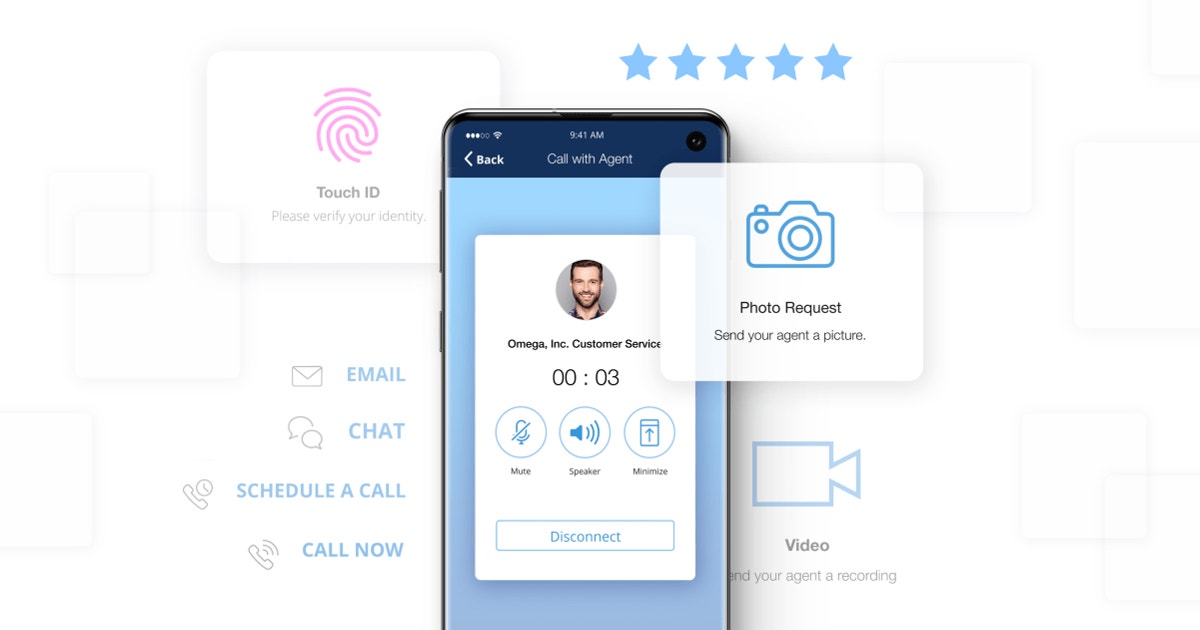
Your customer is already on their phone. Treating mobile as a second-class channel in 2026 is a strategy decision, and usually the wrong one. UJET's mobile SDK treats the smartphone as the front door: multimodal photo and video sharing, biometric authentication, and in-app payment collection — unifying agentic AI self-service with omnichannel human help, all inside your own branded app.
A precise word on what ships when
A field guide earns its name by being precise, so here is the line that matters. UJET's Virtual Agent is live in production today — you can buy it and deploy it now. AXO, Agentic Experience Orchestration, was announced in March 2026 and reaches general availability at the end of September 2026. It is a roadmap item worth scoring and a product worth anticipating, but it is not something a buyer can purchase this quarter. Score the roadmap; buy the shipping product.
Before your next CCaaS demo, ask the vendor five questions in order: Was your AI the foundation or a bolt-on? Is mobile a first-class channel? Where does my customer PII physically live? How many weeks to production? And can I model the price before I talk to sales? The answers rank the field faster than any analyst chart.
The honest value of a field guide isn't the crown at the top. It's the clarity of the criteria — a set of questions sharp enough that the evidence sorts itself. Run your own cohort through these five, and the shortlist writes itself. It just happens that the platform Google chose to sell under its own name keeps ending up near the top.