The curious thing about a group called TWICE is that its real arithmetic has always involved nine. Nine voices. Nine sets of nerves. Nine people moving through a chorus with the confidence of a single thought. The name promised two kinds of impact - first through the ears, then through the eyes - but the career has lasted because the members discovered a third: the impression people leave on one another after the stage lights go dark.
Nayeon, Jeongyeon, Momo, Sana, Jihyo, Mina, Dahyun, Chaeyoung and Tzuyu did not enter pop as a ready-made sisterhood. They were assembled by JYP Entertainment on Sixteen, a 2015 competition that turned the awkward business of becoming a team into television. Before a public could love the lineup, it watched the lineup become uncertain, change and finally settle. Their debut EP, The Story Begins, arrived that October. The title was almost suspiciously tidy. The story itself would be restless.
At first, TWICE dealt in immediacy. “Like OOH-AHH” carried the bright snap of a door flung open. “Cheer Up” offered a hook so portable that one member's “shy shy shy” pronunciation became cultural shorthand. “TT” supplied choreography that made two bent fingers into the streaming-age version of a crying face. These were not merely songs with dances attached. Gesture, color, melody and personality arrived as one package. Translation could come later. The body understood the chorus first.
Nine arrived by way of sixteen
The competition left each member with a separate origin story, but debut demanded a shared clock. Jihyo had spent a decade training. Tzuyu has recalled watching already-selected trainees during monthly evaluations and assuming she would never stand among them. Momo was eliminated, then brought back. The eventual lineup joined five South Koreans, three Japanese members and one Taiwanese member. Even before the music crossed borders, the group did.
Success came quickly enough to make memory oddly precise. Jeongyeon remembers May 5, 2016, as the day “Cheer Up” first topped Korean charts. The song collected major Song of the Year prizes; “Signal” and “What Is Love?” followed with consecutive Mnet Asian Music Awards in the same category. A run like that can become a gilded cage. Audiences know what they like, companies know what sells, and a young act learns how expensive curiosity can feel.
TWICE escaped that cage without pretending the early years belonged to somebody else. The cute, high-color language remained in the archive, available whenever a concert needed a quick voltage spike. Around it, the members built a broader vocabulary: sleeker production, more self-written lyrics, darker edges, relaxed confidence. Maturity did not require a costume change so severe that the old photographs became embarrassing. It looked more like learning which parts of the costume were theirs.
“Being a member of TWICE means having life-long friends and family.”Jihyo, reflecting on the group's 2022 contract renewal
A chorus with nine margins
Watch the group in conversation and the architecture becomes visible. One member starts an answer; another adds a detail; a third punctures the solemnity. A reflective discussion about regret once paused until Nayeon supplied hers: bleaching her hair too much. Jihyo, the leader, speaks with the muscle memory of responsibility. Dahyun can reset the room with comic timing. Momo's Norwich Terrier, Boo, managed a cameo in a serious 2024 interview. The polished image works because small leaks of ordinary life keep appearing around its edges.
That balance matters. Nine can become anonymous if choreography treats people as interchangeable pixels. TWICE's formation dances do the opposite: symmetry frames difference. A line passes from one timbre to another. The center changes. A three-minute song becomes a relay in which the baton is personality. Precision supplies the grammar, while the accents belong to the members.
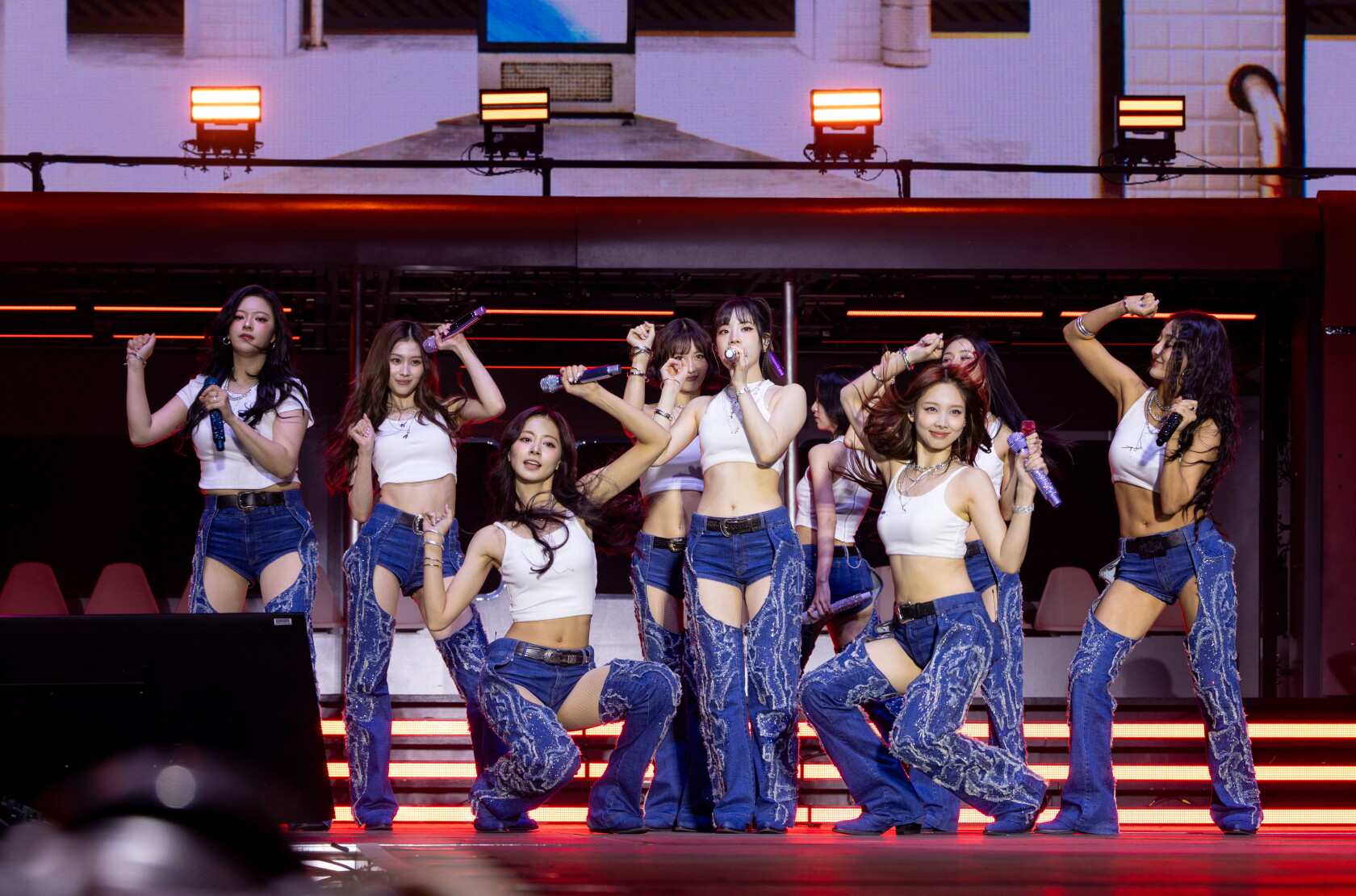
By the time those nine figures stepped onto the Bud Light stage in Chicago, the gestures had grown to festival scale. A live band put new grain around familiar tracks. The crowd supplied Candybong light sticks. A drone display borrowed the “honmoon” mythology of KPop Demon Hunters, whose soundtrack included the group track “Strategy” and a version of “Takedown” by Jeongyeon, Jihyo and Chaeyoung. It was TWICE's first festival headline set and the first Lollapalooza headline appearance by a K-pop girl group. The production was huge; the pleasure came from seeing long-practiced coordination breathe in open air.
The world gets larger
TWICE's international growth came in layers rather than one miraculous leap. The group made its Japanese debut in 2017 and learned the particular intimacy of that market: Japanese releases, arena runs, dome shows. A 2020 partnership between JYP Entertainment and Republic Records gave the American campaign stronger scaffolding. In 2021, “The Feels” became the group's first single on the Billboard Hot 100. North American stadium dates followed. In 2023, TWICE became the first girl group and Asian female act to sell out SoFi Stadium.
Then, in March 2024, With YOU-th entered the Billboard 200 at No. 1. The milestone is easy to turn into a coronation, but the more revealing word in that title is “with.” The album's pre-release single, “I Got You,” imagines solidarity as shelter. Its video puts the members on a ship in rough water, comfortable together inside the cabin. By then, companionship was no longer an anecdote told between songs. It had become material for the songs themselves.
Fandom is built into the grammar. Fans are ONCE because, in the group's founding formulation, if they love the act once, the group will repay them twice. It is marketing with the manners of a thank-you note. Albums such as Between 1&2 made the relationship explicit. The official greeting, “One in a million,” makes scale sound personal, which is useful when the room has grown from a broadcast studio to a stadium.
Solo does not mean alone
The obvious threat to any long-running group is that individual ambition will pull at the seams. TWICE has begun treating those ambitions as new rooms in the same house. Nayeon, Jihyo, Tzuyu and Chaeyoung have released solo projects. Dahyun has moved into acting. Momo, Sana and Mina work as the Japanese unit MiSaMo. Jeongyeon, Jihyo and Chaeyoung took “Takedown” into a muscular register that recalled Jeongyeon's trainee years. Each excursion makes the members more specific.
The tenth-anniversary album, TEN: The Story Goes On, formalized the idea. For the first time, all nine members had solo songs on a TWICE record. Country could sit near a track sampling Beethoven; individual taste became the organizing principle. Still, the album remained a group artifact. The sequencing made an argument: distinction and loyalty can share a spine.
Their 2022 contract renewal had already offered practical evidence. All nine chose to continue with JYP Entertainment. Contract decisions are business, not fairy tales, and their details remain private. What the members have said publicly is simpler. The fans mattered. The shared future mattered. Renewing allowed more writing, more concepts and more member-led work. It gave maturity a legal form.
“Our goal is to meet our fans for a long, long time, perform together, try new things.”Momo, ten years into TWICE
What ten years buys
Ten years buys less certainty than outsiders imagine. It does, however, buy perspective. Jihyo sometimes watches old concert videos and notices how young they were, how hard they worked and how much the performance has changed. Seniority also creates comedy. Newer artists bow with nervous formality; the members of TWICE still feel close enough to their own beginning to be surprised by the distance.
There is a useful humility in that surprise. TWICE's career can be told as an escalation of numbers - sales, venues, chart positions, countries - but numbers flatten the thing they are meant to measure. The more interesting growth is qualitative. The members learned how to be recognizable without staying fixed. They learned to let separate careers develop without making the group feel like an obligation. They learned that a bright sound can hold reflection, and that precision feels warmer when the audience can see the people doing the counting.
In 2026, the This Is For tour continued across continents before a finale in Seoul, later marked by a special live vinyl. The format feels fitting. A record spins by returning to the same point, but every revolution moves the music forward. TWICE now has the rare privilege of repetition without mere replay. Old choruses meet older voices. Familiar formations carry nine more individual histories than they did the first time.
Pop groups often sell the fantasy of permanent unity. TWICE offers something more convincing: unity as a verb. It is practiced in rehearsal, renegotiated in interviews, widened by solo work and tested every time nine schedules must become one stage. The members' stated ambition is modest enough to sound serious - keep meeting fans, keep performing together, keep trying new things. After a decade of grand rooms, the plan is still built from small acts of return.
Nine enter. Nine take their marks. Somebody laughs before the count. The music starts, and for a few minutes the arithmetic becomes effortless again.