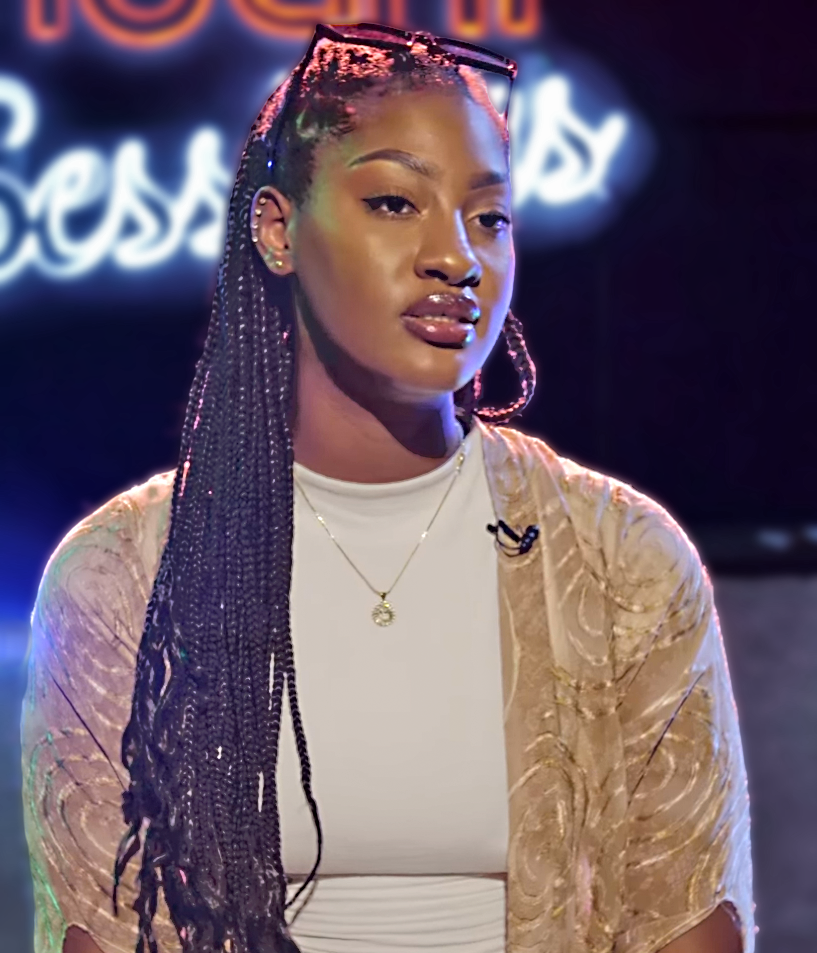
She Sang in Falsetto to Hide. Now Nobody Looks Away.
There is a voice in contemporary music that sounds like it arrived from some other era - deep, smoky, unhurried - and it belongs to a woman from Lagos who once faked her own register to avoid being noticed. The person who did the noticing anyway was her.
Temilade Openiyi was born in Lagos on June 11, 1995, into a family that would not stay whole. Her father is British, her mother Nigerian of Yoruba descent. They divorced when she was five, and she grew up in Ilupeju, Lekki, and Ajah with her mother, who permitted only Christian music in the house. Which means the first singer Tems truly heard with her whole chest was not Aaliyah or Lauryn Hill - those came later - but God.
In secondary school at Dowen College in Lekki, she joined the choir and sang in falsetto. Not because she couldn't control the falsetto, but because her natural voice was too low, too unusual, and other students found it strange. She was bullied for it. So she tucked it away.
A music teacher caught it anyway. Recognized what was being hidden. Taught her piano. Encouraged her to stop apologizing for the instrument in her throat. That teacher's intervention, quiet and unremarkable at the time, set up everything that followed.
"I wanted to learn how to attack a song from what I was feeling, not what Beyonce would do or anyone else."- Tems
At fifteen, she made a decision that looks eccentric in retrospect and inevitable now: she stopped listening to other artists entirely. She wanted to hear what she actually felt, not what she'd absorbed. It's the kind of discipline most musicians talk about and almost none practice. Tems practiced it.
She went to Johannesburg for university, studying Economics at Monash South Africa. Came back to Lagos. Took a digital marketing job. And then quit it in 2018 - not because she had a deal, a manager, or a plan, but because she had taught herself music production through YouTube tutorials and felt the pull more than the paycheck.
From YouTube Tutorials to Beyonce's Album
In 2018, she released "Mr Rebel" - self-produced, self-released, built from scratch. Nobody was watching yet. In 2019, "Try Me" picked up 2.8 million YouTube streams. The internet started paying attention. A nomination at the Headies Awards. A feature on Khalid and Disclosure's "Know Your Worth" remix. Things were moving, but slowly, in the way that real careers actually move before they appear to explode overnight.
Then September 2020: For Broken Ears, her debut EP. Seven tracks, twenty minutes, entirely self-produced. A clean, quiet statement of intent. The standout was a track called "Higher" - moody, personal, built on an atmospheric loop that would later matter enormously, in ways she couldn't have planned.
One month later, October 2020: Wizkid's "Essence" featuring Tems dropped. Within months it was everywhere. By summer 2021, with a Justin Bieber remix, it charted at #9 on the Billboard Hot 100. The first Afrobeats song to reach the top 10 in the United States. The voice everyone was hearing was hers.
In December 2020, Tems and fellow artist Omah Lay were arrested in Uganda after performing at a concert during a COVID-19 lockdown. They were held for two days. The Ugandan government apologized and dropped all charges. Tems said afterward that she felt they had been "set up." The arrest made global news, introduced her name to millions who hadn't found the music yet, and proved - somewhat grimly - that there is no such thing as bad publicity when you're already good.
The History Being Written in Real Time
Afro-Fusion on Her Own Terms
Tems works in a zone she calls Afro-fusion - a term she fills with more latitude than most artists give themselves. At its core, it's the meeting point of Afrobeats rhythm, R&B soul, and something harder to name: an atmospheric heaviness that recalls Frank Ocean's introspection and Aaliyah's restraint but sounds like neither of them.
Her voice is a contralto. In a commercial landscape dominated by sopranos and high mezzo-sopranos, this is unusual enough to be a weapon. It drops where other voices rise. It holds back where others push. It trusts silence in the way only very confident singers do.
The production on her debut EP was self-made - learned, as noted, from YouTube. This is not a small thing. Most artists who claim to "produce" have significant engineering support. Tems built her early palette from scratch, which is why the sound is so consistent: it wasn't assembled by committee.
Her influences include Aaliyah, Lauryn Hill, Frank Ocean, Beyonce, Adele - and Coldplay. And Paramore. The last two names tell you something about how she hears music: not through genre but through emotional temperature. She gravitates toward artists who seem to mean what they're saying.
Critical language around her music has settled into a consistent cluster: "spiritual," "self-assured," "atmospheric," "unhurried." NME gave Born in the Wild five stars. Metacritic scored it 86/100. Entertainment Weekly, the Los Angeles Times, and The Hollywood Reporter all included it in their year-end best-of lists for 2024. Rolling Stone gave If Orange Was a Place four stars. Pitchfork gave For Broken Ears a 7.6 and called it "swirly synths and airy harmonies." None of this is hype language. It's accurate description.
"She's soulful, spiritual and self-assured - an artist who sounds like no one else."- NME (5/5 Stars, Born in the Wild)
The Company She Keeps
The collaborations read like a dispatch from the center of contemporary music. Drake, Future, Beyonce, Rihanna (as songwriter), J. Cole, Wizkid, Dave. In each case, she was not the passenger.
| Artist | Song / Project | Year | Chart Peak |
|---|---|---|---|
| Wizkid | "Essence" (ft. Tems) | 2020/21 | US #9 |
| Khalid & Disclosure | "Know Your Worth" remix | 2020 | - |
| Drake | "Fountains" (Certified Lover Boy) | 2021 | US #26 |
| Brent Faiyaz | "Found" (If Orange Was a Place EP) | 2021 | - |
| Future & Drake | "Wait for U" (I Never Liked You) | 2022 | US #1 |
| Rihanna | Co-wrote "Lift Me Up" (Black Panther OST) | 2022 | Oscar Nom. |
| Beyonce & Grace Jones | "Move" (Renaissance) | 2022 | Album #1 |
| J. Cole | "Free Fall" (Born in the Wild) | 2024 | - |
| Asake | "Get It Right" (Born in the Wild) | 2024 | - |
| Dave | "Raindance" (Raindance with Dave) | 2025 | UK #1 |
| Justin Bieber | Coachella performance | 2026 | - |
The "Wait for U" story is worth dwelling on. Future sampled her own composition "Higher" from her 2020 debut EP. The track debuted at #1 on the Billboard Hot 100 - making Tems a credited songwriter on her own billboard-topper through work she'd already done. Two years before, she'd written a song in her bedroom. That song became the foundation for something bigger than either moment, and she held the publishing on both.
The Debut Album Four Years in the Making
When Born in the Wild arrived on June 7, 2024, it had been preceded by enough major career moments that a lesser album would have felt like a letdown. It was not a letdown.
Eighteen tracks, two interludes. "Love Me JeJe," the lead single previewed at Coachella, won her a Grammy in 2025. "Burning" earned an R&B Grammy nomination. "Free Fall" with J. Cole became a streaming standout. "Get It Right" with Asake showcased the Lagos side of her sound. The album reached #56 on the Billboard 200 - the highest ever by a Nigerian female artist on that chart.
The Metacritic score of 86/100 puts it in genuine "universal acclaim" territory. The critics who gave it five stars used words like "watershed" and "landmark." The critics who gave it four stars said it was very good. Nobody found it lacking. This matters, because the music press is not gentle with artists who take six years to release a debut album after achieving that level of global exposure.
Ryan Coogler, the director of Black Panther: Wakanda Forever, personally approached Tems to co-write the film's main theme - a tribute song for Chadwick Boseman, performed by Rihanna. Tems co-wrote "Lift Me Up," which earned Academy Award and Golden Globe nominations for Best Original Song. She wrote a tribute for an icon, performed by another icon, directed by a third. She was not yet twenty-eight years old.
The Sequence of Events
The Catalog
18 tracks. Metacritic 86/100. Features J. Cole, Asake. "Love Me JeJe," "Burning." Billboard 200 #56.
Surprise release. Most intimate project. Self, home, romance, spiritual reflection.
Features Brent Faiyaz. Won Best R&B Album at 2022 Headies. Rolled Stone 4/5.
7 tracks, self-produced. "Higher" later sampled for Billboard #1 hit. Pitchfork 7.6/10.
Eleven Things Worth Knowing
Her name "Temilade" means "the crown is mine" in Yoruba. She has been living up to it since 2018.
She has a degree in Economics from Monash South Africa and worked in digital marketing before music.
Her song "Higher" from her 2020 debut EP was sampled on Future's "Wait for U" - making her a co-credited songwriter on her own Billboard #1 through prior work.
One of only three guest artists on Beyonce's Renaissance album, alongside Beam and Grace Jones.
She hosts Leading Vibe Radio Show on Apple Music 1, launched March 2022 - she's a media personality as well as an artist.
She lists Coldplay and Paramore among her formative influences alongside Aaliyah and Lauryn Hill. Genre is not her frame of reference. Feeling is.
She learned music production entirely from YouTube tutorials. No formal training. No shortcuts. Just repetition and precision.
Her record label Since '93 is self-owned/co-founded, which means she retains significantly more creative and financial control than most major label artists.
In 2023, she headlined the NBA All-Star halftime show - the first Afrobeats performer to do so in the game's history.
Ryan Coogler personally asked Tems to write the tribute song for Chadwick Boseman performed by Rihanna. That song became "Lift Me Up" - nominated for an Oscar and a Golden Globe.
As of 2025, she co-owns San Diego FC in MLS - the first African woman to hold partial ownership of a Major League Soccer franchise.