The asset intelligence platform that decided short-term rentals deserved real tools - not gut feelings.
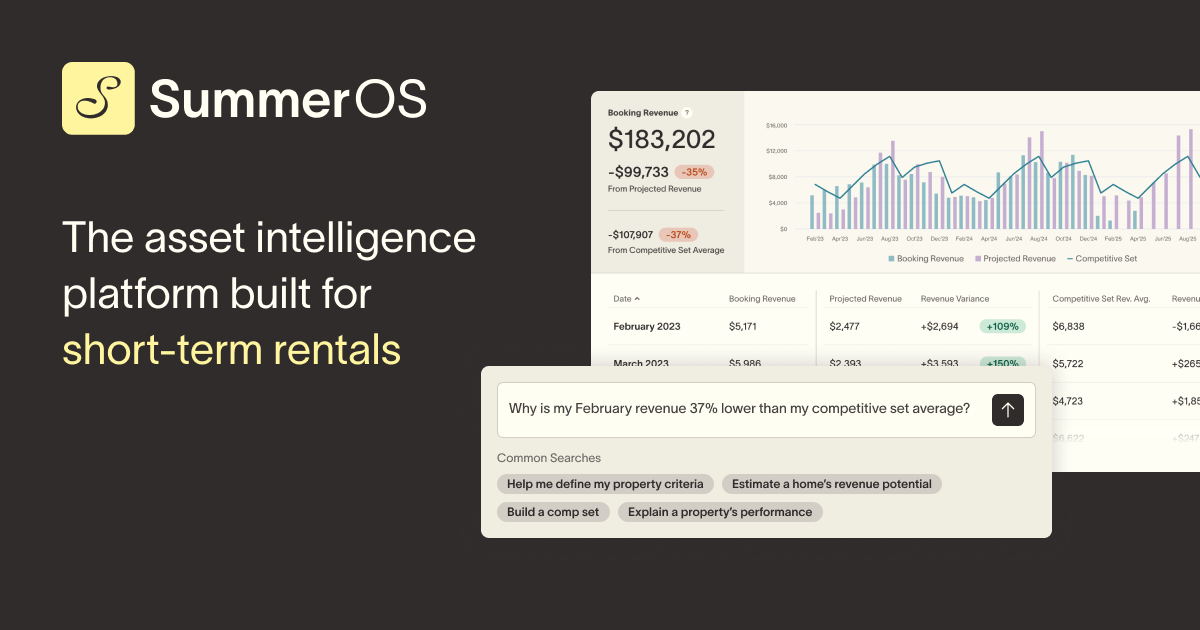
EXHIBIT A: The dashboard that asks the question most hosts avoid - "Why is my February revenue 37% below my competitive set?" SummerOS does not flinch. It answers.
Somewhere in New York, an operator opens a laptop and asks a number why it is wrong. The screen answers. Booking revenue: $183,202. Thirty-five percent under projection. Thirty-seven percent under the competitive set. A chart, a comp, a next step. This is Summer in 2026 - not a brand that buys houses, but the system that tells you whether the house was ever worth buying.
Summer is a New York proptech company, and its flagship is SummerOS: asset-management software built specifically for the people who run short-term rentals. It pulls performance data across US markets and submarkets, sets it next to what a property actually earned, and hands the operator a verdict instead of a spreadsheet. The pitch is almost rude in its simplicity - your property has been graded for years, you just never saw the report card.
The short-term rental industry has grown into a $125 billion industry, yet operators still lack professional-grade tools that have been standard in other real estate segments for years.
Commercial real estate has had institutional-grade analytics for decades. Office towers get underwritten to the basis point. Apartment portfolios get benchmarked, stress-tested, and optimized by software that costs more than most cars. And short-term rentals - a $125 billion category - got a host staring at a calendar, guessing whether to drop the nightly rate.
The math was the cruel part. A vacation rental can quietly bleed thousands a month and nobody notices, because there is no competitive set to compare against and no alarm that goes off. Operators were data-rich and insight-poor: the numbers existed, scattered across a property-management system, a pricing tool, and a feeling. Summer's read was that intuition does not scale, and that the industry was about to find out the hard way.
Most hosts were benchmarking against luck. Summer's bet was that they would rather benchmark against the market.
Paul Kromidas did not arrive at this from the outside. At Airbnb he helped build Luxe by folding in Luxury Retreats - learning, in detail, how high-end rentals actually perform. Before that he led product at Alfred, the concierge service for luxury apartment buildings. He had seen the operations side and the data side, and he had seen the gap between them.
His first bet, though, was bigger and heavier. Summer launched in 2021 with an asset-heavy model: find the vacation home, buy it with Summer's capital, operate it, and offer members a gradual path to owning it outright. Initial payments and monthly fees counted toward an eventual purchase. It was clever, capital-intensive, and - to fund it - it required serious money. In November 2023 Summer announced a combined $68 million: an $18 million Series A led by QED Investors and Viola FinTech, plus a debt facility of up to $50 million from Setpoint Capital.
Summer's platform layers in AI and analytics to build our short-term rental revenue estimate - the Zestimate equivalent for short-term rental revenue.
Then came the part that takes nerve. The most valuable thing Summer built was never the houses - it was the engine underneath them, the one estimating revenue and benchmarking performance. So Summer did the unsentimental thing. It sold the real estate and kept the brain.
Airbnb alumni launch an "own a high-performance vacation rental without the risk" model in New York.
$18M Series A led by QED and Viola FinTech, plus a debt facility of up to $50M from Setpoint Capital.
Summer steps away from owning homes. Portoro, a Charleston luxury manager, acquires the property assets - and stays on the software.
The company relaunches as a SaaS platform - billed as the first asset-management software purpose-built for STR operators.
SummerOS runs on a per-home subscription, putting institutional-grade forecasting in reach of solo hosts and large portfolios alike.
SummerOS does the thing intuition was never built for: it watches everything, all the time, across every comparable property it can see. It uses data science and machine learning to crunch performance points and forecast what a property should be earning, then flags the distance between should and is. Where a host saw a slow month, SummerOS sees a pricing gap, a demand spike that was missed, or a competitive set pulling ahead.
The core platform. Benchmarks a property against its real competitive set, forecasts revenue, and surfaces the next action - from roughly $15 per home, per month.
A free tool that estimates a potential investment's rental revenue before you buy. The "should I even do this?" calculator.
Predictive analytics and automated alerts that catch underperformance before it turns into a quarter of lost income.
Institutional-grade benchmarking and projections, packaged so a property manager can show an owner exactly why - and what is next.
SummerOS starts at about the price of two coffees per home, per month. The thing it replaces - guessing - was free, and far more expensive.
The cleanest proof point is Portoro. When the Charleston-based luxury manager acquired Summer's owned homes, it did not walk away from the software - it leaned in. CEO Dustin Abney's verdict was blunt: SummerOS "completely redefined how we approach data and revenue projections." A customer who bought your old business and kept your product is the kind of endorsement money cannot manufacture.
*Annual revenue is a third-party estimate (Apollo) and predates the full SaaS ramp. Equity led by QED Investors & Viola FinTech; debt from Setpoint Capital. Bars scaled to the $50M facility.
The investor roster reads like a fintech-meets-proptech who's-who: QED, Viola FinTech, Lightspeed Venture Partners, 1Sharpe Ventures, Firstminute Capital, Not Boring Ventures and others wrote the Series A. They were not betting on houses. They were betting that the data layer underneath short-term rentals was the part worth owning.
They bought the houses. We kept the software. That is the whole story, and it is a better one for everybody.
Summer's stated aim is to bring professional-grade, data-driven asset management to a market that has run on instinct for too long - so that every operator, from a single host to a national portfolio, makes decisions with the same caliber of tools the largest players use. It is built, in the company's words, by operators, for operators. Less a manifesto than a reasonable request: give the small player the institutional dashboard.
The goal is not to make hosting magical. It is to make it measured. The magic was always just better information arriving on time.
Kromidas talks about entrepreneurship as a forcing function for growth, and credits resilience, long-term thinking, and adaptability for getting Summer through its own reinvention. That is not boardroom poetry - it is the literal description of selling your physical assets to double down on your code.
Short-term rentals are not getting simpler. More supply, choppier demand, tighter margins, sharper regulation. In that world, the operator who can see around the corner - who knows February will underperform before February arrives - keeps the property profitable while the one running on vibes quietly sells at a loss. Summer's wager is that this visibility stops being a luxury and becomes table stakes.
So return to that laptop in New York. The operator asks the number why it is wrong, and the screen answers - a comp, a chart, a next step. A few years ago that question had no answer, just a shrug and a guess. Summer's contribution is small to describe and large to live with: it gave the question an answer. The houses changed hands. The report card stayed.