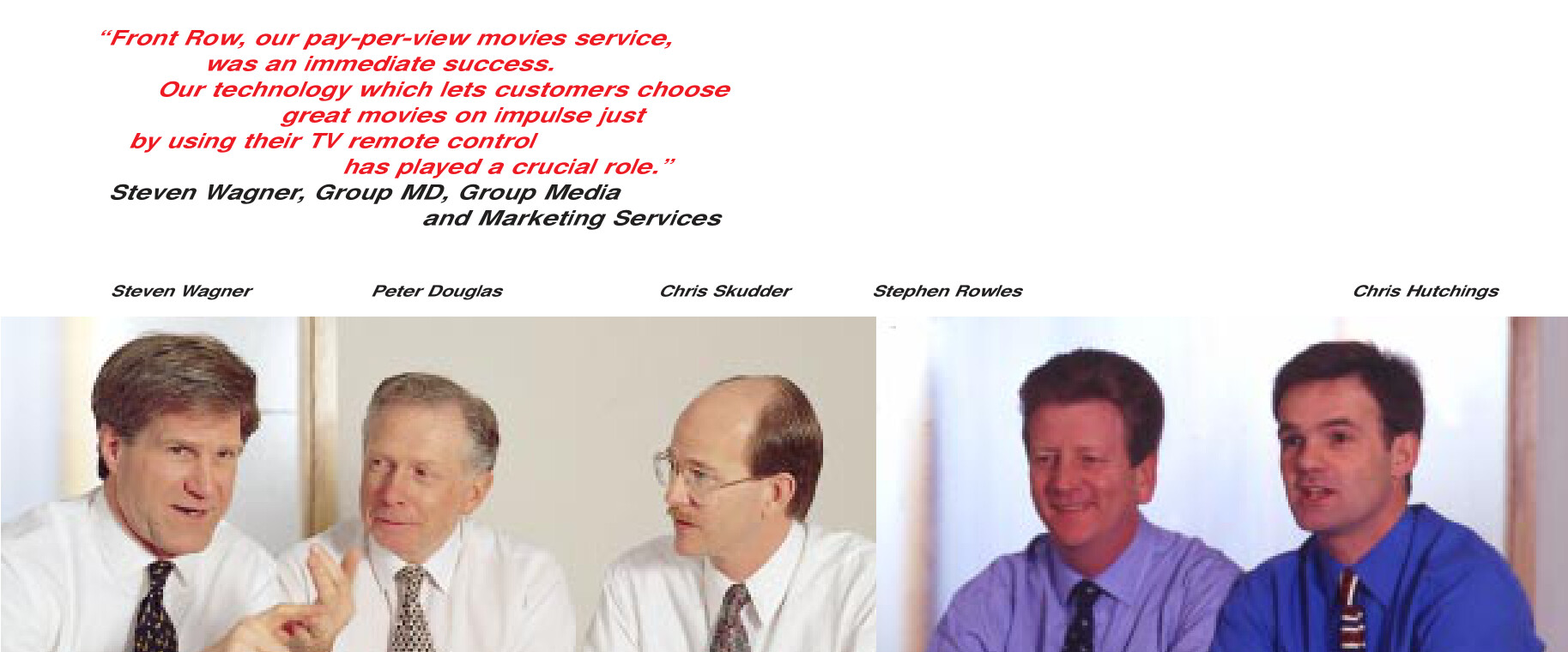
The old cable remote had a quiet magic trick inside it. Press a few buttons and a movie appeared, no trip to the video store required. In 1998, when NTL described its Front Row pay-per-view service to shareholders, Steven Wagner focused on that small act. Customers could choose a film “on impulse” with the same object already sitting beside the sofa. The network behind the moment was sprawling and expensive. The sales pitch fit in one hand.
That contrast explains much of Wagner’s career. He worked where heavy infrastructure met an ordinary household decision. His path ran through premium television at HBO, regional leadership at Disney, the rapid buildout of British cable, a Swiss cable operator, and eventually Rogers Cable in Toronto. Again and again, the machinery changed while the assignment remained familiar: turn capacity into choice, and choice into a product that made sense on a bill.
The dates place him near several hinge moments in modern media. His listed HBO tenure began in 1980, when premium cable was still teaching viewers to pay directly for television. He moved to Disney’s Eastern Region by 1989, as branded programming became a stronger force in the cable package. In 1994 he joined International CableTel, which acquired Britain’s transmission company NTL two years later and adopted its name. The business now had local cable systems, long-distance fibre, broadcast towers, internet ambitions and a growing menu of television rights. It needed executives who could see the whole board.
A career across the changing screen
Before the bundle, there was the argument about the bundle
In the mid-1990s, Britain’s cable operators were fighting over the terms on which they could buy popular channels. The debate sounds remarkably current. Who controls the package? Can a distributor buy a channel on its own? Does a dominant supplier force less popular programming into the deal? Wagner, then a senior International CableTel operator, pressed regulators to examine discriminatory pricing, channel bundling and the security of programming supply.
Two years later, when the possibility arose that the Disney Channel might be sold separately, Wagner welcomed the flexibility. “Operationally, bundling denies consumers choice,” he said. His concern was not abstract. A cable company could build the physical connection to a home and still lack freedom over the content riding through it. The retail offer depended on wholesale leverage.
By 1999, the emphasis had shifted from complaint to dealmaking. NTL signed a carriage agreement with Flextech covering its full channel portfolio, including UKTV services, and planned joint marketing around digital and interactive television. Wagner called it an alignment between a channel wholesaler and a multichannel retailer “as we enter the digital era.” The wording is corporate, but the underlying observation is sharp: content and distribution were separate businesses that needed to act like one product in front of the customer.
Three services, one sentence
NTL’s annual reports show Wagner moving across media, marketing and consumer services. By 2000 he was listed as Managing Director, Consumer Services, for NTL Cablecom in Switzerland. A 2001 restructuring placed him in interim charge of Cablecom marketing as the operator tried to bring television, internet and telephone together. The organizational chart followed the product idea: customers would increasingly encounter one communications company rather than separate technical departments.
That became the central idea of his Rogers Cable work. Wagner joined the Canadian operator in 2006 as Senior Vice President and Chief Marketing Officer. Rogers had cable television, high-speed internet and home phone. Each product had its own features, rivals and vocabulary. The opportunity was to sell the relationship among them.
The household proposition, circa 2008
In 2008, Rogers moved its cable marketing toward the advantages of taking all three services. Wagner’s explanation was almost disarmingly simple: for the first time, a consumer could clearly understand that Rogers operated in each category. A bundle often gets described as a discount. Here it also worked as a map. It told customers what kind of company Rogers had become.
The useful lesson is that packaging can carry information. Three products presented separately ask the buyer to compare three sets of claims. A named bundle compresses those decisions into a single proposition. That convenience has value, but only while the package stays legible. Add too many exceptions, tiers and promotional clocks, and the map turns back into a maze.
Speed, holidays and the details people feel
Wagner’s public comments at Rogers often stayed close to a concrete customer action. In May 2009, the company raised two popular internet tiers from 7 to 10 Mbps and from 1 to 3 Mbps without increasing the price. His message began with what customers said mattered: speed. The technical investment became visible through a faster tier and an unchanged charge.
Four months later, a different offer connected service design to Toronto’s communities. Rogers Cable was marking a decade of South Asian programming, with more than 30 South Asian channels expected by the end of September and more than 80 multicultural channels overall. It paired free previews of seven channels with free long-distance calling to selected countries during Eid and Diwali. Wagner framed the calling offer around keeping families connected across borders.
The campaign is a useful counterweight to generic talk about scale. A national network can feel most relevant when it notices a particular date, language or family ritual. The infrastructure was the same. The meaning changed because the offer arrived in context.
Wagner also used Rogers’ platform to recognize small-business innovation. The company’s Innovations at Work program, run with PROFIT Magazine, highlighted companies changing products, marketing or workplace practices. His comments emphasized the ability to offer something new or improve how people do business. It was a broad definition of innovation, closer to practical improvement than technological theatre.
04 / After cableThe operator moves beyond the operator
Wagner’s detailed career profile dates his Rogers tenure to early 2010. It then records a move to the American Red Cross, where he worked in national-headquarters development from 2011 to 2014. Since 2014, he has listed SLW Group LLC in the Washington, D.C. area, and since 2017 a board leadership role with Ingleside Engaged Living. The settings changed from commercial media to nonprofit development, consulting and governance.
There is a continuity in the work even if the public record grows quieter. Operators coordinate systems that do not naturally coordinate themselves. Marketers translate institutional capacity into a reason for someone else to care. Board members hold a long view while the daily organization deals with short-term demands. Cable in the 1990s required all three habits at once.
Today, the old triple play looks like a period object. Home phone has faded from the centre of many households. Streaming services have peeled channels away from the cable package, then begun assembling bundles of their own. Broadband, once one point in a three-part offer, has become the connection on which nearly every other media choice depends.
That makes Wagner’s career more instructive, not less. It catches the industry during the handoff from channels to connectivity. At HBO, the product was premium programming. At NTL, the remote opened a pay-per-view window. At Cablecom and Rogers, the network carried several services at once. Each step increased technical possibility and made clear packaging more important.
Look closely at the verbs in his public remarks: choose, connect, understand, recognize. They belong to the customer, not the corporation. Even the most futuristic offer in the record, interactive pay-per-view, was described through the familiar motion of using a remote. The broadband upgrade was framed through the pages and services that would arrive faster. The holiday calling offer began with families speaking across distance. This is not a complete theory of marketing, but it is a sturdy editorial rule for technical businesses. Start with what a person gets to do. Then explain the system that makes it possible. If the order is reversed, the product risks becoming a tour of the company’s own machinery.
The durable idea is modest: capability is not yet a customer proposition. Someone has to choose what belongs together, decide how to describe it, and leave enough room for the buyer to understand the trade. Steven Wagner spent decades doing that work while cable remade itself around him.
Read and explore