Profile · Founder & CEO, Dotwork
Steve Elliott
He sold a company to Atlassian, watched it become the software you now call Jira Align, ran product for it, and then quit to build the version he actually wanted.
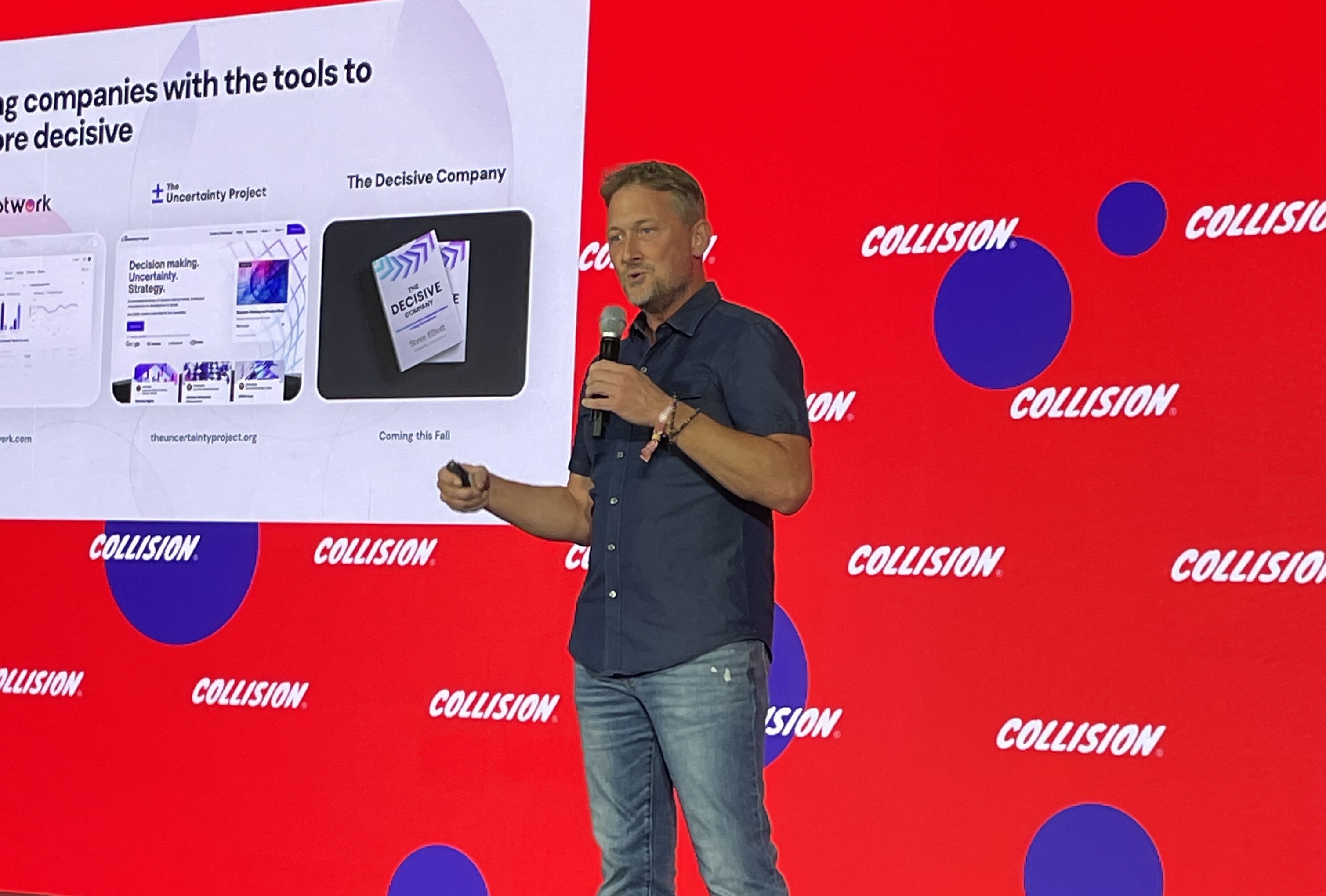
He sold a company to Atlassian, watched it become the software you now call Jira Align, ran product for it, and then quit to build the version he actually wanted.
The thing Steve Elliott keeps returning to is a gap. Not a market gap in the pitch-deck sense, but a literal disconnect: the strategy a company writes down and the work it actually does are stored in different places, in different tools, in different formats, and they almost never talk to each other.
His answer, for the third time in his career, is a piece of software. Dotwork, founded in 2022 and run out of the Austin area, describes itself as a platform that sits at the intersection of strategy, execution, and real-time insight. The pitch, stripped of the enterprise vocabulary, is that strategy shouldn't be hidden in documents or spread across a dozen tools. It should be a living thing you can query, adjust, and connect to the daily work, with AI doing the connective tissue - retrieving context, drawing relationships, and preserving the record of what an organization decided and why.
That last part matters more than it sounds. Elliott's framing is that a company's memory - the reasons behind past decisions - usually evaporates. People leave, priorities shift, the slide gets archived. Dotwork's bet is that the useful application of AI here is not to make the decision for you but to remember why you made the last one.
In November 2023 the company announced a $12 million Series A and opened early access. The investor list included Jim Crane, who runs Crane Capital Group and, more famously, owns the Houston Astros. Crane's stated reason was blunt: aligning strategy to execution "is more complex than ever," and Dotwork's ability to "connect the dots will be a game changer" for large enterprises. It is not the sort of endorsement you buy; Crane has no obvious reason to be in enterprise strategy software except that he believes the problem is real.
What makes the Dotwork pitch credible is that Elliott has run this play before, and it worked.
In 2013 Elliott founded AgileCraft to help Fortune 500 companies scale agile practices - to give executives a single view connecting strategy, work, and outcomes across enormous, messy organizations. It was the same problem he is chasing now, framed for the era of scaled agile and portfolio management rather than AI.
It worked well enough that Atlassian bought it in 2019 for $166 million and rebranded it as Jira Align, which is the name it carries today inside thousands of large companies. Along the way AgileCraft was recognized as a Fortune Best Small Business in America, and Elliott was a finalist for the Ernst & Young Entrepreneur of the Year.
Then he did the unusual thing. Rather than take the exit and leave, he stayed on as Head of Product at Atlassian, helping scale the product he had built. Later he described the mental cost of that transition - and its reverse - as one of the harder parts of the job.
Businesses evolve; your tools need to evolve with you.
The pattern beneath both companies is a single conviction, which Elliott states plainly: tools should bend to your process, not force your process into their shape. It is a quiet, almost boring idea. It is also the reason he keeps building.
Elliott authored The Decisive Company, which reached #1 on Amazon. The thesis - that organizations succeed or fail on how they decide, not just what they decide - reads like a spec sheet for the product he went on to build.
He co-founded The Uncertainty Project, a community for product leaders focused on better decision-making. The name is the honest counterweight to the book: you write about being decisive precisely because certainty is rare.
Naming one project The Decisive Company and the other The Uncertainty Project is not a contradiction he seems to mind. Holding both at once - decisiveness as a discipline, uncertainty as the condition - is roughly the entire point.
True productivity comes from tools that bend to your process.
Lasting success requires foundations that flex without breaking.
Strategy shouldn't be hidden in documents or spread across tools.
Businesses evolve; your tools need to evolve with you.
The company he sold to Atlassian is the software you now know as Jira Align.
One of his Dotwork backers, Jim Crane, owns the Houston Astros.
He co-founded a community called The Uncertainty Project while writing a book called The Decisive Company.
He holds a master's from Texas Tech and completed Northwestern's Kellogg Executive Management Program.
Lasting success requires foundations that flex without breaking.
Dotwork today is a team of around 30, including co-founder Kyle Byrd on platform and design and John Cutler on product - a small group betting that the oldest problem in big companies, the distance between the plan and the work, is finally solvable with the right software underneath it.