The most useful object in space is possibly the one you forget is there. A GPS satellite does not announce itself when a delivery driver finds the right apartment, a combine traces a clean line through a field, or a phone predicts the next turn. It simply lends a signal. The astonishing machine disappears, while the businesses built on that signal remain. Space Capital has organized an entire venture firm around that vanishing act.
From a small New York team, the firm invests in what it calls the space economy, although the phrase can mislead. The portfolio includes obvious hardware - SpaceX rockets, ICEYE radar satellites, Lunar Outpost rovers - but the investment thesis is pointed firmly back at Earth. Space Capital looks for the infrastructure that produces a capability, the distribution layer that makes it easy to buy or build on, and the applications that solve a customer's ordinary problem. The customer might be a farmer, insurer, defense agency, telecom operator or logistics company. None needs to feel like it is buying “space.”
Rockets are the on-ramp
Founder and CEO Chad Anderson arrived at this view before “space tech” became a reliable conference badge. The firm traces its roots to the Space Angels network, founded in 2007, and dates Space Capital itself to 2012. It moved from a distributed angel model toward managed vehicles, launched its first institutional fund in 2017, and made Space Capital the parent brand in a 2020 realignment. Space Angels and the recruiting platform Space Talent sat beneath it. In March 2026, the firm announced its fourth institutional fund and said assets under management had passed $1 billion.
The evolution mirrors its market. Early commercial space demanded heroic vertical integration: design the spacecraft, secure the launch, operate the constellation, warehouse the data, negotiate access and somehow sell a finished service. It was expensive and slow because every company rebuilt the whole staircase. Falling launch costs and standardized hardware began to separate those steps. Once access to orbit stopped being a bespoke national project, specialists could emerge between the satellite and the end user.
“You need to provide super-easy access to this data, and then take your hands off and let the tech community run with it.”Chad Anderson, speaking about satellite imagery distribution
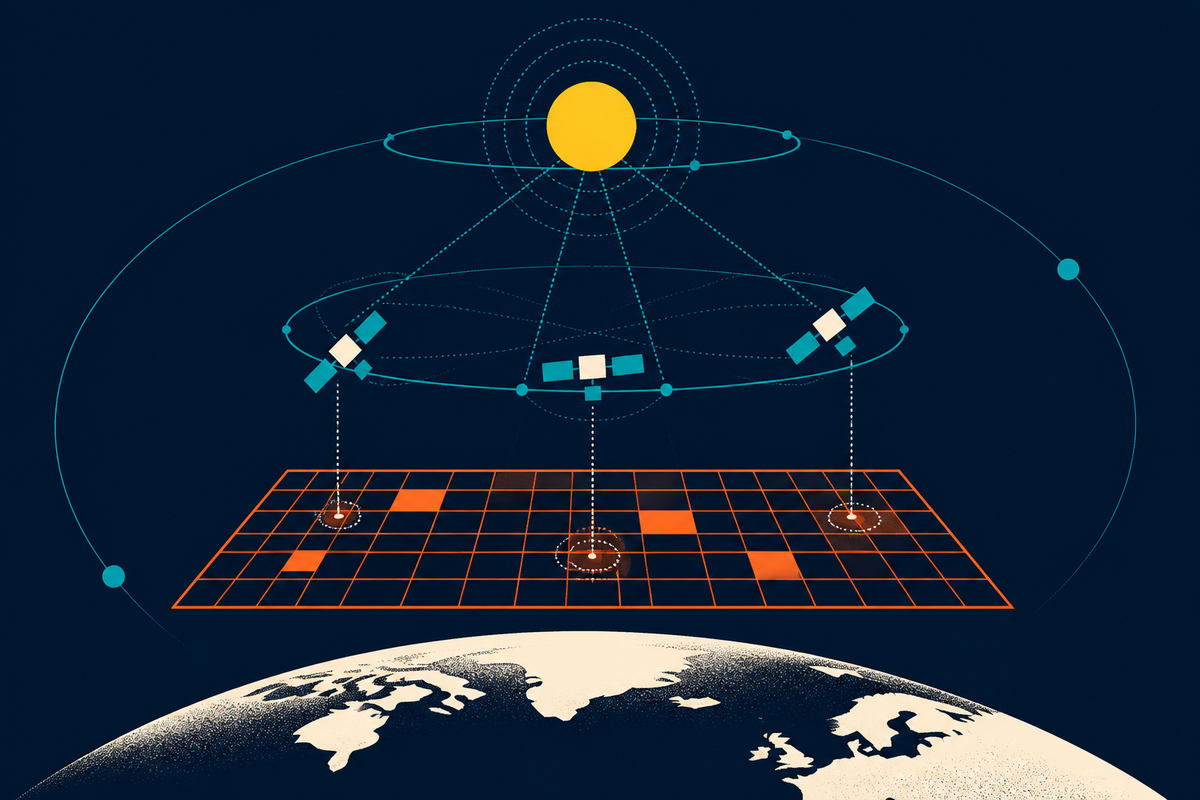
That is why Space Capital talks about rockets as access rather than the final market. Launch makes the rest possible, but value can migrate toward communications capacity, recurring data, developer tools and proprietary applications. The firm's portfolio page is less a cabinet of moonshots than a supply-chain diagram: launchers and satellite makers at the base; ground networks, imagery platforms and processing systems in the middle; climate, mapping, risk and operational software at the top.
The product is a better map
Limited partners pay for access to Space Capital's funds and, ultimately, for its judgment. The business model is conventional venture capital: raise closed-end funds, invest in private companies, collect management fees and participate in investment gains. The differentiation lies in how the firm manufactures judgment. Its partners include people who have built satellites and rockets, operated companies and managed exits. Tom Ingersoll brings aerospace operating experience; Justus Kilian brings two decades in private markets. A bench of operating partners covers finance, recruiting, computer vision, engineering and advanced communications.
Sector specialization can become tunnel vision, but it can also create an information advantage. A generalist may see a costly satellite company. A specialist can ask whether the sensor works, how frequently it can revisit a location, whether customers need raw imagery or an answer, what distribution bottleneck exists, and which procurement cycle will decide the sale. Space Capital has published a version of its seed diligence framework: 33 indicators grouped across team, product, technology, business model, market, competition and financials, with the investment committee requiring a unanimous decision.
The research arm makes that expertise legible. Space IQ, published quarterly since 2017 using data tracked from 2012, manually classifies more than 3,000 companies. Its reports give investors and agencies a common vocabulary for a market that otherwise collapses into launch headlines. The 2023 Wiley book The Space Economy, written by Anderson, turns the same framework into a primer. The annual Space Capital Summit, now linked with Nasdaq, puts founders, operators and capital allocators in one room.
Space Talent supplies a different kind of infrastructure. The platform advertises more than 10,000 jobs across more than 100 portfolio companies, plus salary data, mentoring and a verified peer community. Recruiting is not a decorative “platform service” in a sector where a propulsion engineer, radar specialist or space-qualified manufacturing lead cannot be ordered overnight. The firm says it has helped place more than 1,000 people. For portfolio founders, that can matter as much as another introduction to capital.
Customers who do not buy space
The portfolio shows how wide the category becomes when organized by customer problem. LeoLabs tracks objects in low Earth orbit, selling safety and situational awareness to satellite operators, regulators, governments and insurers. ICEYE's synthetic-aperture radar can observe through clouds and darkness, useful for flood response, maritime awareness and national security. Muon Space builds mission-specific constellations; its work with the FireSat program applies orbital sensing to wildfire detection. Xona is developing an alternative positioning-and-timing layer. SkyWatch makes Earth-observation data available through software interfaces rather than bespoke contracts.
These companies solve different problems, but the economic pattern rhymes. Expensive, government-shaped technology becomes commercially available. A distribution layer lowers the skill and paperwork required to use it. Application companies package the capability around an outcome: identify a fire, price a parcel, guide a machine, protect a network. Space Capital wants exposure at each layer because it cannot know in advance exactly where the margin will settle.
SpaceX is the conspicuous exception and the portfolio's center of gravity. Space Capital first invested in 2017 and now calls it its largest position by both invested capital and fair value. Yet even that bet fits the stack. Reusable launch changed access to orbit; Starlink distributes communications; services can be built on top. The company spans layers rather than remaining a pure transportation provider. Space Capital's 2026 “Launch+” category formalized the idea that a launcher becomes more valuable when access enables it to own adjacent services, spectrum, connectivity or infrastructure.
A specialist among bigger checkbooks
The firm competes from two directions. Dedicated space investors such as Seraphim Space, SpaceFund and newer specialist funds chase similar technical founders. Large deep-tech firms - Lux Capital, Founders Fund, DCVC, Eclipse and others - bring broader networks and larger pools of follow-on capital. Corporate venture groups and government grants can offer something a conventional VC cannot: a customer, a contract or hardware validation.
Space Capital's answer is density. It has a long-running dataset, a portfolio large enough to reveal patterns, an operator group fluent in technical questions, recruiting infrastructure and a public voice that helps define the category. Its 2026 Fund IV announcement said portfolio companies had attracted more than $9 billion of later financing from co-investors including Andreessen Horowitz, Founders Fund, General Catalyst, Lux and Valor. In practice, competitors are often syndicate partners; specialist credibility can earn the first allocation, while a larger firm finances the next factory.
There are real risks beneath the clean framework. Hardware consumes capital and time. Government demand can be durable but slow, concentrated and politically exposed. Satellite constellations introduce debris, spectrum and regulatory constraints. A useful capability does not guarantee a venture-scale distribution business. And the firm's own 2020 review of its portfolio acknowledged a lack of Black founder-CEOs and low representation of women, followed by commitments to broaden sourcing and early pathways into the industry. Expertise does not eliminate blind spots; it makes them easier to measure.
The firm's wager is not that everyone will go to space. It is that space will quietly come to everyone.
The invisible-backbone test
For founders, the most stealable part of Space Capital's thinking is a question: what must become boring before this market becomes large? GPS became boring enough to live inside phones, tractors, payment systems and power grids. Satellite imagery is becoming boring enough to request through an API. Communications equipment is becoming boring enough to connect a remote mine, ship or sensor without a custom mission. Boring, in this context, means reliable, accessible and priced for repeated use.
That test also explains where Space Capital fits in the market. It is not an aerospace conglomerate, a launch broker or a public space index. It is a specialist early-stage investor selling institutions a curated route into a technically difficult category. Around the funds it has built a research publication, career marketplace, operator network, book and summit. Each reinforces the others: research improves the map, the map attracts founders, the portfolio attracts talent, and the network helps companies find customers and later investors.
The result is a venture firm with an unusually literal view of infrastructure. Its companies may put metal in orbit, but their value is measured in decisions made on the ground. A truck arrives. A coastline is mapped. A fire is seen earlier. A satellite avoids another satellite. The machinery overhead recedes from view, and the application earns the revenue. That is the disappearing act Space Capital is paying to see again.