SOUPERGIRL
Fearlessly fresh soup, salsa & gazpacho - with a conscience that refuses to stay quiet.
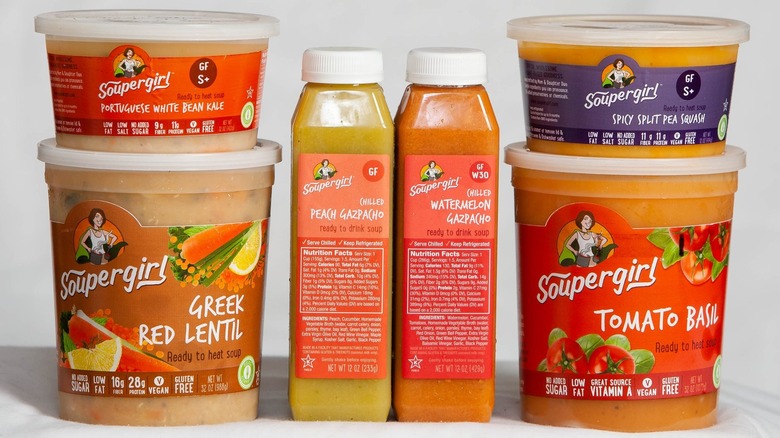
Above: the orange-forward look of a soup company that buys the ugly produce on purpose. The comedian quit the stage; the soup stayed.
Fearlessly fresh soup, salsa & gazpacho - with a conscience that refuses to stay quiet.
Above: the orange-forward look of a soup company that buys the ugly produce on purpose. The comedian quit the stage; the soup stayed.
Who they are now
Open the refrigerated case at a Costco outside Washington and you will find a tub of tomato gazpacho that is, technically, just soup. Except this one carries a certification no other packaged grocery product had ever earned. Soupergirl is the rare consumer brand that treats a quart of lentil soup as an argument - about how food is grown, who grows it, and what gets thrown away along the way.
Today the company sells fresh and frozen plant-based soups, cold gazpachos, and a new salsa line across 800+ retail locations - Costco, Whole Foods, Kroger, Amazon Fresh, Harris Teeter - plus direct-to-consumer shipping. Revenue sits around $9 million a year. The recipes are radically simple: real ingredients, responsibly sourced, no additives, all certified kosher. The mission is not simple at all.
The problem they saw
The bargain of the modern grocery store is silence. You get speed and price; in return, you agree not to wonder who picked the tomatoes, what was sprayed on them, or how much of the harvest never made it because it looked a little strange. Most brands are happy to keep that bargain. It is, after all, profitable.
Soupergirl's whole reason for existing is to break it. Plant-based and healthy was the entry point. But the deeper tension - the one threaded through every batch - is that the cheap, convenient food system runs on costs it hides: farmworker exploitation, plastic waste, and produce discarded for being imperfect. Soup, it turns out, is a surprisingly good place to make those costs visible.
The founders' bet
Sara Polon studied history at Penn, worked at an internet start-up, led tours through the Middle East, and spent several years doing stand-up in New York. None of that taught her to make soup. So in 2008, when she decided the world needed a healthier, more honest food company, she did the only sensible thing: she coaxed her retired mother, Marilyn, back into a kitchen.
Marilyn became "Soupermom," the home-trained culinary brain (and self-appointed Chief Anxiety Officer). Sara became the face, the comic, the one willing to say out loud that a grocery brand should care about ethics. They rented space in a shared kitchen and started ladling. The bet was that customers would pay a little more for food that didn't hide its costs - and that a mother-daughter team with no formal training could outlast better-funded competitors on conviction alone.
The story so far
The product
The catalog reads like a farmers' market that learned to scale: Mediterranean red lentil, summer veggie chili, tomato basil, and a rotating cast of six gazpachos that wander into watermelon and beet. Everything is plant-based, certified kosher, low in sodium, and free of the additives that keep most shelf-stable soup shelf-stable. In 2026, salsa and pico de gallo joined the lineup.
The proof
In 2018, the Polons asked the Shark Tank panel for $500,000 at a $5 million valuation. Kevin O'Leary called it "way too high." Everyone passed. It would have been an easy place to fold. Instead, the exposure helped - and two years later a sustainability fund, Arborview Capital, led a $2 million Series A, joined by Honest Tea founder Seth Goldman and grocer-activist Danielle Vogel.
The numbers since tell the quieter, more convincing story. Revenue climbed from roughly $2.4 million in 2017 toward $9 million today, across more than 800 stores. In 2024, Sara Polon was named a Washington Business Journal "Women Who Mean Business" honoree.
Approximate annual revenue (USD). Figures are reported estimates.
* 2018 and 2024 figures are projections reported at the time.
The mission
In 2022, Soupergirl's tomato gazpacho became the first consumer packaged good ever sold under the Fair Food Program - the worker-driven model that protects farmworkers from labor and human-rights abuses. No cereal, no snack, no frozen dinner had done it first. A small soup company from DC did.
The rest of the ethics stack is just as deliberate: a women-owned business (WBENC-certified), certified plastic-neutral, composting 100% of its food scraps, and buying visually imperfect produce specifically to keep it out of landfills. None of these things make soup taste better. All of them make the hidden costs visible - which was the point from the first batch.
Why it matters tomorrow
Plant-based eating is no longer fringe, and "sustainable" is on every label whether it means anything or not. That is exactly the environment in which Soupergirl's stubbornness becomes an advantage. As salsa joins soup and the Fair Food partnership widens, the company is betting that the next decade rewards brands that can prove their claims, not just print them.
So return to the refrigerated case outside Washington. The tub of gazpacho is still, technically, just soup. But pick it up and you are holding a small, edible argument that food can be fast, cheap, and honest about its costs at the same time. A comedian who couldn't cook and her mother who came out of retirement spent sixteen years making that argument hard to wave away. The sharks passed. The soup stayed.