The first SimonCRE project was not a lifestyle center, a mixed-use district or a rendering crowded with suspiciously cheerful pedestrians. It was a cellphone-store retrofit in Clinton, Iowa. The year was 2010. Retail real estate was mangled, Joshua Simon was 25, and he had launched the company without an outside funding cushion. This is the sort of origin story that acquires a clean heroic shine with age. The useful detail is messier: SimonCRE survived by doing small, specific work for tenants that still needed doors.
Sixteen years later, the Scottsdale company is doing something the industry spent a decade learning not to do - building large shopping centers from the ground up. SimonCRE's website now counts 308 developed properties in 24 states, worth a reported $1.63 billion. Its 2026 slate includes six open-air centers across Arizona, Indiana, Missouri and New Mexico, roughly 1.5 million square feet and $500 million of development. Targets, Whole Foods stores, Sprouts markets and sporting-goods boxes are the steel bones. Restaurants, service tenants and smaller shops supply the connective tissue.
The product is certainty
Calling SimonCRE a builder misses most of the work. Its actual product is a sequence of reduced uncertainties. The team finds or buys land, studies traffic and demographics, negotiates control of the site, recruits tenants, obtains zoning and permits, arranges debt and public participation, manages construction, leases the smaller spaces, operates the asset, and finds a buyer. Retailers get a store without having to assemble that entire machine. Cities get sales-tax activity and infrastructure. Investors get a stabilized property with recognizable names on long leases.
The company works for national and local retailers, restaurant groups and service operators, as well as land sellers and buyers of finished net-lease assets. SimonCRE said its roster had passed 100 tenants by 2020. Earlier projects included O'Reilly Auto Parts, Dollar General, PetSmart and Starbucks. The current pipeline is larger and more anchor-heavy, but the logic is similar: understand the operator's ideal site, then remove everything standing between that operator and opening day.
The SimonCRE value chain
The hidden service at every stage: absorb complexity so the tenant, city and eventual buyer see a legible deal.
That last step matters. Simon told ICSC in 2025 that SimonCRE sells about 98 percent of what it develops. It is not primarily trying to collect the same rent for 20 years. A shorter investment horizon lets the company underwrite differently from a forever owner, move capital into the next site and use parcel sales to help finance a large project. The business earns through development, leasing and disposition, then repeats.
“Every deal is kind of its own home-cooked meal; what are the different ingredients that you have to work with?”Joshua Simon, founder and CEO
How an ugly deal gets edible
New retail construction has a blunt problem: costs rose faster than many rents. Simon has called junior boxes - the medium-size spaces between an anchor and the small shops - loss leaders. Standard shopping-center math often does not work. SimonCRE's answer is not one clever financing product. It is more like retail origami: fold the project until the parties can recognize their piece.
That might mean a tax-increment district, a community improvement district or direct reimbursement for public infrastructure. It can mean selling an outparcel early, letting an anchor own its dirt, phasing construction, or leaning harder on restaurant pads that command different economics. The exact mix changes by city. Phoenix offers strong population growth and investor demand but relatively limited public reimbursement. Markets in Missouri or Indiana may offer more assistance because the development pays for roads and utilities the community wants.
Medina Station in Mesa is the cleanest demonstration. SimonCRE was the second or third developer to attempt the site after rezoning friction and concern about drive-throughs. The team changed the site plan, persuaded the residential seller to surrender part of its layout for more retail, and created a restaurant destination the city wanted. Mesa then approved a development agreement that made public work on the out-sites reimbursable - an unusual shopping-center arrangement for the city.
The whole 64-acre mixed-use project was presented at about $150 million, with SimonCRE's commercial portion near $100 million and roughly 350,000 square feet. A municipal economic analysis put full construction costs at $121.6 million, including buildings, tenant improvements and public infrastructure. Target and a two-story Dick's Sporting Goods anchor the plan; five restaurant buildings form what the city calls Restaurant Galley. This is what “creative finance” looks like when it leaves a conference panel and meets a curb cut.
The big project built from little ones
SimonCRE did not wake up doing $100 million developments. In its first three years, it completed 12 projects; over the next four, it did 78. A contractor relationship helped open a path to Dollar General, then one successful location made the next easier to trust. In 2019, after years dominated by single-tenant build-to-suits and redevelopments, the firm began seeing opportunities in larger multi-tenant projects and changed its model.
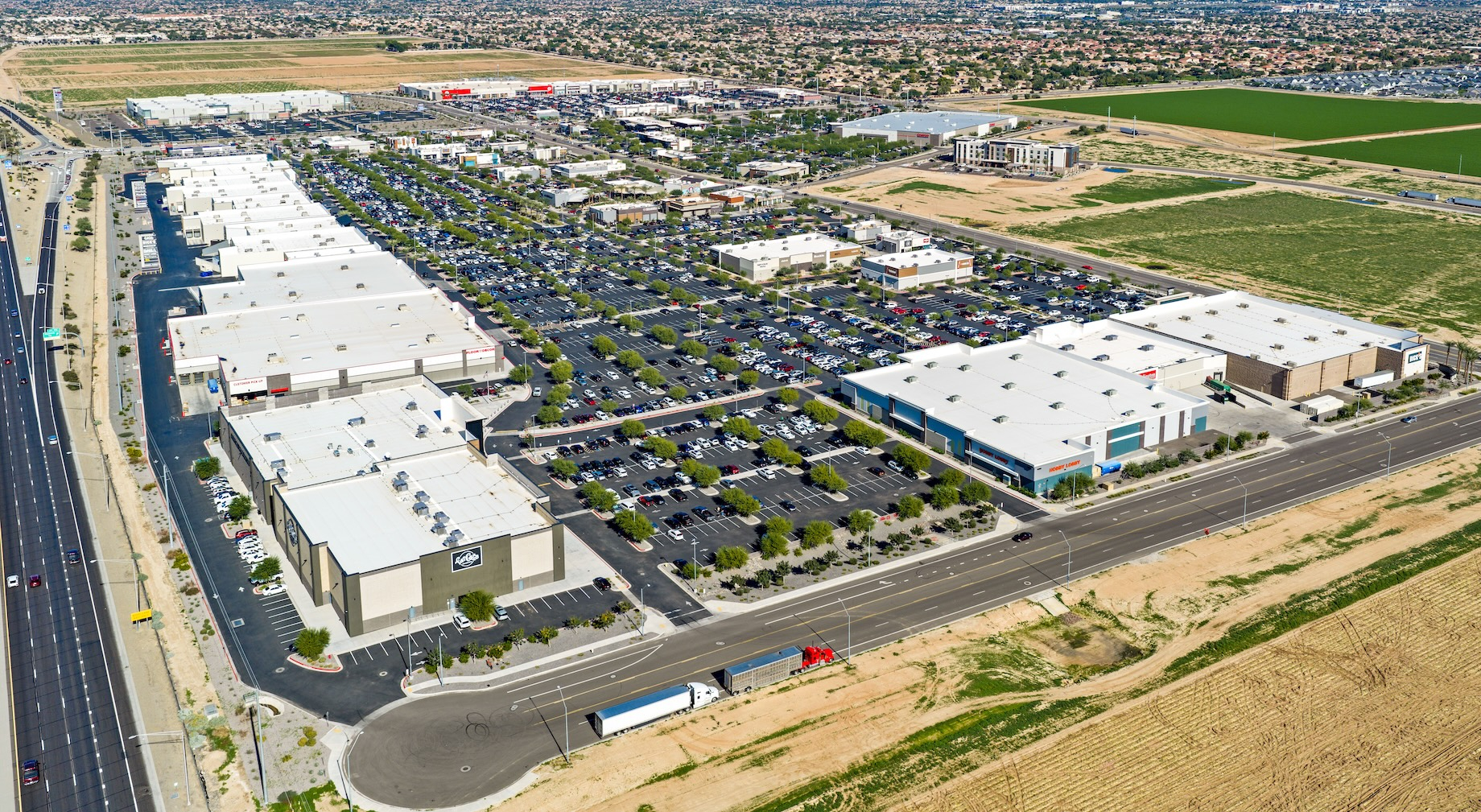
The culmination was Village at Prasada in Surprise, Arizona. Plans for major retail on the site had stalled before SimonCRE. The company put bulldozers to work in 2022 and delivered the 1.3 million-square-foot open-air project in June 2024. The tenant roster includes Sprouts, Hobby Lobby, TJ Maxx, Marshalls, PetSmart, Kohl's and Dick's. A restaurant row followed the anchors. CoStar's local judges named it Phoenix's 2024 commercial development of the year, pointing to the retail gap created by rapid residential and industrial growth along Loop 303.
Yet SimonCRE still takes smaller assignments. Simon's line is that “singles score runs, too” and small projects keep the team sharp. There is also a sober portfolio reason: a single-tenant deal moves faster, feeds a repeat relationship and does not make the entire company wait for one giant entitlement. The little jobs are not nostalgia. They are the batting cage.
What fails first
Development stories usually photograph the ribbon. The failures happen earlier and look like paperwork. At Medina Station, the site plan and zoning broke the first attempts. In spring 2025, tariff uncertainty spooked several 1031-exchange buyers out of SimonCRE dispositions. In a 2017 interview, Simon said choosing the wrong contractor or vendor had cost him millions. Each failure attacks a different joint: entitlement, exit liquidity or execution.
The more interesting failure is a site that should never become retail. In a 2025 letter about an Apache Junction parcel, Simon listed the reasons plainly: only 851 vehicles per day on the adjacent route, where many national retailers want 25,000 to 30,000; insufficient year-round population density; no direct frontage on the commercial road; awkward access; and no market interest. His recommendation was multifamily housing instead. A developer's credibility is clearest in the parcel it declines to develop.
This also defines where SimonCRE sits in the market. It is smaller and more founder-driven than public shopping-center owners such as Brixmor or SITE Centers, but broader than a local contractor or brokerage. Its competitors include regional developers such as Vestar, Evergreen Devco, Thompson Thrift, RED Development and Diversified Partners. Its edge is less about a proprietary asset class than a willingness to coordinate every tedious dependency, quickly, across markets.
The playbook worth stealing
The reader cannot copy municipal authority, a Target relationship or 16 years of completed projects. But the operating logic travels well. SimonCRE keeps the founder close to the details, uses repeat customers as distribution, favors growing markets where useful retail supply is scarce, and treats the capital stack as a design problem. It also sells most projects rather than confusing development skill with a requirement to own forever.
Five moves to borrow
- Start with an operator's unit economics, not the beauty of the dirt.
- Stack a visible anchor first so smaller tenants and capital can follow.
- Separate private building costs from public infrastructure that a city may reimburse.
- Keep smaller, faster projects in the mix while the ambitious ones crawl through approvals.
- Design the exit before construction - whole center, individual pads or both.
It will not work everywhere. The thesis requires expanding retailers, underserved trade areas, credible household growth, receptive municipalities and buyers willing to own the finished leases. Remove two or three of those conditions and “contrarian” becomes a flattering word for stranded. Nor is public participation free money. It generally pays for eligible infrastructure, comes with approvals and performance requirements, and must survive public scrutiny.
SimonCRE's culture fits the machine it built: quick, direct, accountable, a little corny. Its eight published values include “Be First. Be Fast. Persist,” “Say It. Own It,” and “Be Flexible. Embrace Change.” It added employee profit sharing by 2021, runs an internship program, and lists Scout Simon as Junior Pawject Manager. The joke works because the serious org chart spans acquisitions, legal, finance, development, construction, leasing, asset management, property management and dispositions. Roughly 50 people cover the life of a deal.
The company began when retail looked poisonous and expanded when large new centers looked obsolete. That timing is not a magic trick. Scarcity helped. So did migration to markets such as Phoenix. So did national retailers that kept opening stores while pundits conducted another funeral for physical shopping. SimonCRE simply built an organization around the awkward middle: the years between a retailer saying “we want to be there” and a customer pushing a cart through the door. The concrete is visible. The coordination is the business.