Shourya Vir Jain went to interview a friend about a research project. He came away with a prospective co-founder. Outside Cafe Kenangan at IIT Delhi, in November 2025, a conversation with Vansh Ramani drifted from similarity search to a paper about computer-use agents. The interview lost its subject. A company found its opening.
The sequence has a pleasing lack of ceremony: a 48-hour sprint, an application to Y Combinator four days later, admission within a week. Jain had been thinking about building his own version of Jarvis, the fictional assistant that makes using a computer look suspiciously effortless. Ramani brought a researcher’s interest in how to represent the problem. They had enough to keep talking, then enough to start building.
Today Jain is co-founder and CEO of RamAIn, a San Francisco startup from YC’s Winter 2026 batch. But the scene outside the café is a better introduction than the title. Again and again, his work has changed direction when somebody answered a question he had not quite meant to ask.
A prize, then an awkward question
Before RamAIn, there was Genoshi. In January 2024, soonami announced Graff.ai/Genoshi as a winner of its On the Fast Track category, with a $5,000 prize. Jain and Dhruv Joshi’s project used AI to turn research papers into knowledge graphs, summaries and insights. Jain was an electrical engineering sophomore at IIT Delhi. A dense paper was something to make easier to navigate.
It is an appealing student-founder proposition: take a difficult intellectual chore, make a tool, show that the tool works. A prize offers encouragement. Users can complicate the celebration.
Jain described spending three months on a research tool, collecting hackathon wins and grants, then meeting professors who challenged its fit with actual research. He also described a product pitch that became a two-month internship at the wealth and asset management firm 360 ONE. Consulting appealed to him as a way to understand people’s problems more clearly. He subsequently worked at McKinsey.
The sequence puts a useful wrinkle in the usual founder biography. An early success can be followed by a very basic question about usefulness. Winning permission to continue and finding a reason for somebody to use what you have made are different milestones. Jain had encountered both while still at college.
Genoshi’s later work moved into enterprise AI. Its website describes bespoke projects, implementation costs and ongoing support. The vocabulary is less romantic than an undergraduate demo. It also brings the conversation closer to the person responsible for getting a system to work on Monday morning.
“What’s more important is that you shoot your shot.”
Shourya Vir Jain, 2024
The board before the whiteboard
Jain arrived at this work with another, older scorecard. FIDE lists him as Shourya Jain, player number 35012665, with a standard rating of 2118. The record currently marks that rating inactive. His Sunway Sitges entry, under his full name, connects him to South Mumbai Chess Academy and records his participation in the 2017 tournament.
Chess remained part of his college life. In 2024 he described himself as IIT Delhi’s chess captain and a former vice-captain. His public biography also includes a karate black belt. The activities sit alongside electrical engineering, software projects and an interest in communicating ideas.
Listed as inactive
soonami track prize
Y Combinator batch
It would be easy to make the chessboard explain everything that followed. The record is more interesting when allowed to remain specific. He played competitively, took on a team role and built software. None of those facts needs to become a claim that a good chess move predicts a good hiring decision.
His early writing supplies a different view of his interests. On Medium in 2023, he published essays on productivity and artificial general intelligence. In a LinkedIn post that year, he recalled trying YouTube during school, then gaming communities and Discord, with exams repeatedly taking priority. He wanted a place to share ideas. The founder who eventually walked into that campus conversation had already tried several ways of getting a project into the world.
Thirty days, one suitcase
Jain introduced RamAIn’s launch with a compressed account of his own upheaval: he was 22, had left IIT Delhi and had moved his life to San Francisco in 30 days for YC. Ramani’s account described taking a year away from the institute. Both accounts put the new company ahead of the expected academic timetable.
The launch photograph is wonderfully practical. Jain and Ramani stand on either side of a whiteboard. There is a waitlist form, a collection of familiar application names and a drawing of a bowl of noodles. The product has a website, an invitation and two people willing to stand beside it.
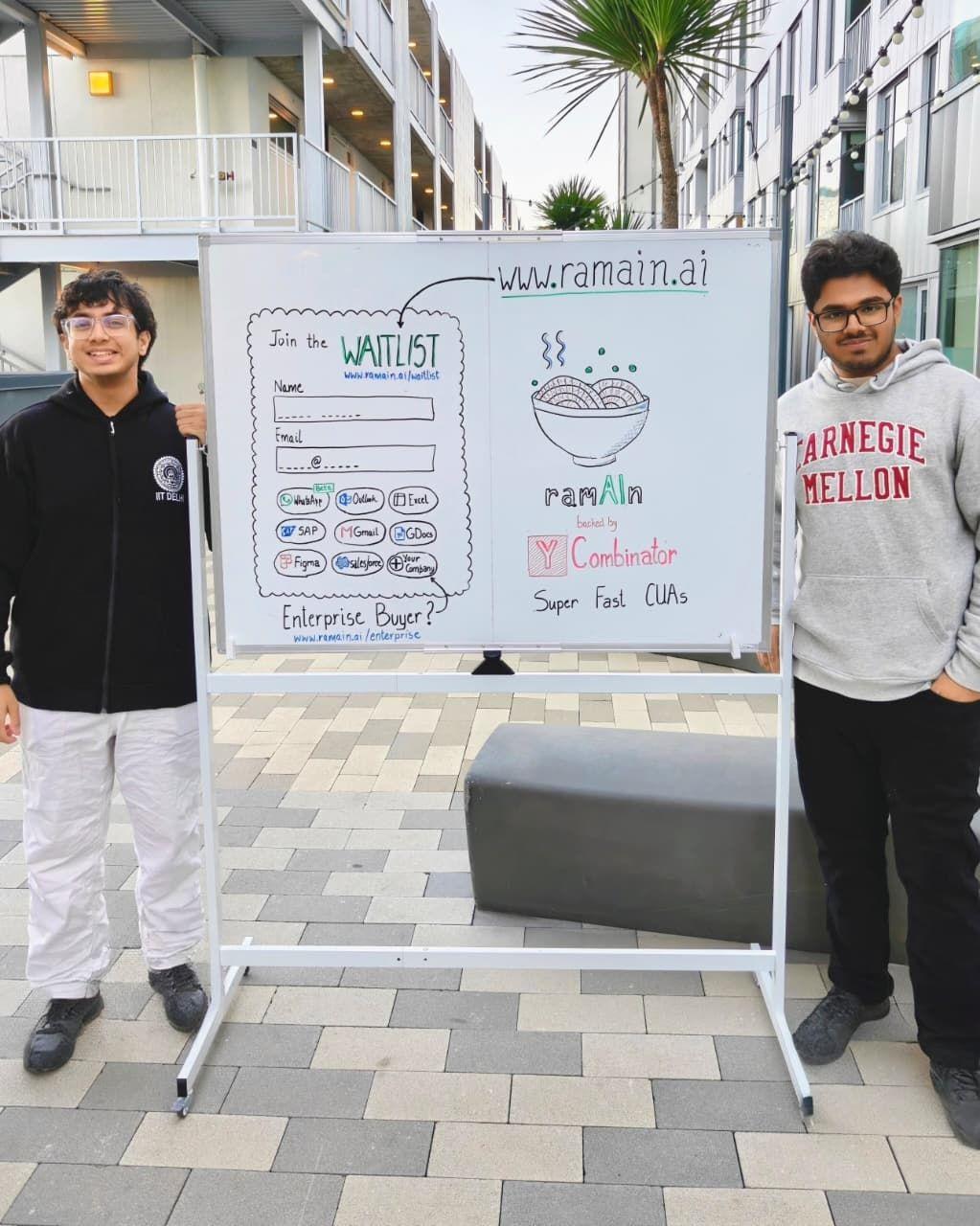
At launch, Jain offered the first 100 waitlist sign-ups free access. He described an assistant working across applications such as WhatsApp Desktop and Outlook, carrying out mouse and keyboard actions in response to instructions. Alongside that invitation was a request for enterprise design partners.
That pairing reveals the two audiences he was trying to reach: people who could immediately imagine an assistant using their apps, and businesses willing to test it against their own processes. A fictional assistant is a helpful way to begin the explanation. A company still has to earn its place in somebody’s working day.
The work between the windows
RamAIn’s proposition starts with software that is already there. Its agents interact with browser and desktop interfaces, including systems where an integration is unavailable. The company describes learning interfaces, handling changes and asking a person for clarification when needed. Human oversight and decision records are part of its stated design.
For Jain, the ambition is tied to a recognizable kind of work: moving information between applications that do not conveniently cooperate. The attraction of a computer-use agent is that the screen itself becomes a way in. The existing software can remain in place.
In June 2026, Jain published an article on the judgment involved in UI process automation through Forbes Technology Council. He argued that agents could address work involving unstructured information and decisions, beyond the clean rules that conventional automation expects.
That argument explains why the details matter. A screen can look familiar while the information on it changes. A workflow can reach a point where an instruction is insufficient. The useful question is whether the system can continue appropriately, or recognize that it needs help.
This is where the ambition becomes demanding. A person buying an automation system needs a finished task, a comprehensible outcome and a way to intervene. Jain’s work now sits in the distance between an appealing assistant and those everyday requirements.
The recruiter changes sides
One relationship around RamAIn began with the opposite intention. Ankon Bhattacharya met Jain while recruiting at IIT Delhi. He was trying to hire him. They stayed in touch, and eventually Jain and Ramani flew to Bangalore to show him their product. Bhattacharya joined RamAIn.
Bhattacharya’s account connects their backgrounds directly to the enterprise problem. Jain had worked at McKinsey; Bhattacharya had worked at Bain and then Pascal AI. He described people spending time reading one system and entering the information into another. He would take responsibility for work outside engineering at RamAIn.
Jain’s own recollection adds the recurring conversations over food in Gurgaon. Before the recruitment announcement, there had been time spent talking about startups and AI. The relationship had somewhere to go because it had continued after its original purpose expired.
Put beside the meeting with Ramani, it becomes a distinctive feature of this company’s beginning. A researcher became a co-founder. A recruiter became a colleague. The people stayed; the original job descriptions did considerably less well.
A question that survives the demo
The partnership also has a research record. In May 2026, Ramani and Jain submitted a paper examining how optimizer choice affects neural scaling laws. Their experiments used a controlled random-feature model. The paper explicitly left open how far the findings transfer to large-scale language-model training.
That qualification matters. It gives the work boundaries. An experimental result can be useful without being asked to explain every larger system.
In September, Jain co-authored a RamAIn report with Jayoo Hwang and Ramani covering four browser-agent benchmark suites. The company reported strict pass-or-fail results, including 89.4 percent on WorkArena L3 and 84.2 percent on WebArena-Verified Hard. These are company-reported evaluations, with a completed task as the stated unit of success.
For a founder whose earlier research tool met a difficult reception from intended users, that focus on completion is an apt place to leave the story. The next test belongs to the people using the product. They have their own screens, exceptions and reasons for needing the work done.
The campus interview never got written as planned. Jain and Ramani gave themselves a longer assignment instead: build the assistant, put it in front of people, and find out which part of the plan the next conversation changes.
Keep the conversation going
Writing, work and watchable things