Quilter unveils world's first computer designed by AI $25M Series B led by Index Ventures - $40M raised to date 98% of placement and routing done autonomously in 27 hours Ex-SpaceX avionics engineer trains AI on physics, not humans Project Speedrun: schematic to manufacturing in under a week Quilter unveils world's first computer designed by AI $25M Series B led by Index Ventures - $40M raised to date 98% of placement and routing done autonomously in 27 hours Ex-SpaceX avionics engineer trains AI on physics, not humans Project Speedrun: schematic to manufacturing in under a week
Founder · Engineer · Quilter

Sergiy
Nesterenko

He watched one of his first circuit boards burn up in his hands at SpaceX. Then he spent a decade making sure a machine would never let it happen again.

Physics-driven AIPCB AutomationEx-SpaceXUC Berkeley
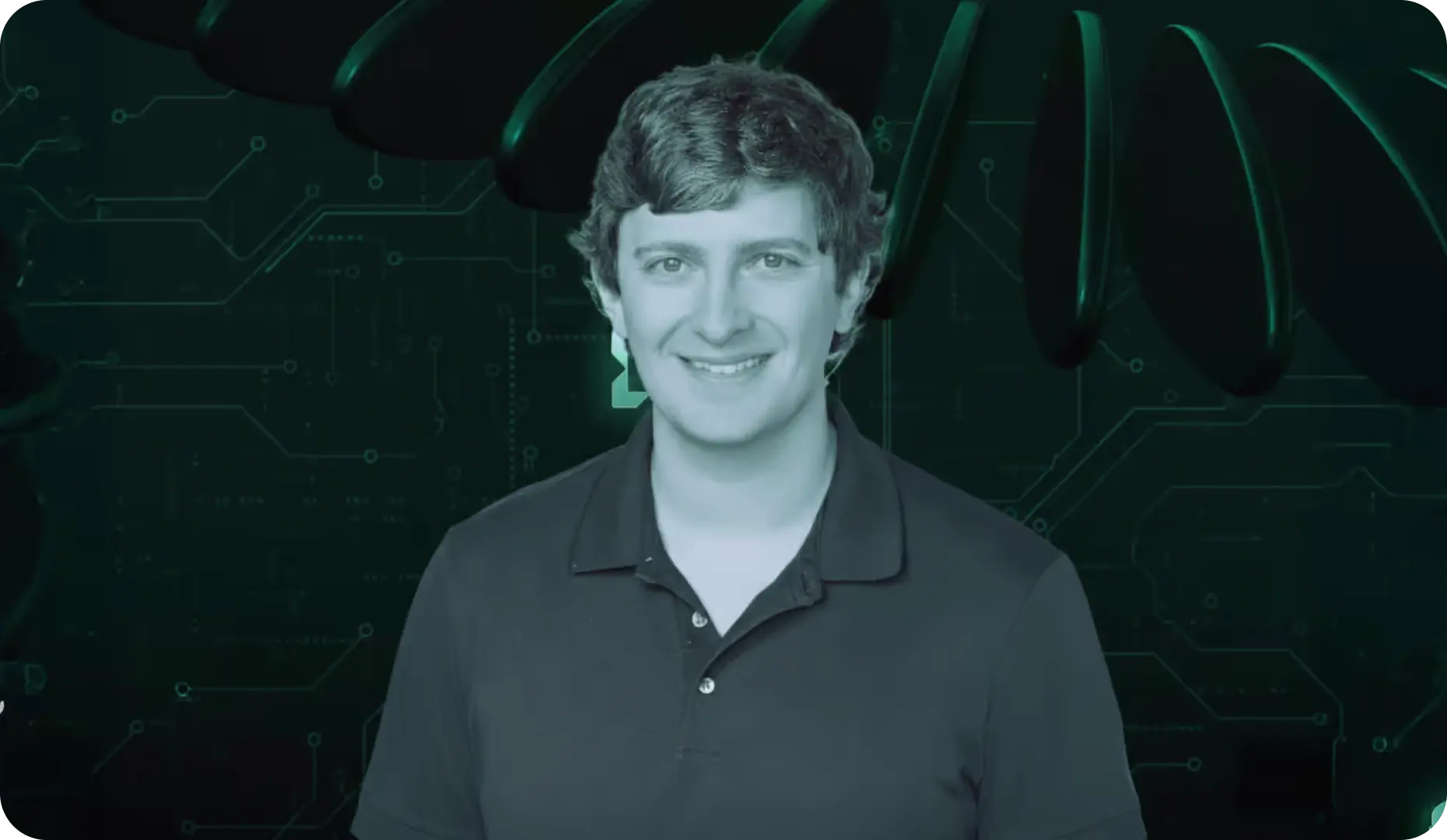
Sergiy Nesterenko, founder and CEO of Quilter
Calm in a sea of circuit traces. The man who taught the machines.
The Headline

A circuit board, designed start to finish by a machine, booted on the first try and ran a video call.

In December 2025, a single engineer at Quilter took a schematic built around the NXP i.MX 8M Mini processor - the same silicon that runs car dashboards and machine-vision systems - and handed it to an AI. The AI placed and routed 98% of the board on its own. Twenty-seven hours of compute, a day and a half of human cleanup, and out came a working computer. It played video games. It made video calls. In a field where a board failing on first boot is the norm, this one simply worked.

That is the world Sergiy Nesterenko is building toward. He runs Quilter, a Los Angeles company that does one strange and stubborn thing: it automates the layout of printed circuit boards, the green slabs of copper and fiberglass underneath every electronic device you own. For fifty years that work has been done by hand, trace by trace, by engineers squinting at screens. Nesterenko thinks that era is ending, and he has raised $40 million from investors who agree.

His pitch is contrarian in a way that takes a second to land. Most companies chasing AI for hardware design train their models on millions of boards humans already built. Nesterenko refuses to. He trains his AI on physics instead. No human examples, no inherited shortcuts, no bad habits passed down through generations of engineers. Just the laws of electromagnetism and a set of constraints, and a system that learns to satisfy them better than the people who wrote them down.

It is a bet that the way humans design circuit boards is not the ceiling. It might be the floor.

By The Numbers

The case, in five figures.

$40M
Total raised for Quilter
5 yrs
At SpaceX on Falcon avionics
27 hrs
AI compute to lay out a computer
11x
Faster than a human team

Three majors, one rocket company, nine months of looking for the right problem, and a decade spent on a question most engineers never thought to ask: why are we still doing this by hand?

"Most people try to train AI for PCB layout by copying humans. But humans leave value on the table. We train directly from physics."

Sergiy Nesterenko
Before The Boards

Born three months before a country disappeared.

Nesterenko arrived in Ukraine three months before the Soviet Union collapsed. By the age of six, his home had cycled through three currencies amid hyperinflation wild enough that store shelves emptied and families bartered. At ten, he landed in the United States without a word of English.

His grandfather designed aircraft in the Soviet aerospace tradition, and something of that rubbed off. As a kid he built robots and circuits. As a student he rigged an indoor GPS out of ultrasound, then ripped it out and rebuilt it with radio waves when the physics demanded it. That instinct - tear it down, rebuild from the ground - never left.

At Berkeley he triple-majored in chemistry, physics, and mathematics. Not to specialize. To go deeper.

"I triple majored in math, physics, and chemistry at Berkeley not because I wanted to specialize, but because I wanted to master the fundamentals."

Sergiy Nesterenko
The Path

Currency to circuitry.

  • ~1991 · Ukraine
    Born three months before the USSR collapses.
  • ~2001 · USA
    Immigrates at age 10, no English.
  • UC Berkeley
    Triple major: chemistry, physics, mathematics.
  • SpaceX · 5 years
    Radiation-hardened avionics for Falcon 9 and Falcon Heavy. Builds sub-centimeter RF positioning.
  • 2019
    Founds Quilter.
  • 2023
    $10M led by Benchmark for an AI "compiler" for boards.
  • 2025
    $25M Series B; total funding hits $40M.
  • Dec 2025
    Project Speedrun - first computer designed by AI.
The Spark

The board burned up in his hands.

At SpaceX, Nesterenko spent five years building radiation-hardened avionics for the second stage of Falcon 9 and Falcon Heavy - electronics that have to survive the slow bombardment of space without flipping a single bit. Along the way he developed an ultra-wideband RF positioning system accurate to under a centimeter, sharper than GPS. Ultra-wideband tech of that flavor later turned up inside iPhones.

But the moment that changed his trajectory was smaller and a lot less glamorous. One of his early PCB projects, routed with the help of an auto-router, literally burned up in his hands. The tooling everyone trusted had quietly produced something that failed. That was the "there has to be a better way" instant.

The realization underneath it was bigger than one scorched board. Designing the circuit boards for a rocket's electronics was tedious, manual, and error-prone - and the tools meant to help, the auto-routers, were widely distrusted for good reason. An entire industry had decided that the only reliable way to lay out a board was for a skilled human to do it slowly, by hand.

Nesterenko didn't buy it. He left, consulted on diligence for a sensors company, and then got an offer that most engineers only daydream about: an investor handed him roughly $1 million to start a company, with almost no strings attached. He could have chased anything. He spent nine months reading and researching before he chose his problem. He kept landing back on the same one. The boards.
01

Radiation-hardened

Five years building avionics tough enough for Falcon Heavy's upper stage.

02

Sub-centimeter

An RF positioning system more precise than GPS. The lineage later showed up in iPhones.

03

Nine months

Given $1M and a blank slate, he spent the better part of a year just finding the right question.

The Heresy

Don't copy the humans. Skip them.

Every other approach to AI circuit design starts the same way: feed the model a mountain of boards that humans already built, and teach it to imitate. Nesterenko calls that leaving value on the table. Humans cut corners, follow rules of thumb, and inherit decades of habit. An AI trained to copy them inherits all of it.

Quilter does something else. It learns from physics and constraints alone - electromagnetic simulation, signal integrity, manufacturability - using reinforcement learning to find layouts no human would think to try. Nesterenko likes to compare it to a software compiler. You describe what you want at a high level; the machine handles the brutal, fiddly execution underneath. Some early users run it many times a day, even on half-finished schematics, just to feel out the design space.

The skeptics - and the PCB world has many - keep asking whether it scales to big, complex boards. Project Speedrun was the answer, printed in copper.

Project Speedrun

Share of work, by who did it

AI autonomous
98%
Human cleanup
2%
vs. human team
11x faster

Placement, routing and physics validation completed by AI in 27 hours. Fully functional on first boot - rare for any PCB, let alone one no human laid out.

FILE: Why physics?

  • No human examples means no inherited bias
  • Trained on electromagnetics, not screenshots
  • Run it like a compiler - many times a day
  • Goal isn't to match engineers. It's to pass them.
In His Own Words

A founder who calls bullshit on the brief.

"We're not trying to match humans. We're trying to surpass them by avoiding their constraints entirely."

"All of hardware is about accelerating learning loops - build fast, test fast, and find out what you didn't solve."

"The first step in any serious engineering process? Call bullshit on all the requirements."

"Hardware doesn't have a Ctrl-Z. When something breaks, you rebuild."

"Great engineers develop taste. They look at a design and just know if it's going to go well or not."

"Research is about refining the question over and over. More than half the battle is asking the right question."

The Person Behind The Physics

Asks "why?" until you run out of road.

In interviews, Nesterenko asks "why?" over and over, peeling back layers until he finds out whether a candidate actually understands something or is just performing confidence. He would rather hire the person who says "I don't know" than the one who bluffs. It is the same posture he brings to engineering: distrust the requirements, distrust the received wisdom, keep asking until the answer is load-bearing.

He is open about the gamble. Quilter, he has said, isn't a guaranteed win - it's a bet on a breakthrough. But he's drawn to the question of whether something is possible or impossible, and finds the impossible version more thrilling. He credits early investor Michael Dearing with believing in him before he believed in himself.

Ask him for his favorite innovation and he won't say the rocket or the chip. He'll say the MRI - the machine that turned quantum mechanics into something that saves lives.

FUN FACTS

  • Arrived in the US at 10 with zero English
  • Triple major: chemistry, physics, math
  • His RF positioning lineage reached iPhones
  • Quilter is built for novelty too - keyboards, vintage computers, decorative PCBs
  • Favorite innovation: the MRI

STILL WANTS TO KNOW

  • Can AI design beat the best human engineer, not just match them?
  • What's left on the table when you stop copying people?
  • Where does the compiler analogy break?

"Quilter isn't a guaranteed win. It's a bet on a breakthrough. But if we're right, we change everything."

Sergiy Nesterenko · on the wager underneath the company

The aspiration is plain enough to fit on a napkin: make hardware design evolve the way software did. From slow, manual, expert-only work to a high-level description that a machine compiles into something finished and manufacturable. Software got its compilers. Nesterenko wants to hand the same gift to everyone who has ever bled over a circuit board.