A business can buy a tool to protect its laptops, another to govern employee access, and a third to watch for suspicious activity. Each purchase makes sense. Then an alert arrives, and somebody has to work out whether the laptop, the account and the activity belong to the same problem. The difficult part begins between the purchases.
- Sequretek combines security software with people who operate it.
- Its Percept suite covers devices, identities, threats and compliance.
- The newer pitch: connect existing tools, then consolidate gradually.
That gap is the subject of Sequretek, founded in 2013 by Pankit Desai and Anand Naik. The Mumbai company builds cybersecurity products and runs managed security operations. Its central argument is appealingly practical: protection becomes harder to use when every new purchase adds another console, another specialist and another handoff. Complexity has a staffing bill.
Two colleagues. One crowded market.
Desai and Naik knew the enterprise technology business before they became founders. They had worked together at IBM and became brothers-in-law. Naik went on to lead Symantec’s India and SAARC business; Desai’s career included Wipro and NTT Data. Their opportunity lay among businesses that needed serious security without the resources to assemble and operate a collection of specialist products.
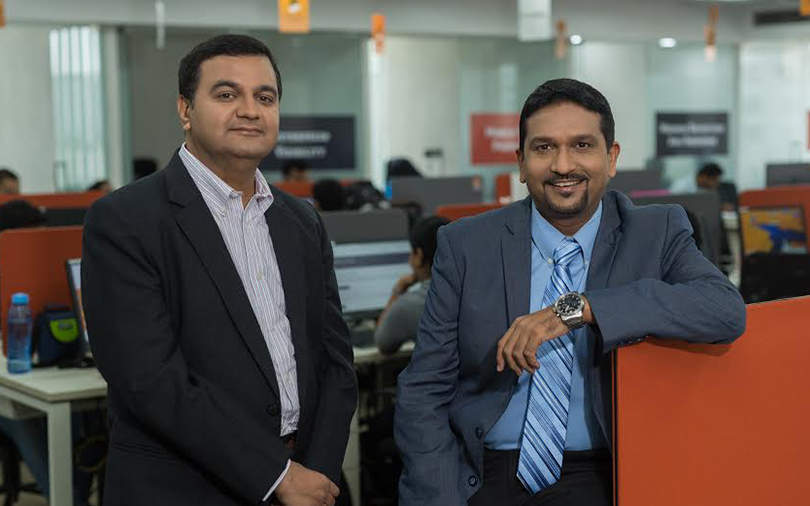
The founders committed real money. In a CrazyEngineers interview, Desai put their personal investment at roughly $750,000. Early offerings included Avatar for access governance and Kawach for device security. Managed monitoring supplied the operational layer. The names have changed; the underlying grouping of people, devices and threats remains recognizable in today’s Percept products.
There was friction. Desai told Techcircle in 2019 that selling to new-age companies and attracting talent had been challenges. His account of product development was customer-led: begin with an actual customer’s problem, then build around it. That is a useful discipline in a market where a technically impressive demonstration can still leave the buyer with more work.
Find it. Rank it. Do something.
Percept EDR handles endpoint detection and response. Percept Identity governs access through the employee lifecycle. Percept XDR and next-generation SIEM bring security data together for detection, investigation and response. For a company without enough internal specialists, managed services add round-the-clock monitoring. Software and service are sold together as a way to make coverage operable.
The June 2025 public launch of Percept CTEM extended that logic. Continuous threat exposure management begins with knowing which assets exist, identifying their weaknesses and deciding what deserves attention. Sequretek describes CTEM as an overlay that works with third-party products and its own suite. Customers can retain existing investments while changing their security setup in stages.
An inventory needs a next step.
- 01DiscoverSee assets and exposures
- 02PrioritizeAdd business context
- 03RespondRoute remediation work
Consider a forgotten server. An inventory records its existence; a scanner records its vulnerabilities. The operational question is whether those weaknesses matter enough to interrupt somebody’s Tuesday. CTEM’s promise is to add business context to that decision. Sequretek markets automated recommendations and remediation workflows. The illustration is hypothetical, but the distinction between discovering a problem and assigning its repair is concrete.
September 2025 brought Percept Compliance Manager, a subscription product for continuous monitoring, evidence collection and audit reporting. It gives the suite another job: helping organizations keep track of obligations alongside technical risks. Automating evidence collection can reduce repetitive work. Responsibility for interpreting that evidence still belongs inside the customer’s organization.
“To simplify security by consolidating the technology landscape.”Sequretek’s stated vision
A smaller pond, by choice
The company applied the same practical thinking to geography. Naik initially considered a U.S. headquarters near New York or Silicon Valley. Participation in The Venture Center’s accelerator changed the calculation. Sequretek announced its U.S. headquarters in Little Rock in 2022. In a subsequent account, Naik cited operating costs, the business environment and the value of being visible in a smaller ecosystem.
Local connections also offered a hiring route. A 2023 account described a partnership with the Arkansas Center for Data Sciences to recruit through apprenticeships. That detail matters because a security provider must staff the service behind its software. A convenient address cannot investigate an incident; a trained person can.
Led by Omidyar Network India, with Narotam Sekhsaria Family Office and Alteria Capital participating.
The financing was earmarked for global expansion and wider adoption, including smaller businesses. Distribution also runs through partners. In February 2025, Aryaka introduced AI>Observe, powered by Sequretek technology, to analyze network activity. Aryaka’s announcement offered optional access to Sequretek’s managed security operations. Here, the technology reaches a buyer through a networking relationship already in place.
The product work has continued into a broader public presence. In its March 2026 newsletter, Sequretek reported selection for PwC’s inaugural Emerging Tech Startup Challenge cohort and participation at HIMSS26. These are signs of market activity rather than proof of security effectiveness. They also show the company looking for conversations beyond a single industry, while keeping regulated organizations in view.
The useful test is Tuesday morning
Sequretek serves financial institutions and businesses in healthcare, pharmaceuticals, manufacturing and other sectors. Its product breadth puts it across markets usually discussed separately: endpoint protection, identity governance, security analytics and managed response. Buyers can compare specialist products in each category. Sequretek’s proposition is the coordination of those capabilities and the service supporting them.
A sensible evaluation starts with one ordinary workflow. Bring a representative device, an employee account and an incident to the demonstration. Ask how the data connects, who receives the case, who can authorize action and how closure is recorded. Check connector support and data-location requirements before assuming a unified interface will fit the organization.
Consolidation also concentrates dependency on a provider. A business with tightly customized tools or a strong internal security team may value that trade differently. The lesson readers can copy is to price the work around the software: integration, investigation, escalation and repair. Sequretek’s story becomes interesting at precisely that point, where a security purchase becomes somebody’s daily responsibility.