In November 2004, Scott D. Jackson took on another job. He was already chairman and chief executive of Affordable Residential Communities, a business that had gone public that February. Now, after its president and chief operating officer resigned, Jackson became co-chief operating officer as well. His explanation was refreshingly physical: he and his fellow founder, John Sprengle, would spend hours in their communities. A housing company could acquire properties from a conference room. Running them required showing up.
That small episode offers a useful entrance to Jackson’s career. His work stretched from financial institutions to manufactured housing, from transactions involving bank capital to streets that needed attention. He understood acquisitions. He also encountered the stubborn distance between owning something and making it work. The distance was where much of his story happened.
The banker before the builder
Jackson arrived in housing with a financial résumé. He worked at Merrill Lynch Capital Markets from 1979 to 1985, then became senior vice president and manager of Republic Bank Capital Markets. Between 1987 and 1991, he worked at Goldman Sachs, serving as a vice president in corporate finance and co-heading its Financial Institutions Restructuring Group. These were jobs concerned with the structure of businesses: their financing, their obligations, and the arrangements that allowed them to keep operating.
His next positions, from 1991 to 1994, included senior roles at financial services companies owned or controlled by Gerald J. Ford and others. Jackson oversaw acquisitions, disposals and capital financing. Ford would later appear in ARC’s history as an investor and director. The connections between the banking chapter and the housing chapter were quite literal.
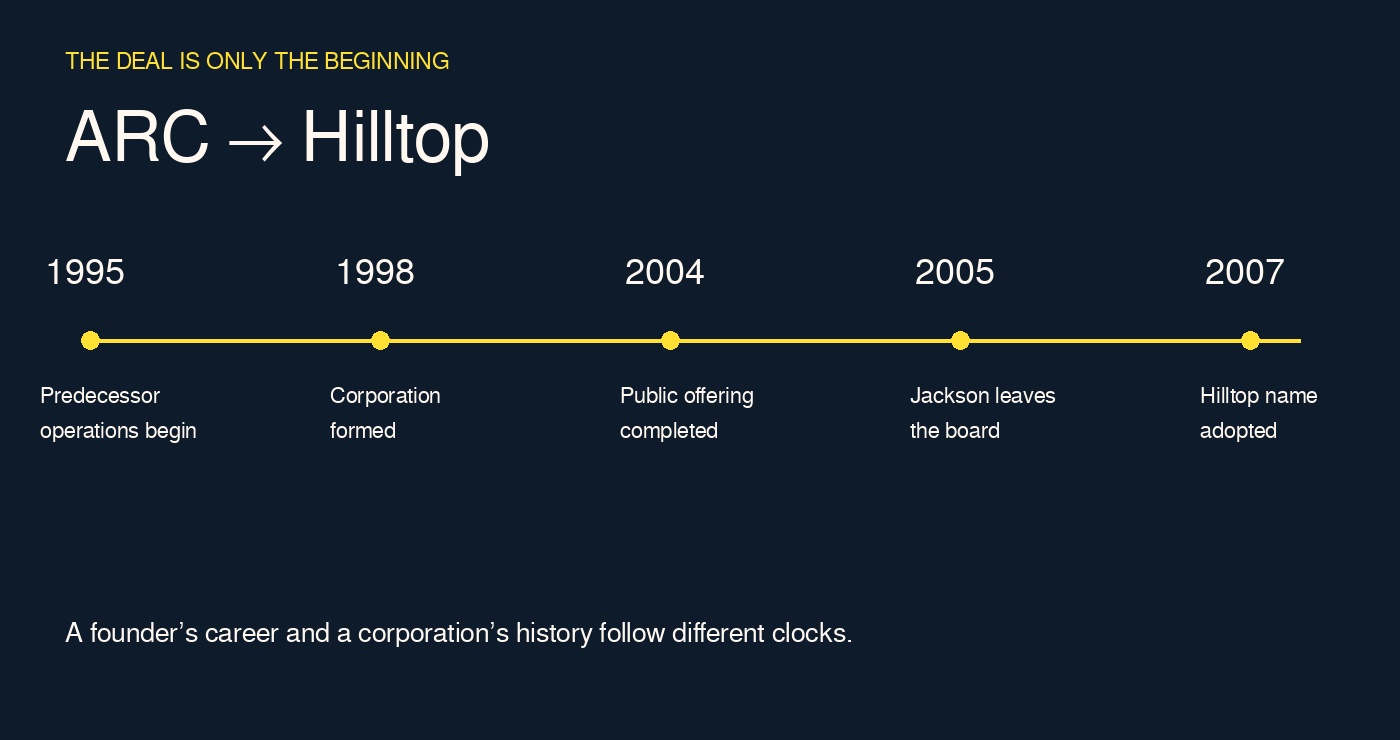
Jackson and Sprengle co-founded ARC’s predecessor in 1995. The corporate vehicle followed in July 1998. Keeping those dates separate gives the enterprise its proper sequence: an operating business first, then the corporation whose later history would lead to Hilltop Holdings. A founding date can be a surprisingly crowded address.
A portfolio becomes a place
ARC’s business combined buying manufactured home communities with renovation, repositioning and day-to-day operation. It also sold, financed and rented homes within its communities. That combination mattered. The company had several ways to bring a resident into a home, and several related activities to coordinate once it did. The property was only one part of the undertaking.
By the end of 2003, including assets obtained through the Hometown transaction, its portfolio comprised 302 communities and approximately 67,000 homesites. Those properties reached across 29 states and 70 markets. Dallas-Fort Worth was its largest market by homesite share, followed by Atlanta. A national portfolio was emerging from a business whose everyday encounters remained local.
The breadth created a practical question: how do hundreds of properties begin to operate as one company? A resident experiences a particular street, a particular manager and a particular home. A shareholder sees the accumulated results. Jackson’s task was to connect those two views without losing the detail in either.
George Allen, an industry colleague who visited ARC’s Denver office around 2000, remembered an executive team dressed alike. He also described a recognizable treatment of acquired communities: new names, coordinated signs, repaved streets and infrastructure improvements. Even the signs had a system. Corporate identity had escaped the stationery cupboard and reached the pavement.
Allen’s recollection makes the acquisition strategy tangible. A portfolio could grow on a spreadsheet while its properties still looked unrelated. The repeated work on names, roads and infrastructure gave the company a visible presence. These were changes a visitor could see before anyone explained an ownership structure.
The public offering came with a work list
ARC completed its initial public offering on February 18, 2004. It issued 22.3 million common shares at $19 each, excluding shares sold by selling stockholders, alongside five million preferred shares priced at $25. Going public placed the housing enterprise in front of a new audience. It also put quarterly results beside the acquisition story, where investors could compare ambition with performance.
The Hometown portfolio added approximately 26,000 homesites. By May, Jackson was describing an expansion in district management from seven districts to twelve. New employees were being trained in ARC’s procedures. Capital projects included getting sites ready for home deliveries, tackling deferred maintenance and improving amenities. The work list was extensive, and reassuringly unglamorous.
A delivery needs somewhere ready to receive it. A newly acquired property needs people who know how the company operates. These details help explain why Jackson’s career cannot be told entirely through transaction dates. The acquisition enlarged the business immediately. The operating organization had to catch up, community by community.
In the second quarter of 2004, ARC reported a $7.1 million net loss available to common shareholders. On a same-community basis, real estate revenue rose 2%, while expenses increased 9.8%. Real estate net segment income for those communities declined 2.8%. Growth in revenue, in other words, did not spare the company pressure on its operating results.
The numbers complicate the familiar founder story. The public offering was a milestone, but the following months brought management changes and continuing operating demands. Buying more property had made ARC larger. The quarterly arithmetic asked what that larger business could earn.
“While 2004 was a disappointing year, we believe that we have made the necessary changes to move forward.”
Scott Jackson, March 2005
Empty homesites and awkward arithmetic
Jackson’s response included a renewed focus on used-home sales and lease-to-own products. During 2004, reported home sales moved from 28 in June to 55 in July, 65 in August and 157 in September. The company estimated approximately 305 for October. The progression showed an operating effort gaining activity, though sales alone could not settle every question about profitability.
Financing remained a substantial part of the picture. At September 30, 2004, ARC had just over $1 billion in long-term debt outstanding. A property business can be busy improving homes and increasing sales while still carrying considerable financial obligations. Jackson’s background in capital markets belonged inside the housing story throughout.
By March 2005, he was candid about the previous year’s disappointment. ARC described spending on acquired-community cleanup, staffing, administration, processes and training. Its fourth-quarter net loss to common shareholders was $35.4 million. The spending illustrates the cost of the operational work; the loss prevents an account of that work from becoming a victory parade.
The first quarter of 2005 brought a more encouraging occupancy direction. Occupancy reached 82.1%, with net occupancy up by 380 residents. The quarterly net loss to common shareholders narrowed to $15.9 million. Community operating expenses declined, and the retail segment’s losses fell. Improvement was visible, alongside a business that remained in the red.
The following quarter offered a lesson in reading percentages. Occupancy rose to 84.5%, supported by an increase of 874 residents. ARC also reduced its homesite count by a net 716 lots. That adjustment accounted for one percentage point of the reported occupancy increase. More residents and a smaller denominator both moved the rate.
Revenue reached $75.6 million, while the net loss to common shareholders widened to $18.2 million. This was an untidy combination: greater occupancy, more revenue, continued losses. It is also a more revealing portrait of an operator than a smooth upward graph. Jackson was working with several measures of progress, and they did not all move together.
Where Jackson ends and Hilltop begins
On December 13, 2005, Jackson resigned from ARC’s board. By then he was a director and vice chairman; the company entered into a separation agreement with him on the same date. That is the boundary to keep in mind when following the corporate history forward. The founder’s career and the company’s subsequent direction have separate timelines.
In 2007, ARC sold its manufactured housing business assets for $1.8 billion. It transferred the Affordable Residential Communities name and became Hilltop Holdings. The company later pursued banking acquisitions and developed into a financial services holding company. Jackson belongs to the origin of that corporate lineage through ARC, rather than to the later leadership of Hilltop under its new name.
People who worked with Jackson also remembered an education. Alan B. Loud, describing his tenure at Affordable, called Jackson a mentor and friend and valued the experience he and the management team provided. That is a different measure from occupancy or quarterly income. An executive’s decisions become part of other people’s working lives, sometimes surviving as lessons after the formal relationship has ended. For Jackson, the operating story included those relationships as well as the properties.
A different kind of property work
In 2012, Jackson and his wife, Kathy, bought a 1,500-acre ranch in Kiowa, Colorado, fulfilling a long-held wish. They restored houses, barns and outbuildings and raised cattle and goats. Flyer Ranch became their home. The scale and setting had changed; the work of improving property remained.
Jackson died there on January 6, 2023, aged 67. He had been born in Rapid City, South Dakota, and graduated from Colorado State University in 1978. His life connected finance, housing and ranching through an unusually practical sequence of undertakings.
There is something fitting about ending this story away from the trading symbol. In 2004, faced with the demands of a newly public company, Jackson had promised to spend hours in the communities. Years later, home was another property with plenty to do. The career makes its clearest sense at that level: capital arranged, land acquired, and then the work waiting outside.
Explore the record
- Career and co-founders - 2005 proxy
- Operating history - 2003 annual report
- 2004 public offering
- Hometown integration - May 2004
- Second-quarter 2004 results
- November 2004 management changes
- Third-quarter 2004 operating decisions
- Fourth-quarter 2004 results
- First-quarter 2005 results
- Second-quarter 2005 results
- December 2005 board departure
- Hilltop corporate history
- George Allen remembers Scott Jackson
- Scott D. Jackson memorial