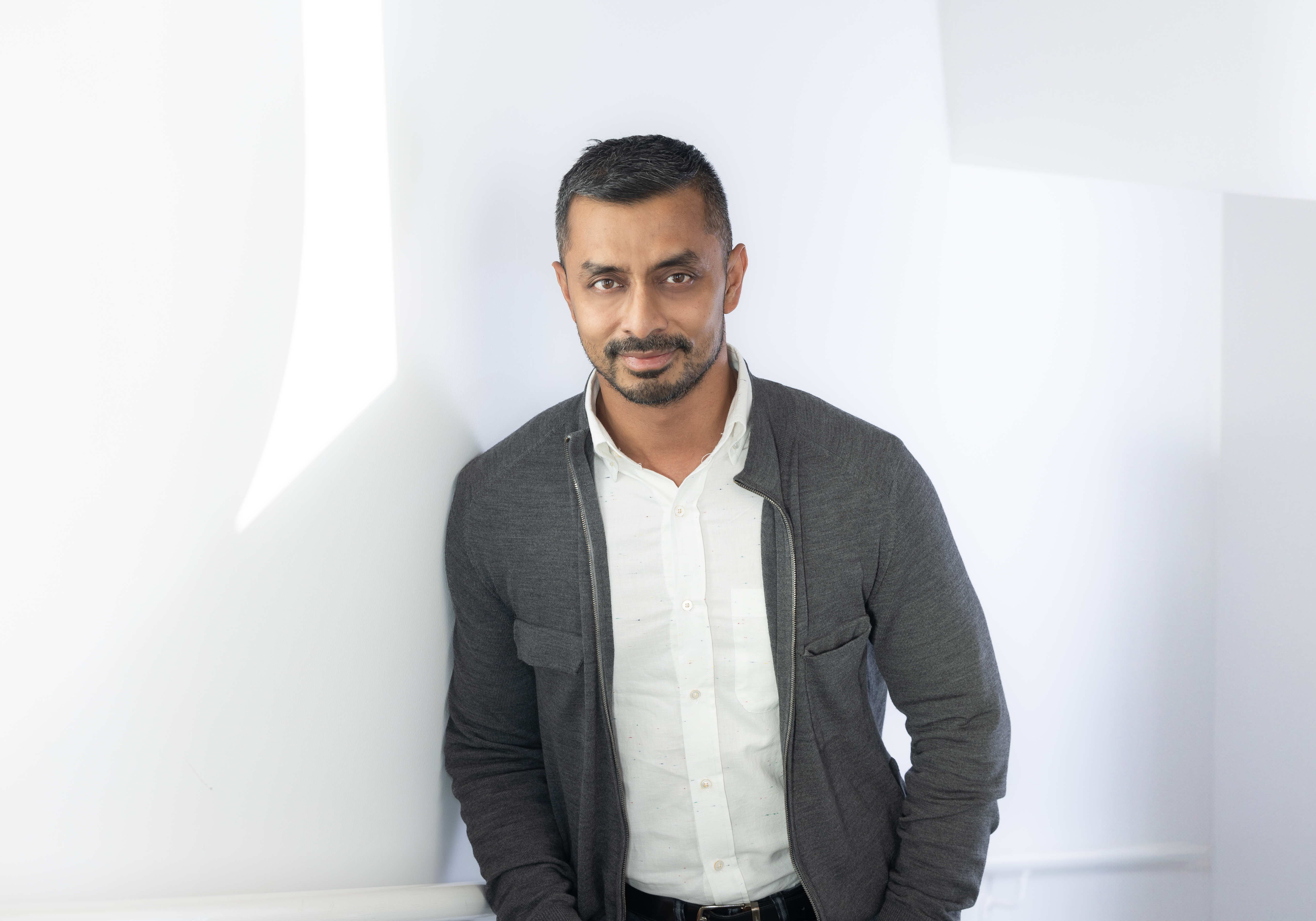
Concentrated Conviction in a World of Spray-and-Pray
There's a quiet discipline at work in Sandeep Bhadra's investing. While most early-stage funds race to stamp as many logos as possible onto a deck slide, he writes two checks a year. Two. The math of modern venture says diversification is protection. Sandeep's math says the opposite: the only edge worth having is the kind you can't phone in.
He joined Vertex Ventures US in 2017 as one of four founding partners, at a moment when the fund was a blank sheet of paper. No portfolio, no track record as a unit, just a thesis: find the software companies rebuilding the infrastructure layer of the internet - the plumbing nobody photographs but everyone uses - before the crowd shows up with term sheets. Seven years later, names like Hasura, Docker, Gitpod, Tulip Interfaces, and Orkes anchor that thesis in concrete.
If you love a product, the business is probably worth investing in.
Sandeep BhadraThe line sounds simple. It isn't. For Sandeep, it means doing the work before a category has a name - reading the documentation, cloning the repo, actually building something. He came up as an engineer, after all. His Ph.D. from the University of Texas at Austin was in electrical engineering, earned the slow way, and he describes it with affectionate exasperation as his best "career mistake." A mistake because it delayed what looked like a conventional career path. Best because it taught him how to sit with ambiguous problems, argue from first principles, and change someone's mind with evidence rather than authority. Those aren't VC skills. They're scientist skills. And in a business built on predicting the future, scientists have an edge.
The biography gets stranger before it gets to Sand Hill Road. After IIT Madras - one of India's most competitive engineering schools - and a Ph.D., Sandeep went to Texas Instruments, where he worked on LTE and LTE-A cellular systems and software-defined networking chips. His work there contributed to the formation of Barefoot Networks, a venture-backed startup that Intel later acquired. That is to say: he's been on the founding side of something, not just the funding side. He knows the smell of early.
Then came INSEAD's MBA, and a pivot to Cisco's corporate development team, where he managed roughly $425 million in cloud and infrastructure software M&A. That number is worth sitting with. It means Sandeep spent years analyzing why certain software bets worked from the acquirer's point of view - the same lens he later applied to identifying which companies were worth funding before they became acquisition targets. Cisco buys things after they've proven the market. Sandeep now bets on them before.
Managed ~$425M in cloud infrastructure M&A at Cisco. Left to back the companies Cisco would eventually want to buy.
The last stop before Vertex was Menlo Ventures, where he served as Principal from 2015 to 2017. There he backed Platform9, Signifyd, Unravel Data, and Clarifai - a pre-Vertex portfolio that previewed the pattern: infrastructure-adjacent, developer-oriented, early, and technical. The thesis didn't change when he moved firms. It sharpened.
Sandeep's investment focus converges on a specific niche: open-source cloud infrastructure software, developer tools, and B2B SaaS in categories that are either underserved or being rebuilt from scratch. He's drawn to companies where developers are the first and most important customers - what he calls "bottoms-up" distribution, where the product sells itself through usage before a sales team ever makes a call.
Hasura is the archetype. The Bangalore-based company built an open-source GraphQL engine that gave developers instant, real-time APIs from their databases. Sandeep backed it when GraphQL was still a Twitter argument, not a standard. The company has raised over $140 million total. Gitpod, the cloud-based development environment, follows the same logic: a product that developers loved before analysts had a category for it. So does Orkes, which brought Netflix's open-source Conductor workflow orchestration platform to market as a managed service.
Tulip Interfaces is the outlier that proves the rule. It builds software for manufacturing floors - not the sexiest sector on the VC circuit. But Sandeep spotted the same pattern: a complex, underserved industry where software could leapfrog decades of legacy tooling. Tulip has raised over $130 million. The same instinct drove investments in BrokerBuddha (insurance brokerage software) and LightBeam.ai (AI-powered data security). Heavy industries. Big pain. Undercrowded pitches.
His check range runs from $2 million to $15 million, with $8 million as the sweet spot. For a $150 million fund making one or two new bets a year, that creates a tight, high-touch portfolio model. He doesn't spread the fund thin and hope something hits. He picks, then he commits - board seats, real engagement, the kind of involvement that matters when a company hits its first real ceiling.
The biggest obstacle facing venture capitalists is maintaining independent conviction amid consensus-driven pattern matching and industry groupthink.
Sandeep BhadraThat quote is pointed. Silicon Valley has its own version of groupthink, where being contrarian is celebrated in theory and punished in practice. Sandeep's version of independence shows up in how he talks about growth metrics. He's publicly pushed back on the "arbitrary benchmarks" that finance types push on companies - the ones who, as he puts it, haven't actually built anything. He points to OpenAI and Figma as companies that didn't follow the standard growth playbook and still became the most important software companies of their generations. The insight: the benchmarks were always proxies for something real. When you can see the real thing directly, you don't need the proxy.
There's a version of Sandeep Bhadra that fits neatly into a PowerPoint slide: IIT, Ph.D., INSEAD, Cisco, Menlo, Vertex. Each bullet more impressive than the last. That version exists. But it leaves out the part where he calls himself the Resident DJ at Vertex Ventures and means it literally - he's an EDM fan who apparently approaches the office playlist with the same seriousness he brings to diligence calls.
He was born and raised in India, and growing up there shaped his intuitions about technology in specific ways. Getting a landline telephone in India required navigating a bureaucratic system that could take years. Mobile phones didn't just offer convenience - they leapfrogged the entire infrastructure problem. Sandeep watched that happen in real time, and it left a permanent imprint: the best software isn't always an improvement on what exists. Sometimes it makes what exists irrelevant.
For insomnia, he reads contemporary English fiction. He chose it specifically because it's "non-urgent" - no action required, no decisions to make, just prose. Given that the rest of his intellectual life involves urgent decisions with ten-year consequences, the logic tracks. He also enjoys strength training, follows education policy with genuine interest (unusual for a VC who focuses on enterprise software), and has stated preferences for Burgundy wines and, bafflingly, drinking egg whites straight. Spirit emoji: shrug.
His philosophy on remote work is worth noting in an era when the conversation keeps bouncing between extremes. He advocates for optimizing remote across sales, marketing, operations, and management - the argument being that geography should follow opportunity, not precede it. This is consistent with his broader contrarianism: he tends to look for the cases where the conventional wisdom was always a convenience, not a truth.
The portfolio companies he keeps citing publicly are the ones where he's most engaged: Hasura, Tulip, Orkes. The pattern is board seats at companies with technical founders solving deeply unsexy problems in very large markets. He gravitates toward builders who know their domain so well that they built the tool because nothing good existed - not because they spotted a market gap on a slide. Those founders, in his experience, are harder to stop.
Recent investments have tracked the AI infrastructure wave without chasing the hype. LightBeam.ai (data security in AI workloads), Northflank (developer PaaS), and Onshore suggest a continuing focus on infrastructure and tooling - the layer below the application that becomes necessary as AI compounds through software organizations. In a moment when every pitch deck has an AI slide, Sandeep is still asking the same question he always asks: do developers actually love this product?