
Start the clock
Imagine a clock mounted above San Francisco City Hall. It begins on January 1, 2023. Every 51 minutes, it rings. Each ring means another home must be added to the city. Not proposed. Not discussed. Not rendered in tasteful watercolor. Added. The clock keeps going through the 2023–2031 housing cycle until it has rung 82,069 times.
That is the scale of San Francisco's state-assigned Regional Housing Needs Allocation, or RHNA. The figure is more than three times the target from the previous eight-year cycle. Spread evenly across eight years, it works out to about 10,259 homes a year, 28 a day, one every 51 minutes. A city accustomed to arguing over buildings one at a time has been given a target that only makes sense as a production system.
The number can sound bureaucratic because it arrived through a process involving the Association of Bay Area Governments and California's housing law. But its meaning is intimate. Every unit is a front door: a place for a teacher, a grandparent, a line cook, a software engineer, a child who otherwise grows up sharing a room. The state has not ordered the city itself to construct every unit. It has required San Francisco to plan, zone and remove constraints so the full allocation can be accommodated. That distinction matters. A zoning map can permit a home. It cannot pour the concrete.
Four San Franciscos inside one number
The target is not a single pile of interchangeable apartments. It is four housing markets stacked on top of one another. The adopted plan assigns 20,867 homes to extremely low- and very low-income households, 12,014 to low-income households, 13,717 to moderate-income households and 35,471 to households above moderate income.
The 82,069-home assignment
Regional Housing Needs Allocation by income category
Add the first three categories and the central challenge comes into focus: 46,598 homes—57 percent of the entire allocation—are intended for households at or below moderate income. This is not simply a market-rate building challenge with an affordable set-aside around the edges. More than half the test sits where ordinary rents do not reliably cover San Francisco's extraordinary cost of development.
The four buckets also prevent the city from declaring victory with the wrong homes. Thirty-five thousand above-moderate units cannot substitute for twenty thousand extremely low- and very low-income units. A luxury tower and a supportive apartment both count as housing, but they solve different problems. One broadens overall supply. The other generally needs a public subsidy large enough to bridge the gap between what a resident can pay and what the building costs to create and operate. The target is a demand for both, at once.
At San Francisco's old pace, the target takes 32 years. The state has allotted eight.The production gap
The arithmetic of incrementalism
Now compare the clock with the old rhythm. Between 2001 and 2020, San Francisco produced approximately 2,550 homes a year. At that pace, building 82,069 homes would take a little more than 32 years. The state has allotted eight. The required annual tempo is just over four times the historical rate.
one every 3h 26m
one every 51m
This is why incremental reform cannot close the gap. Shaving a month from one review, allowing a few more accessory dwelling units or approving a single megaproject may all help. None changes the production curve enough by itself. The challenge is not to discover one magic parcel. It is to redesign the machine that turns land, financing and permission into homes.
San Francisco's own environmental review used its history as a baseline. Production swung from roughly 350 homes in 2011 to about 4,900 in 2016. Even the high-water year was less than half the average now implied by the allocation. The new target does not ask the city to repeat its best recent year. It asks San Francisco to double that year, then do it again and again.
That exposes the most useful way to read 82,069. It is not a forecast. It is a stress test. If approvals speed up but financing collapses, the system fails. If market-rate construction rises but deeply affordable production stalls, the system fails. If new capacity is concentrated again in the same eastern and southern neighborhoods, the equity promise fails. The clock measures the whole mechanism.

Why a permitted home is not yet a home
San Francisco's shortage has a familiar first cause: too little housing in a city where many people want to live. But scarcity is only the beginning. The city's planning documents identify high material costs, a construction workforce that has itself been priced out of the region, complex review and permitting, and investment risk. Each pushes the price of a finished unit upward.
For lower-income housing, the math becomes harsher. Reduced rents cannot repay the full cost of land, construction and operation. Public money must fill the gap, yet federal and state support declined over decades. The city estimated in its Housing Affordability Strategies that reaching a long-run goal of 5,000 new homes annually, with at least a third affordable, would require about $517 million a year in 2020 dollars for affordable production and preservation. Historically, annual local affordable-housing funding fluctuated from $33 million to nearly $200 million.
This produces a trap. Limited supply drives up prices. High prices make development more expensive. Expensive development makes below-market homes more subsidy-hungry. Insufficient subsidy leaves fewer affordable homes, intensifying displacement. The people most exposed are not randomly distributed. City findings show households of color are more likely to be rent burdened than white households; more than half of Black households were rent burdened. In a survey of about 3,200 renters, roughly one third said displacement would leave them with no housing choice, while another third said they would have to leave San Francisco.
Housing policy, then, is not only a question of what gets built. It is a question of who can survive the interval before enough gets built—and who can afford the result.
The plan's wager is that abundance and protection are complements.On building and belonging
A different bargain with the map
The adopted Housing Element differs from older plans in the order of its ideas. It begins by recognizing housing as a foundation for health and economic well-being. It explicitly centers racial and social equity, calls for repairing harms from discrimination and seeks a fairer distribution of both investment and growth. In plain English: the city is not supposed to meet the number by repeating the geography that helped create the crisis.
For decades, much of San Francisco's growth was channeled toward the east and south, while many well-resourced neighborhoods remained dominated by low-density rules. The new framework opens the door to small and mid-rise multifamily housing across more neighborhoods and connects growth to transit, schools, jobs, parks and other daily necessities. Rezoning is the hinge: without legal capacity on enough plausible sites, every other promise becomes theoretical.
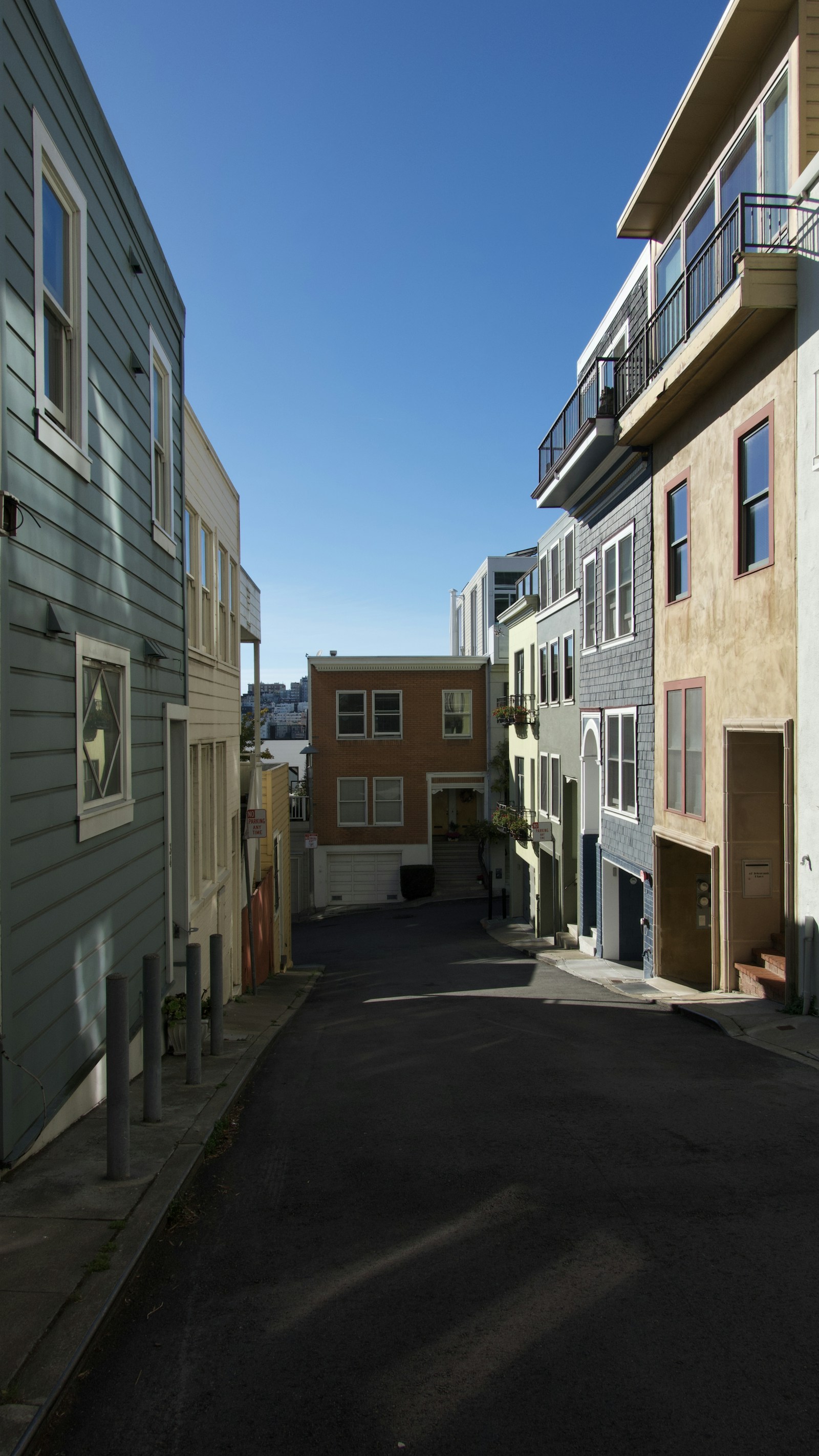
But rezoning is not the entire bargain. The plan pairs production with renter stability, rental assistance, eviction prevention, preservation of existing affordable homes and fair-housing programs. That pairing answers a real fear. A neighborhood can receive investment and still lose the people the investment was meant to serve. Communities of color in San Francisco have experienced exactly that pattern: new housing and infrastructure arrived, while residents and businesses captured limited benefits or were displaced.
The plan's wager is that abundance and protection are complements. Build more, but also help current tenants stay. Distribute growth, but direct resources toward places and people scarred by disinvestment. Put homes near opportunity, but make access to those homes real. It is a more complicated story than simply saying yes to housing. It is also the only story broad enough to match the target.
What passing the test would mean
The easiest mistake is to turn 82,069 into a scoreboard and watch it from a distance. The better question is what must be true for the number to become ordinary. Permits would need to move predictably. More sites would need to support multifamily buildings. Construction would need to become less risky and less costly. Market demand would need to translate into financing. Public funding would need to rise dramatically for the 46,598 homes assigned at or below moderate income. Tenant protections would need to hold while neighborhoods change.
These conditions are interdependent. Faster approvals for projects that cannot secure financing do not produce keys. Subsidies without buildable sites chase scarce land. New apartments without renter stability can change a census tract while ejecting its community. Parks, schools and transit matter because a home is affordable only in the fullest sense when daily life around it is reachable.
And then there is time. At the old 2,550-a-year pace, one home appeared about every three hours and 26 minutes. The new assignment compresses that interval to 51 minutes. The distance between those two clocks is the distance between San Francisco's habits and its obligation.
Perhaps that is why the target is valuable even before the last unit is counted. It makes evasion harder. It turns every delay, financing gap and exclusionary rule into a visible part of the same system. It asks a city famous for reinvention to reinvent the way it makes room for people.
The clock is already running.
Sources: San Francisco Housing Element, Housing Element 2022 Update, implementing programs and Housing Affordability Strategies.