Before there was a consultancy, there was a community centre. Ruwayda Mustafah has written about arriving in Britain as a Kurdish refugee, attending language classes, and meeting families who were also learning how to live somewhere new. English was one thing to acquire. A circle of people was another. In her recollection, the two arrived together.
She is now based in Erbil, where she founded Saaba, a strategic communications and advisory business. She also founded Women Beyond Network. Elsewhere in her working life are political essays, a law degree, media interviews and children’s books. Read as a list, the career looks busy. Follow the audiences, and it becomes more legible.
There are people trying to enter public life, women trying to meet other business owners, and children encountering Kurdish culture through stories. An introduction looks different in each setting. Mustafah keeps finding reasons to make one.
A voice before a business card
Her public writing predates the consultancy identity. In 2011, she was already described as a London-based British-Kurdish writer, a law student at Kingston and editor of Kurdish Rights. The combination put her close to an enduring question for a diaspora writer: how do you make a place intelligible to people who encounter it from elsewhere?
Writing about Kurdistan means writing across different kinds of distance. There is the physical distance between Britain and Iraq. There is also the distance between a political argument and the everyday circumstances it describes. A dispute over institutions can sound remote until it affects somebody’s salary, prospects or ability to imagine a future.
Her founding of the Kurdish Policy Board gave the question a British setting. Its purpose was to increase British-Kurdish political representation. A community can be present in a country and still have work to do to participate in its politics. The board’s stated ambition addressed that gap between having a life somewhere and having a public voice there.
Mustafah’s education moved through law and international political communication at Kingston University London, followed by doctoral research into state-building and referendums. Those subjects suit a writer interested in how institutions secure consent. They also suggest why, in her work, language and political authority so often occupy the same sentence.
“One day you might see me interviewing a minister, and the next you will find me on the streets near Qelat having a Falafel.”
Ruwayda Mustafah
The falafel line comes from her own biographical description. It is a welcome interruption to the solemn machinery of professional credentials. Public life includes ministers. It also includes lunch. Her willingness to put both into the same account gives a glimpse of how she presents herself: interested in institutions, with room left for the street outside.
The trouble with arriving first
By June 2023, Mustafah was speaking as Rudaw Media Network’s public relations manager about a different problem of public voice. At a media-industry congress, she discussed the difficulty of checking information while competing to break news. A newsroom can be late and accurate, or early and wrong. The desirable combination demands considerably more work.
“Misinformation is a global problem,” she said. Her discussion concentrated on the pressures of Iraq’s media environment, the proliferation of politically funded platforms and the challenge of identifying manipulated audio and video. She also expressed interest in verification capacity and possible collaboration. These were concerns about the practical work behind a report, before an audience encounters it.
The distinction matters in a communications career. Reaching people supplies one measure of success; giving them reason to trust what reaches them supplies another. Her interview put the two pressures together. Speed may win the first glance. Reliability has to survive the second.
She had already explored the subject in her 2022 writing about viral news in Kurdistan. There she examined how attention travels through social platforms and how news can become entertainment. The argument questioned the assumption that what commands engagement necessarily reflects what deserves public attention.
In a separate essay that year, she defended online expression against attempts to restrict it. Taken together, the pieces show the tension she was working through: social media can broaden participation while rewarding distortion. A bigger public conversation brings responsibilities for the people who publish, govern and listen.
Giving people a reason to meet
Saaba turns her communications experience toward advisory work with governments, institutions and businesses. Its remit includes public relations, policy advice and geopolitical analysis. The founder’s working geography crosses the Kurdistan Region, Iraq and the Gulf. That range asks for sensitivity to who is speaking, who is listening and what each expects from the conversation.
Alongside that work, Women Beyond Network gives professional connection a physical setting. Its gatherings bring together women business owners, executives and other professionals. The format has a plain advantage: people can ask each other questions. A job title becomes a person, and an unfamiliar business becomes something its owner can explain.
In March 2025, Saaba documented a women’s business reception at the Four Seasons in Dubai. The programme included speeches and discussion about leadership, with participants from several industries. The hotel supplied the setting. The useful part, for the network’s purposes, was the concentration of people who might otherwise have remained outside one another’s circles.
Later that year came a business networking evening at Empire in Erbil. The account describes women entrepreneurs discussing their experiences and meeting other professionals. The change of city matters. Opportunity need not require leaving the region to find a room in which a business owner can be heard.
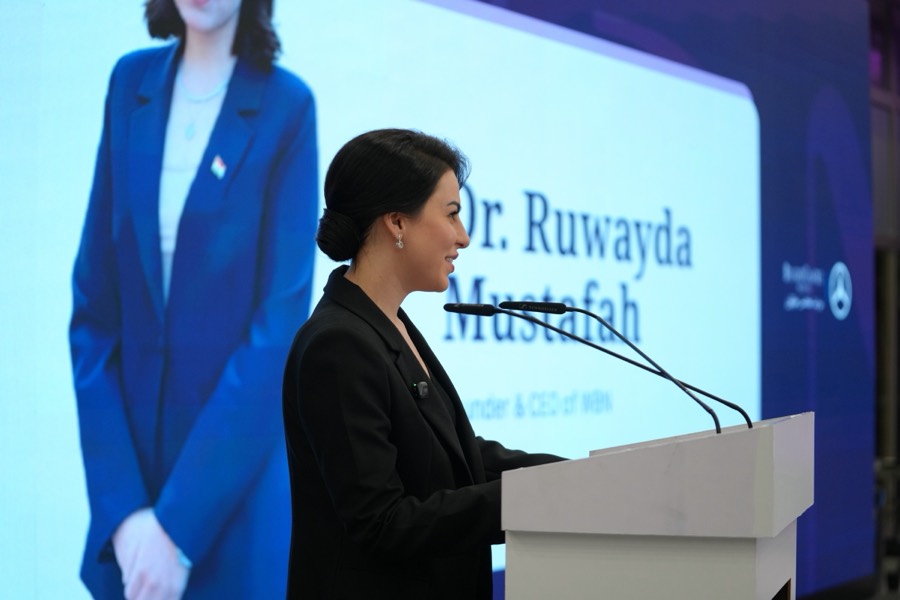
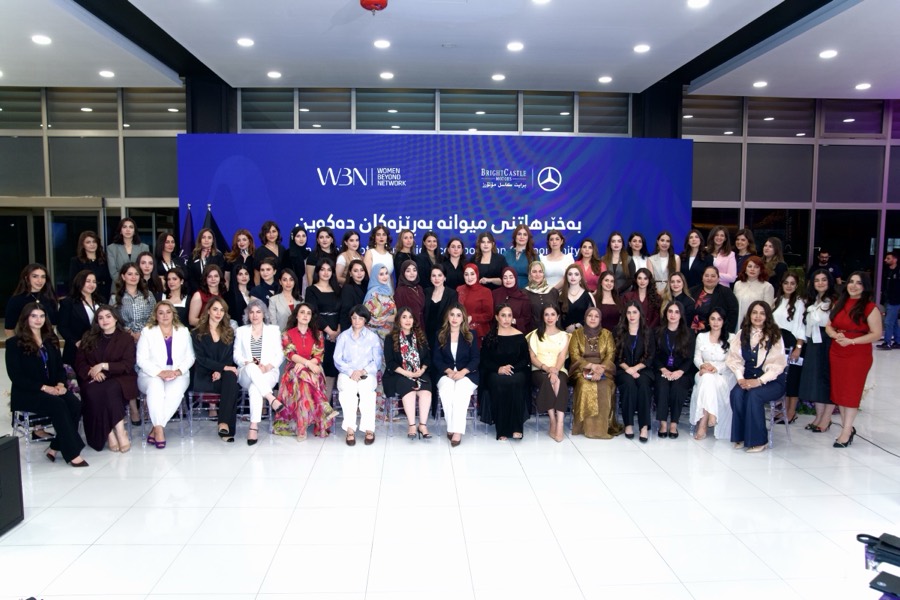
The network also shows gatherings in Slemani and Duhok. At the Slemani reception, held with BrightCastle Motors, Mustafah appears at a lectern, speaking to the assembled guests. The group photograph offers another view of the work: many individuals gathered into one frame, each with a professional life beyond it.
There is a temptation to treat the event photograph as the outcome. The harder question begins after people leave: which conversations continue? Networking offers an occasion rather than a guaranteed result. That is reason enough to pay attention to the design of the occasion, and to the effort of bringing people together repeatedly.
The politics can wait. There is dolma.
Then there are the books. The Magic Pot of Dolma invites young readers to the bazaar with Bêrî and Baban and follows the making of a familiar dish. It is a pleasing change of scale after geopolitical analysis. The ingredients are more tangible. The possibility of a disagreement over the recipe remains.
Mustafah’s description of dolma makes room for household variation: families have their own adjustments and methods. Food offers a way into culture without requiring a child to begin with an explanation of identity. A dish can be recognised, prepared and shared. The story gives readers something to picture before asking them to understand anything larger.
Her bibliography ranges further. There are first words in Sorani-Kurdish, The Three Bears of Kurdistan and From Hewlêr to Hawraman. The titles give language and geography an everyday presence. A place can become familiar through a repeated word or a character’s journey, long before it becomes a subject in a newspaper.
The Adventures of Berivan: From London to Kurdistan appeared in July 2025. Even its title contains a crossing between the two places that recur in Mustafah’s public identity. It offers a smaller reader a route into that geography, at a different pace from a policy essay.
Her earlier A Journey to Kurdistan, published in 2015, belongs to a different register: political argument about gender and opportunity. The range is instructive. An author can address an adult reader about power and a younger reader about a journey without expecting either book to do the other’s job.
Mustafah has described wanting her children to maintain a connection with Kurdish heritage. That supplies a personal purpose for the children’s writing. The question facing a parent is wonderfully concrete: what can I put into a child’s hands? A story is one answer. It can be opened again tomorrow.
Returning to the public argument
The policy writing continues alongside the gatherings and books. In March 2024, Mustafah examined pressures on the Kurdistan Region’s autonomy, including relations with Baghdad and divisions within Kurdish politics. Her argument connected institutional authority to the need for political cooperation. The subject sits close to her doctoral interest in how governing structures hold together.
In June 2026, she returned to cohesion in an essay marking thirty-five years of the Kurdistan Region. Her emphasis was on the consequences of internal division for self-government and external standing. The concern is recognisable across the earlier and later work: institutions require maintenance, and rival political ambitions can place that work at risk.
The following month, she was listed among the speakers for an online discussion of Iraq in a changing Middle East. The format brought her analysis to another audience. Across essays, interviews and professional gatherings, the subject changes; the task of finding a useful way into a conversation persists.
Her career is easiest to appreciate with those differences intact. A child reading about dolma needs a story worth following. A business owner needs someone worth meeting. A political reader needs an argument worth considering. Mustafah’s work keeps moving among them, making introductions on more than one scale.