The clause was only two years long. For Rodrigo Protasio, it separated two substantial chapters of a career. In April 2019, as Marsh integrated JLT in Brazil, the JLT Re executive left the group with a noncompete that restricted him from insurance and reinsurance broking for 24 months. He could advise insurers and reinsurers. The familiar business of placing cover would have to wait.
By October 2021, he was announcing a registration from Brazil’s insurance regulator, Susep, and plans to recruit Gallagher’s first 30 employees for its Brazilian insurance brokerage. A broker who had helped build one operation was helping start another. The interval had an unusually appropriate cause: in insurance, the wording of a contract has consequences.
Today, Gallagher lists Protasio as CEO Retail in Brazil. The title sits alongside country manager Luiz Araripe’s, within a business that combines local teams with international markets. Getting from a Brazilian company’s exposure to someone willing to insure it has occupied much of Protasio’s working life. His second act brought him back to that problem with a different firm’s name on the door.
A surname already in the business
There was a family connection before there was a Gallagher chapter. Protasio’s father, Carlos, was the first president of JLT Re. When Rodrigo’s appointment as executive chairman of JLT Re Brazil was announced in 2014, regional chief Mike Methley specifically recalled the group’s relationship with the Protasio family, dating to 1999. Insurance was a business in which their surname already had a history.
Rodrigo’s own preparation crossed several disciplines. His published biography lists law at PUC-Rio, economics and administration at Universidade Candido Mendes, and a master’s in insurance at IAG PUC-Rio. Contracts, commercial arithmetic and the mechanics of cover all appear in that education. They also recur in his public explanations of what a broker should do.
He founded a brokerage in 1989 that subsequently became part of the JLT business. By the time of his 2019 departure, he had spent three decades in the market. The career had included technical and management work, building a firm and operating inside an international group. Starting again would draw on experience accumulated across those different jobs.
Brazilian risks, international conversations
In January 2008, as Orypaba’s vice-president, Protasio described a business preparing for another phase. The brokerage had represented JLT in reinsurance since 2000 and was looking toward a new JLT Re structure in Brazil. He spoke about international expansion and opportunities extending into Latin America. The ambition depended on connecting a domestic business with markets beyond it.
Orypaba had just appeared among the world’s 20 largest reinsurance brokers in a Business Insurance ranking. Protasio said its business had grown by more than 50 percent in 2007 despite the real’s appreciation against the dollar. His comments paired the achievement with a practical next step: change the operation’s structure to serve clients as the market developed.
Leadership inside JLT added another kind of responsibility. A 2011 restructuring named him vice-president of JLT Brazil Holdings and executive chairman of its reinsurance divisions. In 2014, the group announced his approval as executive chairman of JLT Re Brazil, working with newly appointed CEO Bruno Motta on treaty and facultative business. The terminology is specialized; the underlying task was organizing people around different kinds of risk.
Recruitment was part of that work. When Motta joined JLT Re’s contracts operation in 2011, Protasio emphasized the client and the quality of service. Years later, he would describe Gallagher’s early Brazilian hiring in much the same terms: people who understood the industries their clients worked in.
The return came with a hiring plan
The 2018 Insurance Corp Awards recognized Protasio as Best Reinsurance Broker. By the time the award featured in a 2019 profile, he was reflecting on 30 years in the profession and working as a senior consultant at Orypaba. Recognition for his broking career arrived close to the period when the noncompete required him to work differently.
The Gallagher announcement in October 2021 supplied a concrete return date. Registration had been received, operations were to start that month, and the initial hiring plan called for 30 people. December launch coverage described a business starting with about 250 global clients representing roughly R$300 million in Brazilian premiums. Planned investment in the first years was R$40 million.
initial hires announced when the Brazilian insurance brokerage received its registration
October 2021 announcement; a launch plan, not a current headcount.Those clients gave the operation a starting point. Protasio’s emphasis was on the expertise needed to serve them: energy, oil and gas, marine, agriculture, mining, construction and infrastructure. Each sector brought its own questions about assets, liabilities and interruptions. A recognizable international name still needed people who could understand those questions locally.
The first geographical focus was Rio de Janeiro, São Paulo and Minas Gerais, with expansion toward the South and Northeast envisaged. Araripe led the country operation and the reinsurance business; Protasio led the insurance brokerage. Their responsibilities were connected, and the distinction mattered when describing who was building what.
Buying a business means meeting its clients
On 21 December 2022, Gallagher announced its acquisition of Interbrok Group. The São Paulo broker had been founded in 1976 and served commercial and personal insurance clients across Brazil. Its team would remain in place under Protasio and Araripe. Gallagher did not disclose the transaction’s terms.
Interbrok brought a history of its own into the new operation. An acquisition announcement can make such a change sound instantaneous. The work that follows involves people continuing to serve customers while reporting into a different group. Gallagher’s announcement explicitly retained the team and its location, giving continuity a place in the transaction.
In 2023, Protasio explained another consequence: greater scope to serve individuals. Corporate clients had asked about cover for cars, homes and other personal needs. Interbrok already had an established personal-insurance operation. He described investment and better use of technology as ways to develop it. The executive associated with large industrial risks was also discussing the policies people buy for ordinary possessions.
The international work also had a regional dimension. In June 2023, Protasio described a meeting in Lima to begin assembling Latin American specialty groups, including aviation, marine, construction, energy and mining. He said the initiative would draw on colleagues in other Gallagher markets. His description put shared industry knowledge at the center of the expansion: a local client’s problem could call for experience gathered elsewhere.
A shipyard question with a financial answer
At the first ABEEMAR seminar on financing, guarantees and insurance for naval and offshore construction, in Rio on 7 August 2024, Protasio brought the discussion back to financing. He appeared with Gallagher’s Energy and Marine manager, Moises Neto, and Four Corretora’s Joemir Ramos. The setting connected bankers, industry participants and insurance advisers around the same projects.
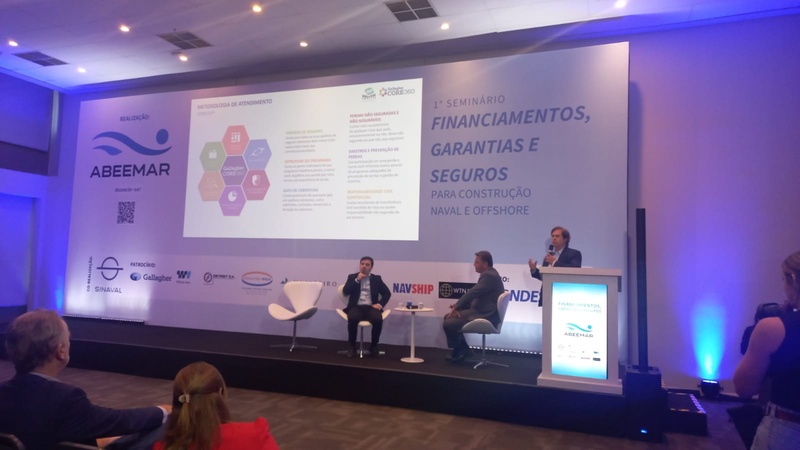
He discussed how insurance and guarantees could help enable investment, including project finance and funding involving the Merchant Marine Fund. He also emphasized the wording of the policy: the scope of cover and its exclusions could affect a company’s future. The financing conversation eventually arrived at the paragraph everyone needed to read.
That argument fits his wider public writing. In a 2022 essay, he connected insurance with infrastructure, digital activity and economic development. His point was about the conditions under which activity can proceed. The insurance adviser belongs in the discussion while a business is making plans, with time to examine the risks those plans introduce.
The search for someone willing to write it
By February 2025, the capacity question was explicit. At Miami Reinsurance Week, Protasio described a Brazilian market needing more companies willing to write large and complex risks, particularly in energy. He estimated that international players accounted for about 70 percent of reinsurance placements. That was his assessment at the time, rather than a current market census.
“We are here this week to find new markets”
Rodrigo Protasio, Miami Reinsurance Week, February 2025
The possible counterparties included reinsurers, managing general agents and global businesses writing both insurance and reinsurance. Miami brought decision makers into reach. After years of corporate changes and new titles, part of the work remained a recognizable broker’s task: find a market willing to consider the client’s risk.
- 01Understand the business
- 02Define the cover
- 03Find willing capacity
An editorial schematic of the work described across Protasio’s public commentary.
The questions before renewal
His more recent public comments return to what happens within the client’s business. In March 2026, he asked managers to examine policy reviews, continuing risk monitoring, sector knowledge and technical claims support. A company grows or changes; its insurance arrangements need attention along the way. Renewal is an opportunity to ask whether the cover still fits.
In September 2026, his LinkedIn activity included energy and logistics risks, wind-generation exposures and Gallagher’s participation at ROG.e in Rio. These are extensions of a longstanding commercial interest: complicated businesses whose risks require close attention. The subjects change as industries develop. The demand for someone who can explain the exposure remains.
Protasio’s career has included founding, integration, a contractual pause and another launch. Across those changes, his public arguments keep returning to the client’s actual operation and the terms under which it can be protected. A title records where he works. The questions he asks before a policy is renewed offer a better view of how he approaches the job.
Keep reading & watching
- Gallagher Brasil
- Current executive team
- Rodrigo on LinkedIn
- Earlier LinkedIn profile
- Watch GallagherCast on YouTube
- 2019 career profile
- JLT departure, April 2019
- Gallagher launch, October 2021
- Interbrok acquisition, December 2022
- FIDES Rio interview, September 2023
- ABEEMAR seminar, August 2024
- Miami interview, February 2025