80+ laws passedFederal survivors' rights act - zero votes against UN resolution co-sponsored by 84 countriesRise Justice Labs: 12 weeks to pass your own law "What Were You Wearing?" shown at the UN, MoMA & DavosFounder nominated for the 2019 Nobel Peace Prize 80+ laws passedFederal survivors' rights act - zero votes against UN resolution co-sponsored by 84 countriesRise Justice Labs: 12 weeks to pass your own law "What Were You Wearing?" shown at the UN, MoMA & DavosFounder nominated for the 2019 Nobel Peace Prize
Civil Rights · Nonprofit · Washington, D.C.

Rise doesn't fight the law.
It writes a better one.

A civil rights organization that teaches everyday people to pen their own rights into existence - and has passed more than 80 laws doing it.

Rise - civil rights organization that changes laws
Rise Now. The brand of a movement that turned one broken rape-kit case into a body of law spanning Congress, 50 statehouses, and the UN General Assembly.
The Dispatch

A survivor walks into a statehouse. She leaves with a bill.

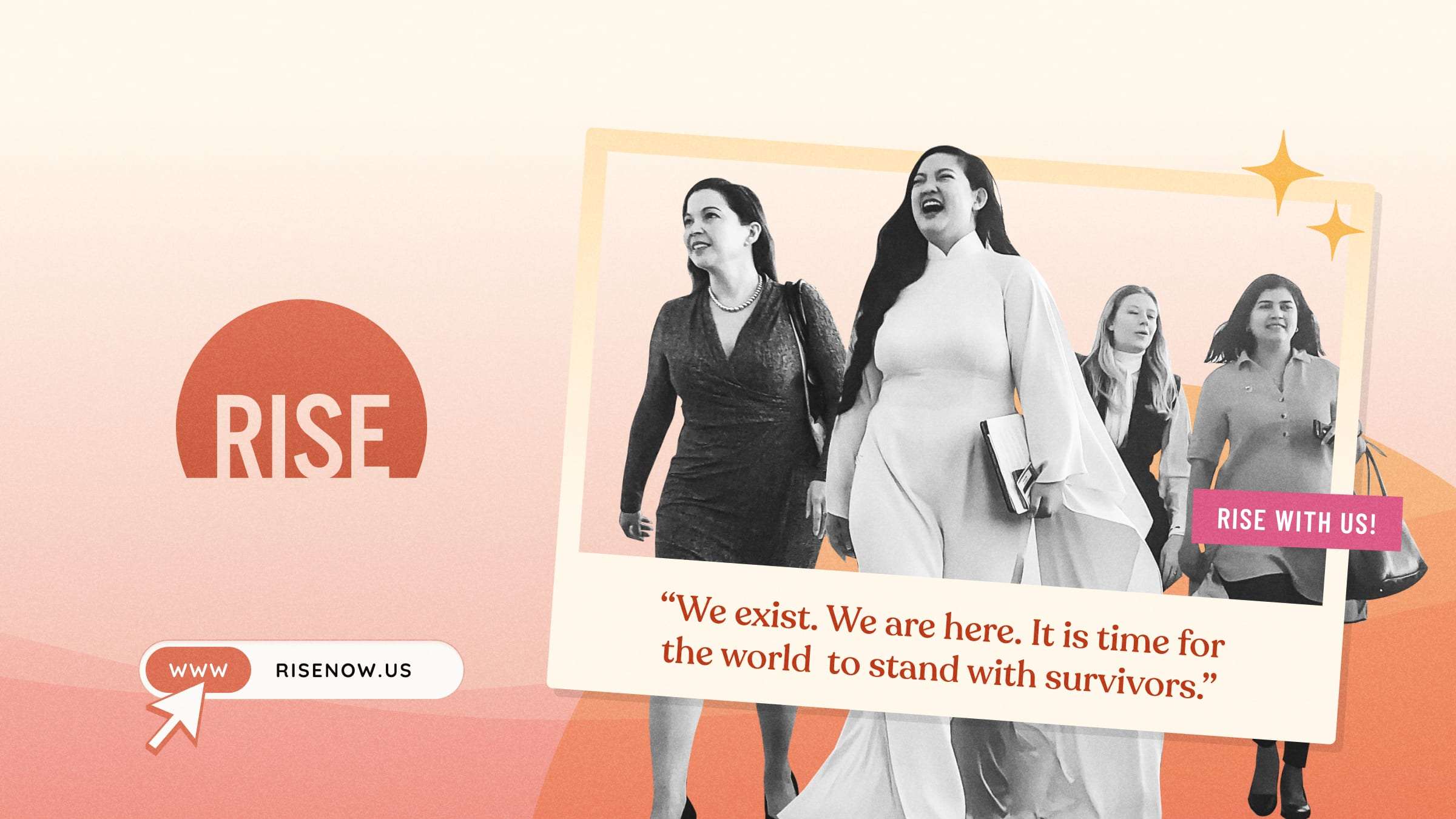
Picture a hallway outside a legislative chamber. A person who was told, not long ago, that nothing could be done - that the system was the system - is holding a folder of language she helped write. In a few minutes a committee will vote on it. This is the scene Rise stages over and over, in capital after capital. It is not a protest. Nobody is holding a sign. The demand has already been translated into the one dialect government cannot ignore: a bill, drafted, sponsored, and ready for a vote.

Rise is a civil rights nonprofit with an unusual product. Most advocacy groups lobby lawmakers. Rise trains ordinary people to become the lawmakers' co-authors. Its founder, Amanda Nguyen, built the organization in 2014 after learning that her own rape kit could be destroyed in six months unless she personally filed to preserve it every half-year - even though the statute of limitations ran fifteen years. She did not write an op-ed about the absurdity. She wrote a law.

The theory of hope, in one line: if you can name a wrong, you can learn to write the right that fixes it.
By The Numbers
80+
Laws passed
84
Countries co-sponsored the UN resolution
0
Votes against the federal bill
2014
Year Rise was founded
The Method

Activism, rebuilt like a startup.

The first law was the proof of concept. In 2016, the Sexual Assault Survivors' Rights Act - drafted with Rise's fingerprints all over it - passed the U.S. Congress unanimously. In an era where the two parties can barely agree on lunch, a survivors' bill of rights cleared both chambers with nobody voting no. That is not an accident of goodwill. It is a method: keep the ask concrete, keep it bipartisan, and hand legislators something they can actually pass.

Then Rise did what a software company does after a successful launch. It shipped the same product everywhere else. The Team Rise campaign carried survivor bills of rights into statehouse after statehouse, iterating the language for local conditions. The tally now runs past 80 laws - a scale that most single-issue nonprofits never touch.

One survivor. One broken system. Then a federal law, dozens of state laws, and a UN resolution. Scale looks different when the product is justice.

The most durable thing Rise built, though, is not any single statute. It is Rise Justice Labs - a 12-week accelerator that treats lawmaking as a teachable craft. Participants learn to draft legislation, build coalitions, meet with lawmakers, pitch journalists, and run a winning campaign. They graduate with mentorship and roughly $5,000 in seed funding to go pass their own law. Cohorts have already put more than twenty laws for survivors on the books. Rise took the thing that felt impossible - changing the law - and turned it into a curriculum.
What Rise Builds

Five instruments, one purpose.

Legislation

Survivors' Rights Act

The federal survivor bill of rights Rise drafted and passed unanimously in 2016 - guaranteeing rights like preserving a rape kit and knowing its status.

Accelerator

Rise Justice Labs

A 12-week program that trains survivors and allies to write bills, build coalitions, and win - with mentorship and seed funding to launch a real campaign.

Exhibit

"What Were You Wearing?"

A traveling exhibit that dismantles victim-blaming. It has appeared at the UN, MoMA, WEF Davos, the WHO in Geneva, and the Brussels Parliament.

Culture

Survivor Fashion Show

A New York Fashion Week runway - hosted at MoMA - where survivors and allies walk to reclaim bodily autonomy and rewrite whose story gets told.

"Our mission is to help anyone with the vision and drive to pen their own rights into existence."

- Rise, on its theory of hope

The Record

From a Harvard hallway to the General Assembly.

2014

Rise is founded

Amanda Nguyen starts Rise after learning her rape kit could be destroyed in six months - turning a personal injustice into a civil rights organization.

Oct 2016

Congress passes the Survivors' Rights Act

The federal survivor bill of rights clears the U.S. Congress unanimously - zero votes against.

2019

Nobel Peace Prize nomination

Amanda Nguyen is nominated for the 2019 Nobel Peace Prize for the movement's work.

2021-22

Survivor Fashion Show at MoMA

Rise stages its NYFW runway, reclaiming the question "what were you wearing?" in front of the fashion world.

Sep 2022

A historic UN resolution

After six years of diplomacy, the UN adopts resolution A/76/L.80 recognizing survivors of sexual violence in peacetime - co-sponsored by 84 countries.

2025

A founder goes to space

Amanda Nguyen publishes the bestselling memoir "Saving Five" and flies on Blue Origin's NS-31, becoming the first woman of Vietnamese heritage in space.

Marginalia

Things worth dog-earing.

Zero. The number of votes against Rise's federal survivor bill of rights - a near-mythical outcome in modern Congress.
1.3 billion. The estimated number of survivors of sexual violence the UN resolution speaks for.
169 lotus seeds. Carried from Vietnam's National Space Center on the founder's 2025 spaceflight.
$5,000. The seed check every Rise Justice Labs graduate takes home to pass their own law.
Nobel + astronaut. Two resume lines rarely seen together, both belonging to Rise's founder.
Hope-a-nomics. Rise's name for treating hope not as a mood, but as a curriculum you can learn.
The Return

Back to the hallway.

Return to that corridor outside the chamber. The person with the folder is not waiting for permission anymore - she is holding the language she wrote. When the committee votes yes, the hallway does not erupt. That is the quiet tell of what Rise actually changed: the outcome stopped being a surprise. A system that once told survivors nothing could be done now routinely does the thing, because someone learned the moves and passed them on.

That is the whole product. Not a march that ends, but a skill that spreads - a way of turning a private wound into public law, and then teaching the next person to do it too. Rise didn't just change one rule about rape kits. It changed who gets to write the rules.

You don't need a law degree to change the law. Rise will teach you the rest.