A bank gave Ricardo Villadiego a month. Then another month. For the first six months of the relationship, his young cybersecurity company had to keep earning its place. The contract could be renewed; confidence could not be invoiced in advance. For a software entrepreneur in Bogotá trying to persuade financial institutions to trust a local product, this was the arrangement available. He took it.
There is something pleasingly literal about that beginning. Years before he built Lumu around the continuous measurement of security, customers were continuously measuring him. A working product bought another month. Eventually, those tentative arrangements became contracts lasting years. The distance between the two was a series of promises kept, with very little room for an impressive presentation to do the work of functioning software.
Today, Villadiego is the founder and CEO of Lumu Technologies, based in the Miami area. His earlier company, Easy Solutions, joined Cyxtera in 2017. Those are the neat entries on the résumé. The less tidy story involves a teenager moving cities, prototypes financed with savings, old professional friendships, and the discovery that software needs to learn the local customs almost as much as its salesman does.
A teenager goes inland
Villadiego grew up in Cartagena, on Colombia’s Caribbean coast. At 15, he moved to Bogotá by himself to study engineering. He attended Universidad Distrital Francisco José de Caldas, earning a degree in electronic engineering. His student years included early walks from his uncle’s home in Ciudad Tunal to the university. Long before international airports became part of his working life, getting to class supplied the mileage.
Unisys provided an entry into professional computing through its relationship with the university. He worked there while studying and moved into a full-time position after graduating. One early assignment involved writing software for ATMs as their communications moved to TCP/IP. He saw a security problem forming inside a useful technical change: connecting things would create new ways to reach them.
That work led him toward Unisys’s security practice, then Internet Security Systems and IBM. The trajectory matters because his interest in security began close to the machinery of banking. An ATM driver is an unglamorous object around which to construct a career. It is also an excellent place to learn that convenience and exposure can arrive in the same software update.
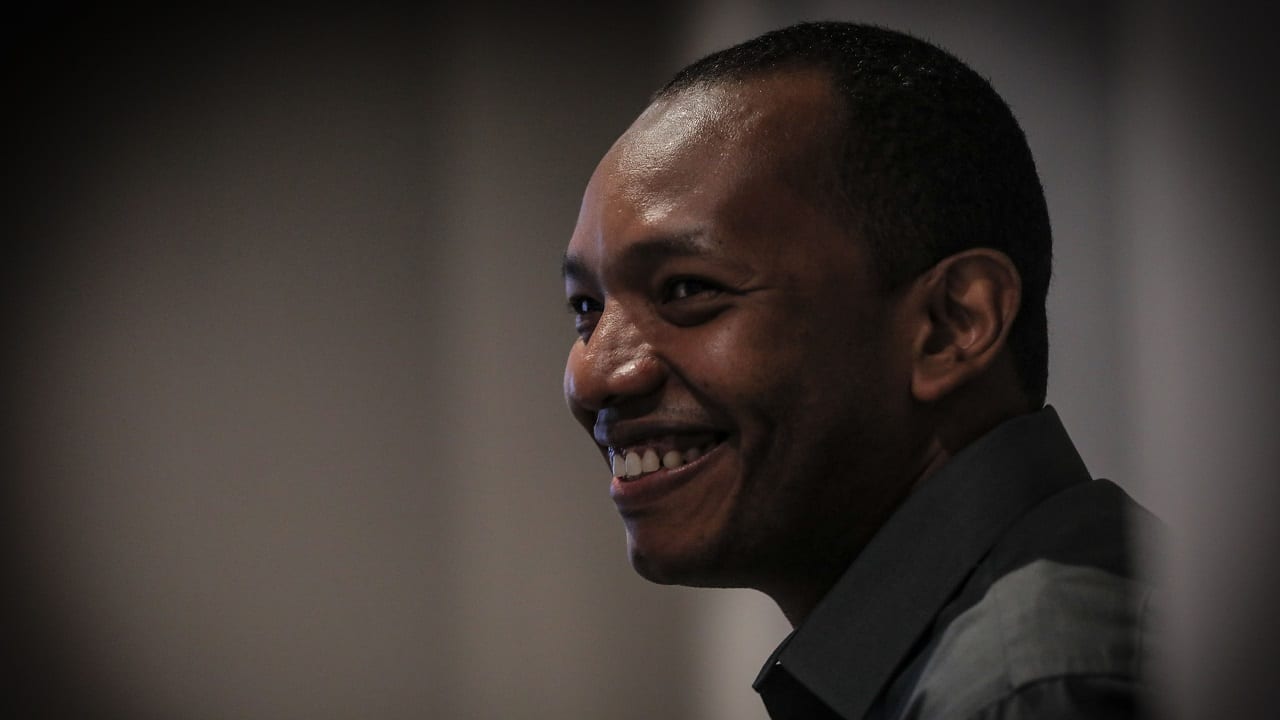
The bank would like another month
Easy Solutions began with people he knew well: his wife and his best friend from university. Before he joined the business full time in 2009, the founders spent years exploring technical approaches. A research and development leader built prototypes. The money came largely from their own savings, supplemented by credit cards. Patience had a very practical meaning when the experiment was appearing on a personal statement.
The company focused on electronic fraud. Villadiego’s complaint was that identifying a fraudulent transaction often meant discovering the problem near the end of its journey. The attacker had already prepared, launched and advanced the scheme. Easy Solutions built its Total Fraud Protection Platform to address more of that sequence. Looking earlier in the chain became a recurring habit in his work.
Early feedback came from a handful of customers, no more than five during the validation stage. Professional relationships helped open those doors. People Villadiego had met while writing code years earlier had risen through their own institutions. Some were now senior executives. An old colleague could offer a conversation, a trial, or a candid account of what failed. The address book had quietly matured alongside the product.
Access did not erase the credibility problem. Banks were accustomed to buying from established technology suppliers. A small Colombian company asking to protect financial transactions had an extra argument to win. Month-to-month agreements let clients test the claim without committing for years. His first customer signed in May 2009, a few months after he began working at Easy Solutions full time.
Raising money in the United States during the financial crisis proved difficult. An investor he knew in Atlanta suggested a different route: raise locally, demonstrate the business, and return later. He followed that advice. Progressive Capital in Medellín backed the company in 2010. Latin America supplied both the initial customers and the capital with which to serve more of them.
“I believe the management team is a huge part of taking a company global.”
Ricardo Villadiego, 2014
Miami is a working distance
By the end of 2010, Easy Solutions had around 40 customers and roughly $1.2 million in revenue. The customer count reached 80 in 2011. For the next stage, Villadiego recruited former Internet Security Systems colleagues in the United States before securing another financing round. Their willingness to join gave him a useful test: would experienced people elsewhere bet their own careers on this company?
Manny Medina became an important backer through Medina Capital, which invested $11 million. Expansion brought sales coverage across the United States and an innovation center in Atlanta. Miami held the corporate headquarters; Bogotá remained the research and development center. By mid-2014, Villadiego described a business with 320 customers and about 80 people in Bogotá.
That arrangement gave Miami a purpose beyond an attractive pin on a map. It kept him within reach of Colombian engineers and US commercial operations. There were different jobs for different places: product management in Atlanta, development in Bogotá, coordination through Miami. A global company still had to work out who could speak to whom before the afternoon disappeared.
The exit leaves a question
The 2017 Cyxtera transaction gathered several businesses and assets into a deal valued at $2.8 billion. Easy Solutions was one component. Villadiego subsequently led cybersecurity operations there. The large number can overwhelm the smaller, more interesting decision that followed: he returned to building a company because an unanswered security problem was still bothering him.
He had been examining how substantial companies with serious security budgets could suffer breaches. Spending was rising. Intrusions persisted. Lumu, founded in 2019 and introduced publicly at the RSA Conference in February 2020, grew out of his effort to make compromise something a company deliberately and repeatedly measures.
Its raw material is network metadata: records such as DNS queries, network flows and firewall or proxy logs. Lumu collects and standardizes those traces, then correlates them with threat intelligence to identify compromised assets. The conceptual attraction is straightforward. An adversary that communicates creates evidence. The difficult engineering sits between having that evidence and giving an operator a conclusion worth acting on.
- Read the tracesCollect network metadata
- Establish contextCorrelate with threat intelligence
- Find the compromiseIdentify affected assets
- Put defenses to workConnect detection to response
The commercial proposition also reflects a founder who has sold complex systems before. Security teams already own tools. Lumu works with that equipment to connect discovery and response. Forgepoint Capital backed the business in its $30 million Series B in September 2023, with Leo Casusol joining its board. A company built around examining evidence now had another set of investors examining its own.
Different country, different product
Crossing borders had taught Villadiego that a technical problem can look similar while the customer’s working conditions differ. Easy Solutions had needed to adapt technology for US buyers. With Lumu, he deliberately put the product in front of the US market from the beginning. That choice made international demand part of development rather than a later translation project.
He has also described how labor costs influence software. Where adding people is relatively inexpensive, a product’s awkward gaps can be bridged by more human work. Where labor is expensive, customers push harder for automation. This is an engineer’s observation with a salesman’s consequences: a feature that seems optional in one market can decide the purchase in another.
His public writing has a corresponding impatience with cosmetic innovation. In a late-2024 post, he compared repackaged old technology to an aging car given new paint and sold as the latest model. It is a sharp image from someone whose own industry has never suffered a shortage of newly polished nouns.
More context, fewer windows
Lumu acquired Spain-based Maltiverse in March 2025, adding threat intelligence capabilities and a foothold for European expansion. The move extended the original question. Finding a suspicious connection is useful; understanding the infrastructure and actors around it can make the next decision better informed. The acquisition’s financial terms were not disclosed.
The same year, a partnership brought Maltiverse intelligence into Wazuh. In August 2026, Lumu announced an integration with CrowdStrike Falcon Next-Gen SIEM. The goal was to place network compromise information beside endpoint and other security data, helping analysts investigate without continually switching applications. The ambition has an almost domestic modesty: put the things people need within reach.
Villadiego’s recent essays carry that operational concern beyond large enterprises. In July 2025, he argued for stronger defenses for smaller businesses. In May 2026, he wrote about AI-assisted protection for critical infrastructure, including utilities and transport. Both arguments return to the practical limits of small teams expected to watch increasingly complicated systems.
He remains an avid reader and a curious technologist, but his career offers a more specific description of curiosity: following an inconvenient observation until it becomes work. A connected ATM raised a security question. A fraud transaction prompted him to look further back. A successful exit left room for another investigation. From those first monthly bank contracts to Lumu’s continuous assessment, Villadiego keeps returning to the same discipline: show what is happening, then earn the next decision.