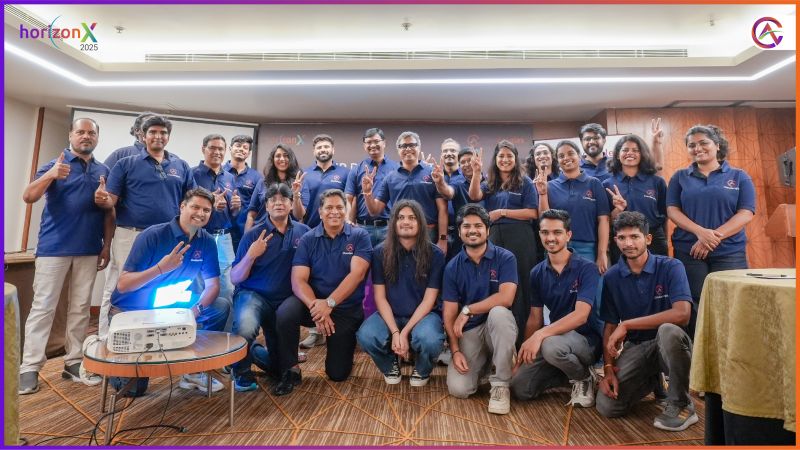
At a Cloudangles leadership meeting in 2025, the teams had something to assemble besides a business plan. They built bicycles. Then came the part Revathipathi Namballa remembered: the bicycles would be given to children, who arrived to collect them. A strategy exercise had acquired actual wheels, and an audience with a rather practical interest in the result.
Namballa described the surprise and delight in a post about HorizonX, the company's annual leadership gathering. There had been sessions on growth, innovation and storytelling, too. Yet the bicycles supplied the scene. For a chief executive whose working life has included software, infrastructure, product engineering and company building, it makes a useful opening image: eventually, someone has to use the thing you have assembled.
The bicycle episode offers an unusually concrete way into a career spent assembling businesses and technology. His own public language tends toward services strategy, operating models and business outcomes. He is known professionally as RP. The initials are considerably easier to fit into a meeting invitation, though the work behind them has rarely fitted into a single job description.
A founder who had already been a founder
Cloudangles was not his first encounter with starting a company. He founded eMcredible Mobile Solutions, which was acquired by Fortify. Fortify was subsequently acquired by Mphasis. The sequence matters because it puts entrepreneurship inside his career well before his current title. His route to Cloudangles passed through both building a business and working within larger technology organizations.
His education links Andhra University, where he earned a master's qualification in computing, with executive leadership study at the Indian School of Business. The latter included programs in 2018 and 2019 covering strategic thinking, innovation, and personal and organizational leadership. Technical education and management education appear here as separate chapters, undertaken at different points rather than squeezed into a tidy origin myth.
At Mphasis he held responsibilities in shared services, product engineering and solutions strategy. Innova Solutions and Zensar followed among his senior appointments. His responsibilities mixed customer conversations with product roadmaps, partner selection and the economics of delivering infrastructure services. These are jobs in which a promising technical idea has to survive a budget meeting.
One Mphasis assignment involved MOATIS, an infrastructure monitoring and management platform. The role involved evaluating competing tools, examining why bids were lost, deciding what to build and what to integrate, and putting together a product engineering team across locations. It is a more revealing detail than another executive title: software was already something to combine with services, price and take to customers.
There is also a research credit in the record. The 2012 IEEE Intelligent Transportation Systems conference program lists him, then affiliated with Mphasis, among the authors of a paper on mobile, event-activated vehicle tracking in urban environments. Its co-authors were Ramakrishna Srinivasa, Samar Agnihotri and Prem Jadhupathi. The paper concerned a functioning prototype for tracking mobile assets. It adds a technical collaboration to a career otherwise easily reduced to a succession of management roles.
The conference took place in Anchorage, Alaska, and the paper appeared in a session on intelligent transportation implementations. Its collaborators brought affiliations from Intel, the Chinese University of Hong Kong and Mphasis. The problem connected location tracking with the practical limits of infrastructure costs and deployment.
Build the platform. Organize the delivery. Explain the business case.
An editorial reading of his product-engineering and services roles.Before AI, there was the awkward cloud question
In May 2019, Namballa appeared in a Zensar announcement about its work with Nutanix. His title was vice president and global head of the Solution Design Center for Cloud and Infrastructure Services. The customer request he described was straightforward enough: a consistent experience across private, hybrid and public cloud, with freedom to move workloads as business needs and costs changed.
The date matters. Long before the present conversation about autonomous agents, he was talking about what happens when an enterprise has several environments and would prefer them to behave like a coherent system. The announcement concerned an offering combining Nutanix technology with Zensar's Vinci automation platform. Integration was part of the proposition, as was keeping the cost of operating the result under control.
His published writing also visits the less glamorous rooms of enterprise computing. In 2016 he wrote about transition planning and the treatment of non-production environments. In 2019 he published an article on emotionally sentient agents. The subjects span operational discipline and questions about human interaction with machines. They establish a chronology of interests without requiring a claim that he predicted everything that followed.
More recently, a Cloudangles article under his name explains continuous integration and delivery for microservices. Its recommendations include separate pipelines, automated tests, monitoring and feedback. There is something reassuringly workmanlike about the list. The CEO discussing AI also spends time explaining how to ship smaller pieces of software without losing control of the whole.
The business case comes back around
At Cloudangles, Namballa's remit covers executive leadership, operations and business direction. The company combines its own platforms with engineering services. Its portfolio covers data engineering, AI operations, cloud cost management, testing and process automation. The products have distinct jobs; the customer still has to make them work within an existing organization.
One of his statements about that ambition gets directly to the point: “We don’t just build proofs of concept”. The useful word is “just”. A prototype can establish that something works under particular conditions. The harder commercial question concerns what happens when the system meets live workflows, ongoing costs and people who already have a job to do.
“We don’t just build proofs of concept”
Revathipathi Namballa
Cloudangles' platform approach gives this argument a concrete form. Dangles addresses data work; mlangles addresses the management and deployment of AI and machine-learning systems; Cloudoptimax addresses cloud costs. Codebenders and Testingaide bring AI into software creation and testing. It is an attempt to place reusable software alongside the services needed to adopt it, rather than leaving every engagement to begin with an empty workbench.
That approach has an antecedent in his earlier product responsibilities. The earlier work offers a point of comparison for the current company. His career repeatedly puts him near the same negotiation: what can a platform do repeatedly, what requires an engineer, and how does the customer decide the combination is worth paying for?
Fourteen new starters, then a much larger target
The people involved are more visible in Namballa's public posts than a product list might suggest. In 2024 he welcomed 14 campus hires from institutions including BITS Pilani Hyderabad, NIT Warangal, KMIT and CBIT. He emphasized fresh perspectives and work on real projects. It was a specific cohort, with a manageable number attached to it, entering a company that wanted to put their skills to use.
The hiring horizon became considerably larger in August 2026. Cloudangles opened a Global Engineering Centre in Hyderabad on August 11, with a stated plan to scale it to 1,000 engineers over two years. Telangana IT Minister D Sridhar Babu attended the inauguration alongside Namballa. The number describes an ambition for the centre, rather than a count of people already at their desks.
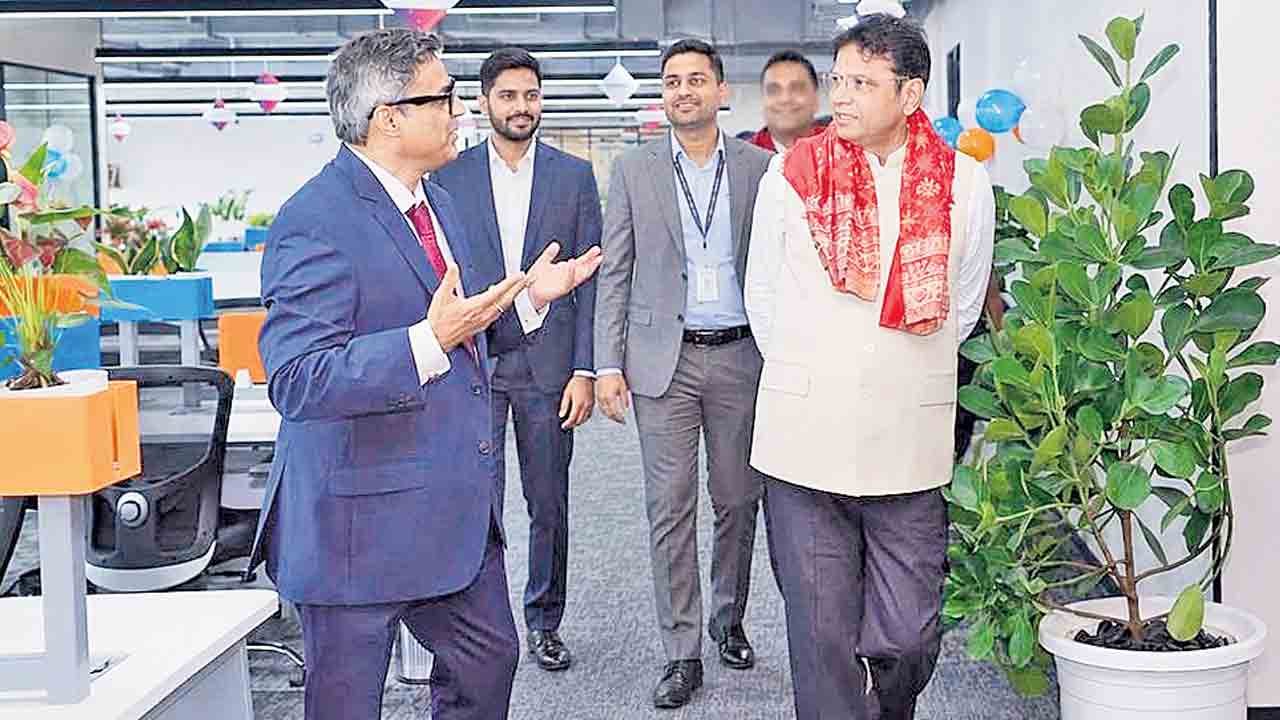
The announced remit includes application engineering, analytics, AI, automation and specialist corporate functions. Namballa has described the broader ambition as helping capability centres become places that create business value. Hiring, in that account, comes with an argument about what the hired teams should accomplish. The proposed organization needs both specialized skills and a reason for those skills to be assembled together.
The Hyderabad centre's announced two-year scaling target, following its August 2026 opening.
Future target - not current headcount.A longer horizon, with colleagues in the picture
The company's quantum initiative, Qangles, extends the range of that work. In June 2025 Namballa used a post from the AI World Conference in London to invite conversations about enterprise adoption of data, AI and quantum platforms. He named the products he was there to discuss and the UK and European markets he wanted to engage. The invitation was specific: meet at the booth and explore a collaboration.
A New York AI Summit post in 2023 struck a similar note. He thanked visitors who had discussed possible uses for mlangles and proposed continuing those conversations after the event. Read together, the conference posts show an executive taking platforms into customer discussions across markets. They also supply a more ordinary view of international expansion: a booth, questions, follow-up work, and a team expected to carry the conversation forward.
His geographical reach has since acquired another formal marker. In September 2026 he was appointed a director of Cloudangles UK Ltd. It is a corporate appointment, with a date and a jurisdiction, rather than a forecast about future market share. Alongside his California base and the Hyderabad engineering operation, it adds another point to an increasingly international working map.
The leadership surrounding him includes Srinivas Manem as CTO and country head, Deepshikha Sharan as chief strategy officer, and Steve Rubin as chief channel officer. Their different remits give the company more dimensions than the founder's biography alone can carry. Engineering, strategy and routes to market all need owners. A chief executive's plan becomes more tangible when other people have responsibility for its parts.
That brings the story back to the bicycles. Namballa chose to recount a moment when a group assembled something together and then saw who it was for. Cloudangles now has a much more complicated assembly job ahead, from enterprise platforms to a growing engineering centre. The scale has changed. The practical question in the room remains a good one: who will use what we have built?