At some point during a Saturday evening, a small public company appears on television. Its ticker sits at the bottom of the screen. An executive explains the opportunity. Thirty seconds pass, or perhaps a sponsored interview runs longer. On Monday morning, somebody types the ticker into Google. Somebody else opens a brokerage app. The company has not discovered a new mineral deposit or received regulatory approval over the weekend. It has simply become visible.
That moment is the product RedChip Companies has spent three decades learning to manufacture. From an office and production studio in Maitland, just north of Orlando, the firm helps microcap and small-cap businesses tell their stories to retail investors, brokers, family offices, portfolio managers, and anyone still willing to look below the familiar names. The work spans research reports, investor decks, press releases, roadshows, conference calls, webinars, social media, commercials, and Small Stocks, Big Money, RedChip's paid weekly television program.
RedChip calls itself an investor-relations, media, and research company. That description is accurate but incomplete. Its real specialty is packaging. A chief executive arrives with a complicated business and a thinly traded stock. RedChip turns the thesis into a collection of repeatable objects: the crisp fact sheet, the practiced interview, the broker call, the email, the 30-second spot. One idea, many doors.
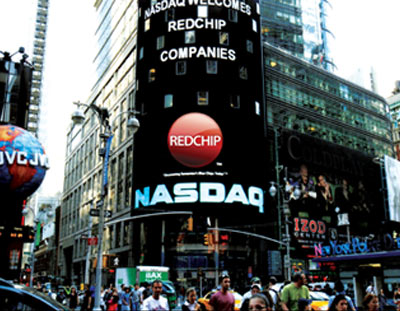
The company began with research. The market asked for distribution.
Dave Gentry founded RedChip in 1992 as an independent small-cap research firm. The early proposition was familiar: find promising companies before the market does. RedChip says its researchers spotted emerging names including Starbucks and Apple. But the business gradually followed a more practical discovery. Analysis is useful only if somebody encounters it.
So the research shop widened. It organized conferences. It built investor lists. It added digital campaigns and direct calls. In 2012, Gentry launched a weekly financial television show, turning the founder into an interviewer and the office into a studio. Today the company says it has served more than 1,000 public businesses. Its LinkedIn profile lists more than 70 current emerging-growth clients across biotech, mining, energy, technology, consumer products, drones, education, and crypto.

The clever move was not abandoning research for media. It was making the same research travel farther.YesPress analysis
The target customer is not hard to recognize. It is the public-company CEO with legitimate operations, a market capitalization too small for broad analyst coverage, and a shareholder register that never seems to change. The problem feels like valuation. Often it begins as obscurity. RedChip's competing alternatives include a specialist IR agency, an internal communications hire, a conference organizer, a video shop, and an ad buyer. Its difference is that it puts those functions under one roof.
The receiptWhat, exactly, does attention cost?
Investor relations is usually described in misty terms - awareness, engagement, visibility. RedChip is unusually legible because public companies disclose what they pay. In one 2021 agreement, Obitx hired RedChip for $12,500 a month plus 75,000 restricted shares upfront and another 25,000 shares subject to approval after six months. The bundle included strategy, collateral, television interviews, a CEO video, quarterly articles, webinars, social help, and a landing page.
More recent agreements often show an $8,500 monthly cash fee, sometimes paired with stock or options. Gorilla Technology also disclosed two separate $50,000 payments for ten-day national television campaigns. An academic working paper examining 57 RedChip client firms between May 2023 and December 2024 calculated an average monthly awareness fee of $8,592. The average television campaign cost $41,302 and lasted 16 days.
The public price card, reconstructed
These are historical disclosed averages, not a current RedChip rate card. Individual contracts vary and may include equity.
The equity matters. RedChip's newsletter disclosures can say both that an issuer is a client and that RedChip intends to sell shares received as compensation once restrictions lift. That plain language performs important work. Paid issuer media is not ordinary newsroom coverage, and the reader should never have to guess which kind they are watching.
The testTelevision moved first. Then the effect wore off.
The same study offers a rare look at what failed first. Broad investor-awareness programs were not associated with statistically significant increases in returns or trading volume. Podcasts and virtual conferences also showed no significant market reaction. Television was the exception.
While campaigns ran, the researchers measured daily excess returns of roughly 1.8 percent and a 90 percent increase in turnover after controls. Around individual broadcasts, reactions were almost immediate. Bloomberg exposure was associated with an excess return of about 1.5 percent and a volume burst around 60 times the pre-broadcast level; CNBC spots produced smaller but still visible reactions. Google search activity rose, pointing to retail attention. Institutional attention did not move in the same way.
Which channel registered a significant market reaction?
Directional summary of statistical significance in the 2025 working paper, not a comparison of absolute audience size.And then came the uncomfortable part: after the TV campaigns ended, the stock-price gains fully reversed within 60 days. Attention was real. Permanence was not.
Visibility can open the door. It cannot make the business on the other side better.The boundary of the model
This is not an argument that investor relations does nothing. For a thinly followed company, liquidity, search activity, clearer materials, and access to new investors are useful. RedChip clients also hire the firm for meetings, financing introductions, conference-call support, and communications discipline - outcomes a stock chart cannot neatly capture. But the study draws a bright line between creating a moment and creating lasting value.
The copyable partBuild one argument, then make it travel.
The RedChip playbook is most useful when stripped of its airtime and contact database. First, compress the business into one defensible value proposition. Second, translate that proposition for different levels of attention, from a 30-second commercial to a 30-minute interview. Third, combine broadcast reach with direct conversations. Repetition is not laziness here. It is the mechanism.
The conditions matter. This approach is better suited to public companies with real milestones, clean disclosure, enough liquidity to absorb interest, and management capable of answering hard questions. It is weaker when the underlying proposition changes weekly, when promotion outruns evidence, when financing pressure is the only catalyst, or when a company mistakes a temporary price reaction for a durable shareholder base.
Do not buy a media campaign to discover your story. Discover the story first. Television is a multiplier, and multipliers are indifferent to whether the original number is good.
RedChip's own history suggests what changed its mind. It began by finding overlooked companies. It grew by noticing that being right in private was commercially weaker than being understood in public. The resulting company belongs to several markets at once: financial communications, paid media, research, investor access, and capital formation. That messiness is the advantage. A chief executive does not have to assemble five vendors and teach each one the same vocabulary.
There is something wonderfully literal about the business. RedChip takes the smallest listed companies and puts their symbols on the biggest screens it can find. Sometimes the market looks up. The hard part begins after it does.