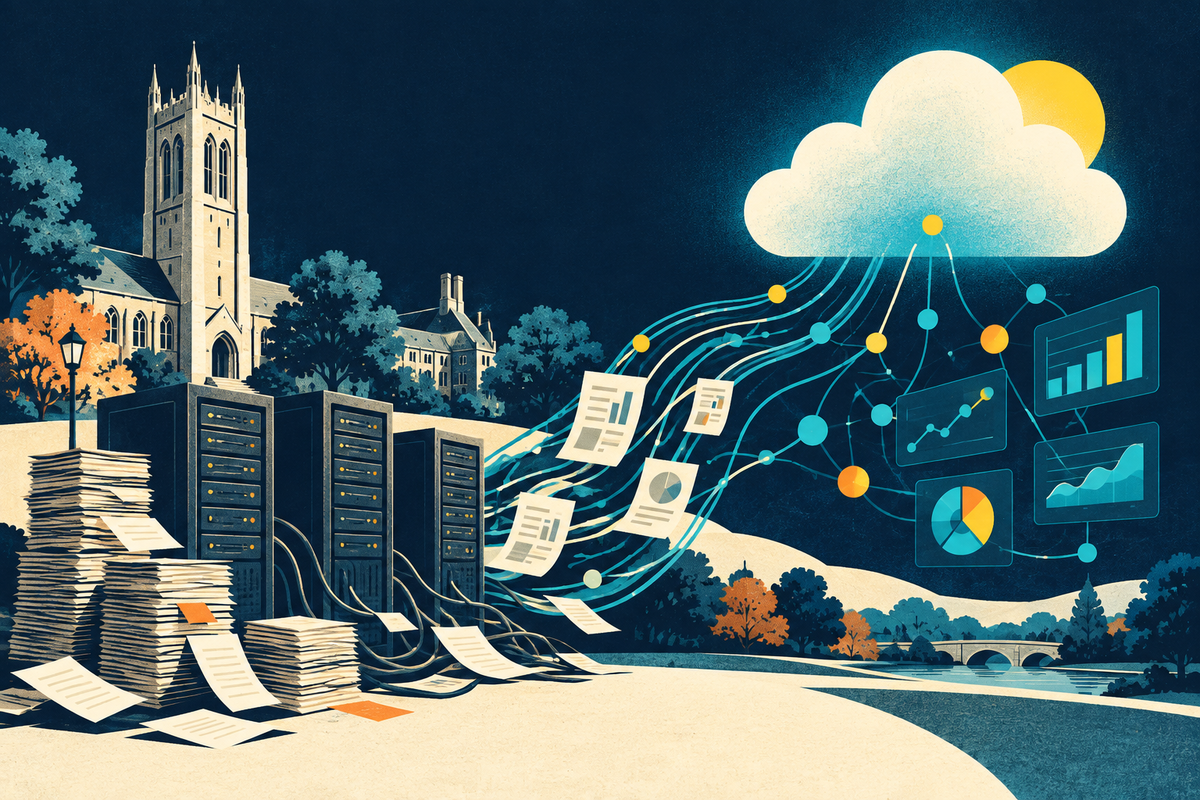
The queue behind every question
A university can have plenty of data and still make people wait for answers. That was the bind at the University of Massachusetts. Its aging on-premise analytics platform carried rising maintenance costs, required recurring upgrades, and kept routine reporting concentrated in the hands of technical staff. A request that should have been ordinary could join a queue. The people who understood enrollment, finance, operations, and student services could ask the questions, but they could not always explore the answers on their own.
That is the quiet tax of legacy infrastructure: not merely old hardware or a looming support deadline, but lost momentum. Every manual pull steals time from the technical team. Every delayed report slows a decision elsewhere. Across a multi-campus university serving more than 70,000 students, those small waits can multiply quickly. UMass needed a modern analytics environment with better visualization and wider access. It also needed to keep the institution running while thousands of users changed how they worked. The goal was not a dramatic cutover. It was an uneventful one.
Cloud was the destination, confidence was the project
UMass chose Oracle Analytics Cloud, or OAC, as the next platform and brought in Pythian to move its legacy Oracle Business Intelligence Enterprise Edition environment. On a diagram, the assignment sounds tidy: migrate the analytics layer, reconnect the data, train the users. In practice, each verb contains a risk. Existing reports and Web catalogs have years of institutional memory embedded in them. Security standards cannot relax because the destination is newer. And a technically correct platform can still fail if the people who need it do not trust it.
Pythian began with a proof of concept. Before committing the whole system, the team tested whether OAC fit UMass requirements for security, usability, and scale. This is an unglamorous move with an important payoff: it converts a high-stakes bet into a sequence of questions that can be answered early. Does the architecture fit? Can the networking remain secure? Will the user experience support the work people already do? The pilot made those questions concrete and let the university validate the path before the migration gathered speed.
Do not automate only the move; automate the evidence that the move worked.Quality assurance
Automate the anxiety out of migration
The most fragile part of a business-intelligence move is often not the new interface. It is the long tail of existing assets: reports, dashboards, permissions, calculations, and catalog structures that users rely on without thinking about them. Checking that estate by hand is slow, inconsistent, and hard to repeat. Pythian used proprietary regression-testing tools to audit and migrate OBIEE artifacts and Web catalogs automatically. Automation compressed the quality-assurance cycle and made it possible to compare behavior systematically rather than leaning on memory and spot checks.
This is one of the clearest ideas other organizations can borrow. A migration earns trust when teams can show what was tested, what matched, and what needs attention. That repeatable proof helped UMass target zero downtime for active users. The transition happened in two adoption phases rather than one theatrical leap, giving the team room to verify the system and keep daily operations intact. The cloud mattered, but controlled change was the real product.
Prove
Validate security, usability and scale before full deployment.
Automate
Test reports and catalogs with repeatable regression tooling.
Connect
Bridge the cloud securely to the existing data warehouse.
Teach
Build confidence through training designed for each role.
A bridge, not a bonfire
Modernization did not require UMass to discard every system it already had. Pythian configured the cloud environment and established secure network connections back to the university’s on-premise data warehouse. That hybrid design preserved the data foundation while moving analytics consumption into a more scalable environment. It also consolidated access to data drawn from multiple campuses without forcing a simultaneous rewrite of the entire institutional stack.
This is a practical pattern for large organizations. Legacy systems are rarely a single object that can be lifted away. They are layers of dependencies built over years, some obsolete and some still useful. A secure bridge lets an institution modernize where the pressure is greatest while sequencing deeper changes over time. For UMass, the immediate pressure sat in the reporting layer: maintenance was costly, the software was approaching end of life, and centralized requests were creating backlogs. Connecting OAC to the existing warehouse addressed that pressure without turning the project into an all-or-nothing replacement.

Train the job, not the crowd
The technology could remove a reporting bottleneck only if people learned to use it. Pythian paired the technical migration with a two-phase adoption program and three customized training tracks. Administrative users, technical teams, and end users did not receive one generic tour. Each group learned the platform through the work it was expected to perform.
That distinction sounds simple, but it is where many transformation projects lose their audience. A system administrator needs to understand controls, integration, and failure modes. An analyst needs to build and test views. A departmental user may need to filter a dashboard, answer a recurring question, and share the result. When all three sit through the same demonstration, most of the room spends most of the time waiting for relevance. Persona-based training treats adoption as product design: start with the user’s task, then show the shortest trustworthy path to completing it.
UMass completed three platform training courses across the program. According to the university’s vice president and chief information officer, the tailored instruction made onboarding seamless while the migration caused no disruption to ongoing operations.
Pythian’s Oracle experts guided our team through tailored training courses, making our onboarding seamless and ensuring zero disruption to our ongoing operations.Vice President & Chief Information Officer · University of Massachusetts
Small program counts, systemwide reach
Counts describe different measures and are shown as a project snapshot, not a shared quantitative scale.
Self-service is a change in who gets to move
After the migration, staff no longer had to depend on technical specialists for every routine data pull. Oracle Analytics Cloud brought modern visualization tools closer to the people making operational decisions, while the central team could spend less time servicing repetitive requests. The useful shift was not that reports moved from one screen to another. It was that more employees gained the confidence and access to investigate questions themselves.
“Self-service” can sound like a cost-cutting euphemism: hand the work to the user and call it empowerment. Done well, it means something more disciplined. The data remains governed. Access stays secure. Reusable definitions prevent every department from inventing its own truth. Within those guardrails, people closest to a question can move at the speed of the question. That shortens the distance between a signal and a decision.
For a university, the eventual beneficiary is not an analytics platform. It is the community the platform helps serve. Pythian says the improved services support more than 70,000 students across UMass. The students may never see OAC, and that is partly the point. Infrastructure does its best work when the institution feels more responsive and the machinery recedes.
What to stealThe playbook hidden in the case study
The UMass project offers a four-part playbook for any institution facing an expensive legacy reporting stack. First, prove suitability before scaling. A focused pilot can expose security, usability, and architecture problems while they are still cheap to fix. Second, automate regression testing so the team can measure continuity instead of merely hoping for it. Third, keep useful foundations in place through secure hybrid connections; modernization can be sequenced. Fourth, design adoption around roles, because different users need different kinds of confidence.
None of those moves makes for a cinematic transformation. Together, they explain why the migration could reach the cloud without taking the university offline. They also point to a better definition of success. The win is not a launch date or a platform logo. It is fewer routine questions trapped in a technical queue, fewer disruptive upgrade cycles, and more people able to work with governed data directly.
Organizations carrying an aging analytics estate can start with the same question UMass implicitly asked: where does the wait enter the system? Find that bottleneck, then design the migration around removing it without creating a new one.
Move the bottleneck, not just the workload
Talk with Pythian about a cloud analytics path designed around your data, your users and the operations that cannot stop.
Contact Pythian →