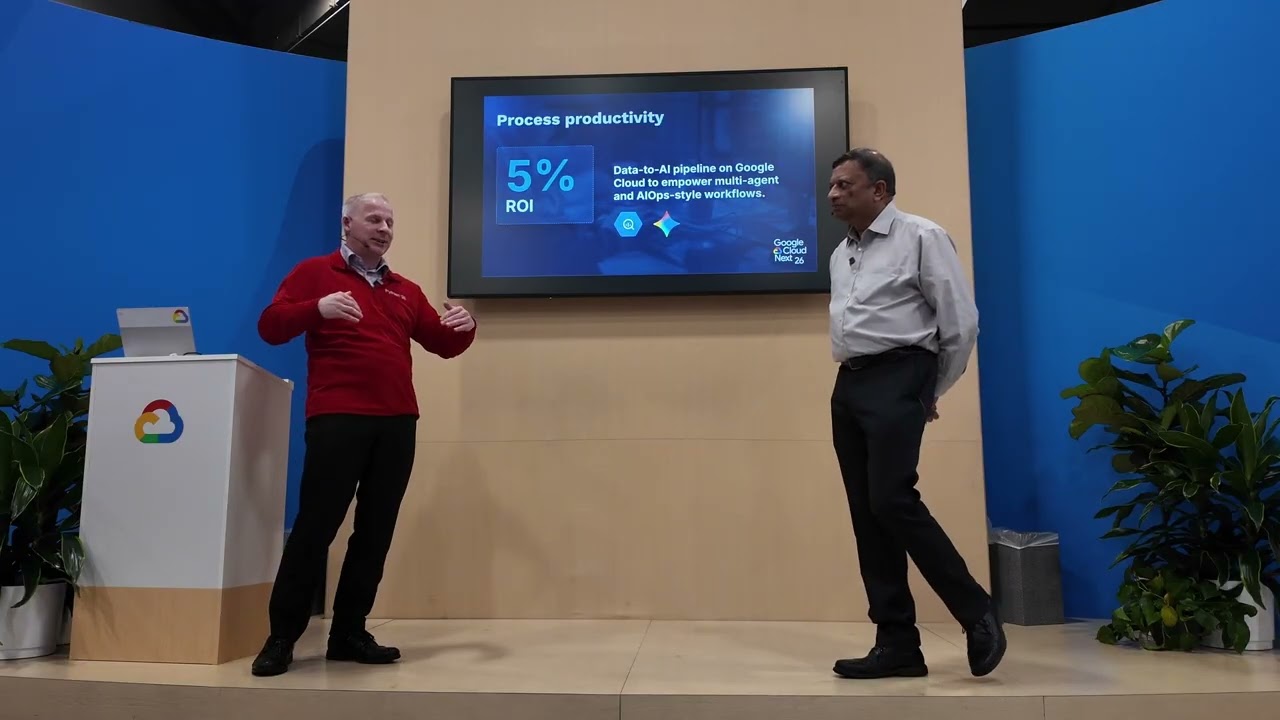
The future of artificial intelligence is standing on a stage in Las Vegas, talking about an old machine that still runs Windows XP. That machine is somewhere inside Sanmina’s sprawling manufacturing world, one piece of operational technology among thousands spread across factories that make everything from MRI scanners to 5G base stations. It is not the glossy picture of AI that tends to win keynote applause. It is more useful than that.
For Manesh Patel, Sanmina’s chief information officer, the stubborn machine captures the real work. AI does not arrive in an empty building. It arrives in a Fortune 500 manufacturer with decades of systems, 39,000 employees, hundreds of customer supply chains and equipment from vendors that evolved at very different speeds. Patel has spent more than 20 years inside that reality. When Pythian CTO Paul Lewis asks him about transformation, he does not offer a magic trick. He offers a method.
Sanmina is attacking AI on several fronts at once: personal productivity, IT delivery, embedded tools and production processes. It is also manufacturing the racks and servers on which the AI boom depends. The company is customer, laboratory and supplier all at the same time. That makes its experience an unusually complete view of enterprise AI—right down to the cooling systems required when intelligence arrives in a rack drawing 100 kilowatts.
The first win is hiding in the meeting
Sanmina moved to Google Apps in 2009 and kept building on that relationship. Today it has about 23,000 Workspace users and deployed Gemini for Workspace roughly a year before the talk. Patel says about half of those users are active. Others may call that healthy adoption; he calls it low. The distinction matters. Buying access is procurement. Changing how work gets done is transformation.
The best example is almost comically ordinary. A business team comes to IT with an idea. Traditionally, IT asks for written requirements, and everyone discovers that nobody particularly enjoys writing them. Sanmina now gathers the right people in a short workshop, transcribes the conversation in Google Meet and asks Gemini to turn that transcript into version one of the requirements document. Humans refine it from there.
No autonomous agent reorganizes the company. No robot strides across the shop floor. A blank page simply disappears, and the full development cycle gets shorter—not only the coding. Lewis calls these gains the “nickels and dimes”: five or ten minutes saved for an individual. Yet repeated across thousands of people, those minutes become at least 350 hours a week.
“The bottoms-up approach is really where we’re going to see a lot more value.”
Manesh Patel, CIO of Sanmina
There is a lesson here for leaders trained to hunt only million-dollar ideas. The giant projects are usually complex, fed by many data sources and measured in quarters rather than weeks. They can pay off, but they can also consume time and money without delivering the hoped-for result. A dashboard produced in ten minutes instead of a week may sound modest beside a production overhaul. It also starts returning value now.
Hundreds of supply chains, one hard problem
The small wins do not mean Sanmina has abandoned ambition. Its business makes ambition unavoidable. More than 100 original-equipment-manufacturer customers may each bring several product lines, each with a supply chain of its own. Sanmina is not managing one flow of parts into one family of products; Patel says it is managing hundreds of supply chains, a level of complexity he places at least two orders of magnitude beyond a regular OEM model.
One strategic pilot uses Vertex AI for supply-demand matching. The calculation has to consider component availability and manufacturing capacity together, then help Sanmina make a commitment against a customer forecast within two or three days. The company is beginning with one customer program in one plant. That limited scope is not timidity. It is how a difficult production problem becomes a test that can be measured.
Two speeds of enterprise AI
A conceptual map of the timelines described in the conversation—not an ROI forecast.
Sanmina’s approach is therefore not bottom-up or top-down. It is both. Employees and teams find practical uses in the work immediately in front of them. In parallel, a smaller number of strategic programs tackle problems the business may have struggled with for decades. The two tracks have different odds, different timelines and different definitions of progress. Treating them as one portfolio prevents a slow moonshot from becoming the only story management hears.
The factory produces the data problem
Information technology is only half the map. Patel’s remit also includes operational technology: factory equipment, its embedded software and the telemetry it produces. Lewis estimates that for every petabyte of IT data, OT creates 20. The volume is only one complication. Different equipment makers expose different capabilities. Technologies vary. Legacy components can sit inside expensive machines that cannot be swapped out like laptops.
Sanmina brought OT into the IT organization because it saw a gap. That creates an opportunity to apply familiar disciplines—security, management and data engineering—to the factory floor. It also reveals why a credible AI plan begins long before the model. Sanmina has standardized its enterprise systems and runs a manufacturing system, now commercialized, across its factory estate. ERP information can flow into BigQuery. Consistency raises data quality; data quality expands what AI can safely attempt.
The physical scale makes the point vivid. Sanmina’s Guadalajara campus covers about 100 acres and holds roughly eight factories. One site can move from low-level components and sheet metal to rack assembly and complex electronics. Medical systems, telecommunications equipment and industrial products share a campus without sharing a simple process. “Factory data” is not a neat object waiting in a folder. It is an ecosystem that has to be governed.
Central guardrails, local invention
Sanmina created an AI office at the CIO level, bringing Patel and key staff together to focus on policy, governance and security. For employees, access to outside AI services is locked down. Gemini is the core environment in a company already standardized around Google. Specialized teams can request exceptions, and IT can assess other partners and tools, but the default is controlled.
Lewis compresses the model into one line: centralized planning, centralized security, centralized governance, federated innovation. Patel agrees. The phrase describes a useful division of labor. A central group owns the boundaries that should not change from one department to another. The people closest to the work still discover where AI helps. Governance becomes the road, not the driver.
The Sanmina build sequence
A practical progression distilled from Patel’s closing advice.
This balance also explains Patel’s focus on the employees who are not yet active Gemini users. A laggard is not necessarily opposed to AI. The person may not have found an incentive or a task worth changing. Targeted training can connect the tool to an actual pain point. That is slower than declaring a mandate and more likely to produce genuine use.
The AI factory builds AI factories
The story turns physical again with Sanmina’s acquisition of ZT Systems. ZT manufactures racks and servers for hyperscalers, moving Sanmina deeper into the infrastructure behind cloud computing. Partners including NVIDIA and AMD supply core technologies that go into AI servers. Sanmina consumes services from hyperscalers and supplies products back to them.
Compute density converts intelligence into heat. Patel describes 100-kilowatt racks as fairly common and expects 300-kilowatt racks in the next year or so, with demand continuing upward. Cooling and power distribution are not side notes. They are the secret sauce that lets denser GPU systems operate. The ethereal language of AI eventually meets plumbing, electricity and the laws of thermodynamics.
That loop—using AI while manufacturing its machinery—gives Sanmina a rare vantage point. The company can see the productivity tool inside a meeting, the model matching supply and demand, the data pouring off a factory line and the rack that gives the model somewhere to run. The same discipline connects them: standardize what matters, preserve room to experiment and respect the complexity of the environment.
“AI is much harder than everybody thinks.”
Manesh Patel
Earn the right to scale
Patel closes with two pieces of advice. First, executives have to understand what is happening. Leaders who are afraid to ask, or who never build a working grasp of AI, cannot confidently approve the work. Education may happen inside the company or with partners. Either way, it is part of implementation, not a preface that can be skipped.
Second, start small. AI is harder than the media makes it appear. Racing to deploy agents before teams understand the systems can create a larger cleanup later. Small projects build fluency, expose the quality of the underlying data and show the governance office which controls work in practice. They also create evidence—something more persuasive than a slide about theoretical return.
This is the twist in Sanmina’s transformation. A company that operates at giant scale, across factories and continents, is not betting everything on one giant move. It is collecting the minutes rescued from routine work while testing the hard problems carefully. Three hundred and fifty hours a week is not the finish line. It is proof that the organization has started learning how to move.
Watch the full conversation