There is a particular kind of grocery-store helplessness. You arrive with a list written by someone who knows what everything means. You stare at a wall of nearly identical spice jars. Then you call home. Paul Lewis, Pythian’s chief technology officer, offered a version of this confession to Caleb Carr during their “Beyond the Cart” conversation: he knows groceries are in the building; the trouble is locating the right ones.
Schnucks has an answer that sounds almost playful. Its electronic shelf labels can blink. A shopper can choose a favorite color and follow the matching light to the item. A robot traveling the aisles maps where products sit. Lists can be shared across a family. Deli orders can be placed ahead. The store, in other words, is learning to answer the small questions before they become phone calls.
But the blinking label is only the visible tip of a much less glamorous system. Behind it sits a business that adds roughly 500 products in an average week, manages thousands of promotions and receives supplier information in formats ranging from advanced APIs to paper printouts and, yes, faxes. Grocery may look modern at the checkout. In the back office, it can still sound like 1997.
The fax machine behind the future
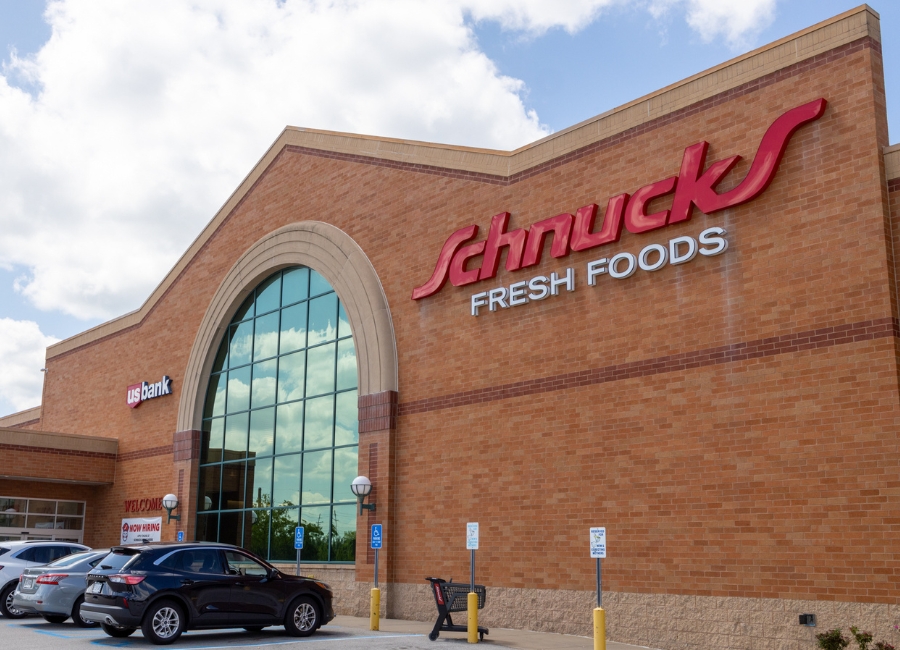
That collision—smart labels out front, manual data entry out back—is where Schnucks’ AI story gets useful. Carr leads the grocer’s data science and engineering organization, including its cloud and data-engineering work. He describes Schnucks as a fourth-generation, family-owned company whose core mission is to nourish people’s lives. At the time of the conversation, it operated 115 stores and had just acquired another 52 Festival Foods locations in Wisconsin.
The scale sharpens every tiny inconvenience. A product record is not merely a name and a price. It can include descriptions, images, attributes, promotions and health claims. If a listing says a product contains no gluten, Carr noted, the claim needs to be accurate. A 15- or 20-minute setup task multiplied across hundreds of new items and thousands of weekly promotions becomes an invisible factory of keyboard work.
Schnucks and Pythian built multiple agents around that flow. Documents are digitized. Computer vision finds the fields that matter. The system determines whether the data describes a product, a store or a consumer-packaged-goods supplier, then places information into the system of record and alerts a person to review it. New document, same circuit.
document
contextualize
system
validates
The human checkpoint is not ceremonial. It is the quality gate. Automation handles the repetitive motions; people check the result and can spend more time contacting vendors about what is missing. Carr’s estimate for the full setup process was striking: hundreds of hours saved each week. The return is not just cheaper administration. It is employees who can, as he put it, keep their heads up.
“It’s really about finding the opportunities to lean in and automate things to allow and create time for our teammates to serve our customers.”— Caleb Carr
Give the robot the aisle
The same preference for practical, mature tools appears on the sales floor. Schnucks is piloting vision AI on handheld devices to help managers and department managers assess produce. The problem is not indifference. It is familiarity: walk past the same display repeatedly and the eye begins to see “apples” rather than the one apple that no longer meets the standard.
A camera can supply a second look. The goal is to identify produce that should be pulled immediately, while feeding what the company learns back into its supply chain so fresh replacements are ready. Carr made the culture around the tool clear. If he walks past a bad apple, being the data leader does not exempt him from taking it off the floor. AI augments that reflex; it does not outsource care.
Elsewhere, an autonomous robot called Tally travels the aisles with vision and other sensors. It spots low stock and products sitting in the wrong place. That information joins demand forecasting models and a stranger signal: what people think the weather will do.
“The talk of weather impacts grocery more than the actual weather,” Carr said. Snow does not need to fall for shoppers to act; people only need to start talking about it. Schnucks can look at online conversation, including discussion in the St. Louis subreddit, to understand how concerned its home market feels. A forecast models the sky. Sentiment helps model the bread aisle.
An answer in every ear
Computer vision dominates the first wave because, Lewis argued, it is already a mature class of model: suitable for out-of-the-box foundations inside an agentic workflow. The next turn is from sight to voice. Schnucks developed agents with Google’s Agent Development Kit that can put organizational knowledge into a teammate’s earpiece.
That matters in a company with two very different kinds of experience. Schnucks recently held a dinner for 75 teammates who had each worked there for 40 years—an extraordinary reservoir of store knowledge. It also welcomes employees home from college who may work for a month. The voice tool narrows the gap without pretending the gap does not exist. A customer can ask where a product is; the employee can get a real-time answer instead of saying, “I don’t know.” During the session, the system’s answer for Starbucks coffee beans was wonderfully mundane: aisle seven.
That two-word response contains the larger strategy. Schnucks is not trying to turn every temporary employee into a 40-year veteran. It is trying to place what the organization knows where a person needs it, at the moment a customer asks. The assistant can also kick off processes behind the scenes, allowing a spoken request to become operational work.
“I might not know, but we know as an organization.”— Caleb Carr
Adoption before the jackpot
The path here was not a hunt for the largest possible number. Carr said Schnucks began with simple use cases and did not lead with return on investment, even when an ROI existed. The early goal was to empower people, show value and make the technology less intimidating. Only after that foundation took hold did the program lean harder into financial returns.
That sequence counters two common failure modes Lewis described from the broader experiment-heavy year of 2025. Teams choose use cases that are too small—five minutes saved here, a few dollars there—or impossibly complex, requiring many models, dozens of data sources and hard-to-measure outcomes. Then, if an experiment does reach production, nobody is ready to care for it.
An AI system is not a database, virtual machine or firewall, Lewis observed. It can still break at 3 a.m., but it introduces a subtler maintenance problem: its accuracy can change. A move from 83 percent accuracy to 81 percent may demand attention even when the service is technically running. Production AI needs an owner, monitoring and continued feeding.
The answer is the middle: a use case important enough to matter, bounded enough to build and welcomed by a business team motivated to use it. “Right now AI is a hammer and everything is a nail,” Carr said. Restraint becomes a technical capability. So does choosing partners inside the business who can make adoption real.
A field guide worth stealing
- Find repetitive work that steals time from the customer.
- Favor mature tools and bounded workflows over moonshots.
- Pair every use case with a business group ready to adopt it.
- Keep human validation where accuracy carries real consequences.
- Monitor model quality after launch, not only system uptime.
The old problem under the new label
When Lewis asked for the one lesson the audience should carry away, Carr did not choose agents, robots or voice. He chose data quality. Some experiments could not produce a good answer because the underlying descriptions were terrible. The model could not learn what the organization itself had not defined clearly.
Lewis traced the familiar loop. Analytics struggled because data was messy, siloed and scattered. Machine learning ran into the same condition. Now AI has arrived and found the same boxes in the hallway. “Data is hard,” Carr replied. The line drew a laugh because every new technology eventually meets an old spreadsheet.
Schnucks’ seven-year journey on Google Cloud matters for this reason. Scale, available tooling and data living in one ecosystem created the groundwork. Google Workspace helped the company begin with people and everyday productivity while the technical organization built toward agents and broader AI-enabled processes. There was no one-month transformation. There was infrastructure, training, use-case selection and the gradual move from confidence to return.
That patience produces a distinctly uncinematic version of the future. The agent reads an item sheet. A person checks the health claim. A robot notices the empty space. A manager photographs an apple. A new employee hears “aisle seven.” No single act is revolutionary. Together they remove enough friction for the original purpose of the grocery store to reappear: one person helping another.
The cleverest detail may still be that blinking shelf label. Choose purple, and a tiny light answers from a forest of spice jars. Yet the deeper signal comes from everything behind it—the clean record, the mapped aisle, the monitored model and the person who now has time to look up. The technology works because, at the end of the loop, somebody is waiting to be served.
Watch the full conversation