Company Dossier · Enterprise SaaS
PHAROS
The company that taught the office printer to keep a secret - and the cloud to take over from the print server.
EST. 1992 · WEST HENRIETTA, NY · B CORP
The company that taught the office printer to keep a secret - and the cloud to take over from the print server.
EST. 1992 · WEST HENRIETTA, NY · B CORP
The Scene
And Pharos has built a 30-year business around fixing exactly that.
Walk into any large office and find the printer. It hums in a corner, fed by a forgotten server in a closet, guarded by drivers that break on Tuesdays, and surrounded by a small graveyard of pages someone printed and never collected - payroll, a contract, a doctor's note. It is the least glamorous device in the building and one of the most dangerous. Pharos noticed this before almost anyone.
Founded in 1992 in New Zealand and now headquartered in West Henrietta, New York, Pharos Systems International makes software that does something quietly radical: it makes the printer behave. It holds your document in the cloud until you walk up and prove it's you. It records who printed what, when, and what it cost. And increasingly, it does all of this without a single print server in the building.
The company calls this approach PrintOps - a category it coined in 2024 to describe what it had, in truth, been building toward since the early 1990s. The pitch is unfashionably practical: print less, spend less, leak less. For a function most CIOs would rather forget exists, that turns out to be a surprisingly durable business.
Pharos is not loud. It is a Certified B Corporation serving thousands of organizations - including a healthy share of the Fortune 500 - and it has done so by being right about a boring problem for longer than most of its competitors have existed.
By the Numbers
Figures published by Pharos. Treat as company-reported, not audited - though the order of magnitude is the point.
The Long Game
If you have ever badged in at a printer to release a job, you have used an idea Pharos shipped in 1993. Co-founders Paul Reddy and Geoff Shaw launched Uniprint - the first secure pull-printing product - and aimed it at universities, where shared printers and student labs made the problem obvious first.
A year later, in 1994, came the first user-level print analytics: the radical notion that an organization might want to know who was printing 400 pages of holiday photos on the company toner. Mundane, yes. But every cost-recovery and sustainability story Pharos tells today traces back to that ledger.
The harder pivot came later. Around 2016, Pharos bet that the print server - the closet box every IT team hated - was a liability rather than a fixture. It began building cloud-native print management while incumbents were still selling appliances. The rebrand of its Beacon platform to Pharos Cloud made the conviction official.
In 2021, private equity firm Spotlight Equity Partners acquired Pharos to accelerate that cloud transition. Then in 2024 it gave the strategy a name - PrintOps - and started arguing, with some success, that print deserved the same operational rigor as the rest of modern IT.
What You Can Actually Do With It
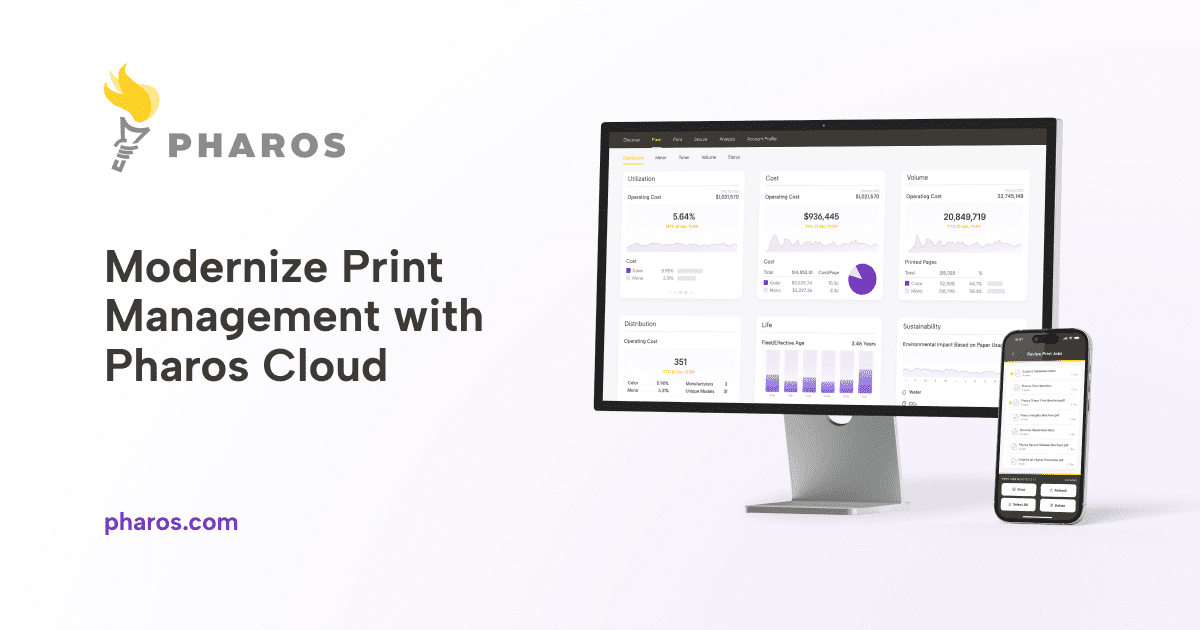
The whole thing: eliminate print servers, secure workflows, and give IT one place to see and control print across the enterprise.
Your document waits in the cloud until you authenticate at the device. No more orphaned contracts in the output tray.
User- and device-level analytics on usage, cost, and environmental impact. The ledger, grown up.
Move direct-to-printer office workflows to the cloud across mixed fleets - and retire driver management.
Lets the remote and hybrid workforce print securely from outside the office network.
The originals: on-premises print management for higher education, libraries, and enterprises not yet in the cloud.
The Pitch, Visualized
Cheaper, more secure, and greener printing. Most vendors pick one. Pharos sells all three as the same move - because killing the print server happens to do all three at once.
Illustrative, based on Pharos-reported outcomes
Who's Behind the Badge
Pharos sells where a stray printed page is a real risk: financial services, insurance, manufacturing, technology, professional services, government, healthcare, higher education, and libraries. These are organizations with regulators, auditors, and a lot of printers - the exact place "who printed what" stops being trivia and starts being compliance.
Internally, the company leans into its B Corp identity. Its stated values - acting with urgency, thinking rigorously, collaborating openly, caring for others, and daring to innovate - read like most value statements, but the B Corp certification and benefit-corporation structure put legal teeth behind the sustainability claims. In 2026 it was named a Top Workplaces winner by the Rochester Democrat and Chronicle.
Filed Under
The Scene, Revisited
Walk back into that office. The printer still hums in the corner. But the closet server is gone. The graveyard of forgotten pages has thinned, because nothing prints until someone is standing there to claim it. Somewhere, a dashboard knows the page count, the cost, and the carbon - and nobody had to think about any of it.
That is the whole arc of Pharos: it didn't make printing exciting. It made it forgettable in the way good infrastructure should be - secure by default, cheaper by design, and quietly out of your way.
The lighthouse, it turns out, was never about the light. It was about everyone else being able to stop worrying about the rocks. Three decades in, Pharos is still standing on the same point of the shore, telling enterprises the same unglamorous truth: the printer can be trusted - you just have to manage it like it matters.
The Rolodex