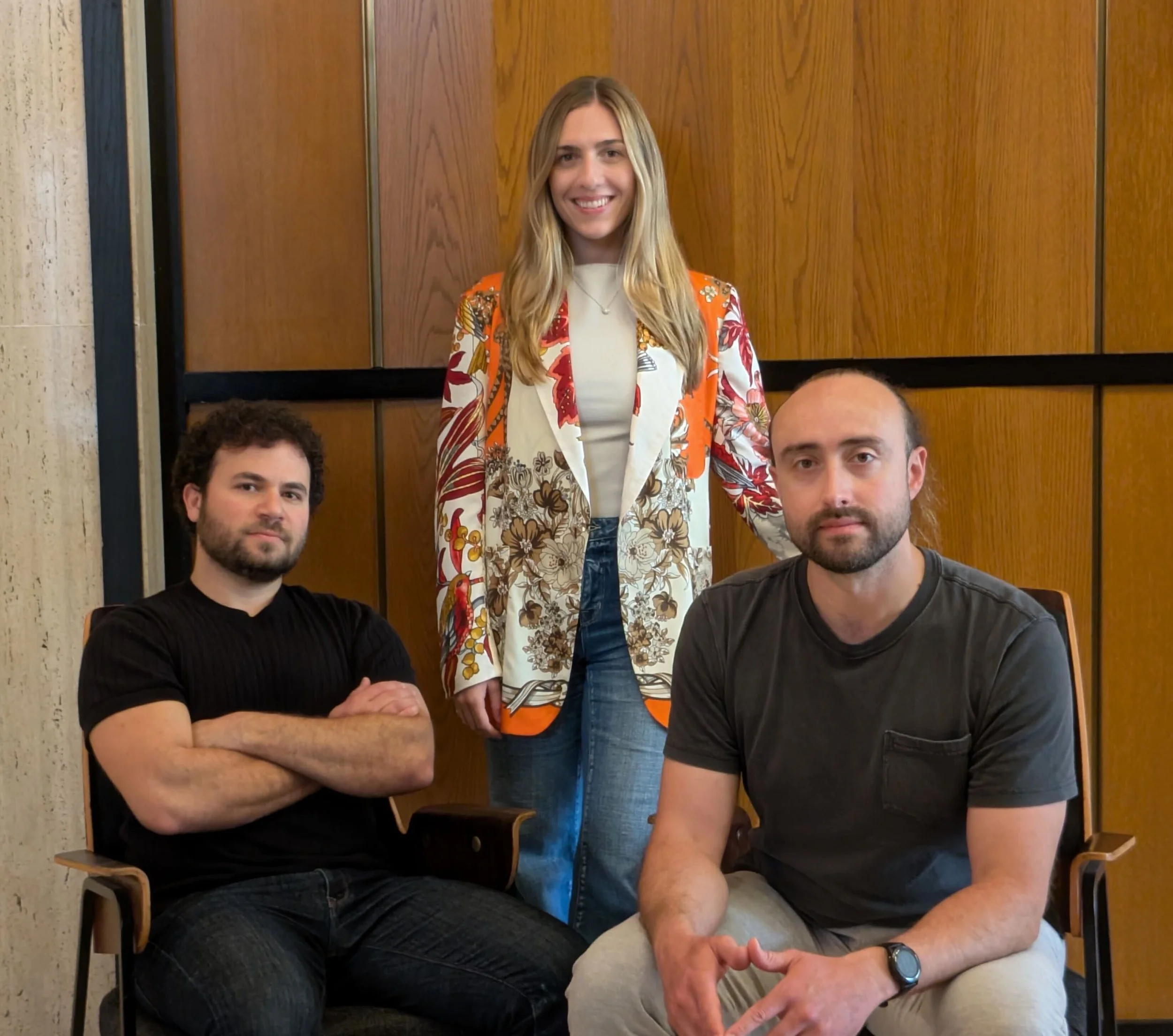
Somewhere in a government list of sanctioned bad actors, Peter Piatetsky's company found one dated back roughly 1,900 years. It is the kind of detail that sounds like a typo and turns out to be a thesis. Castellum.AI, the New York firm he co-founded and runs, now corrects the world's regulators on a regular basis - flagging entities listed only as the Cyrillic equivalent of "LLC," catching errors in records that banks are legally required to screen against. The product has a name only a former insider would dare give it: the Department of Corrections.
Piatetsky knows the inside because he built part of it. Before Castellum, he worked at the US Department of the Treasury, first as an investigator chasing Iran sanctions inside the Office of Foreign Assets Control, then as a senior policy advisor counseling principals on sanctions, money laundering and terrorist financing tied to Iran, Lebanon and Israel/Palestine. "At the Treasury Department, I fined and helped shut down banks that didn't comply with sanctions," he says. He has the rare resume of someone who jailed money launderers and froze illicit assets, then crossed the table to run compliance at a large Asian bank and discovered the tools on the other side were broken.
The break came as a number. In one month at the bank, his team processed 38,000 alerts. One turned out to be an actual risk. The rest was noise - the daily tax of screening software that flags every near-match and lets a human sort the wreckage. "I knew there was a better way," he says. The deeper shock was structural: when he realized the US government did not even know where Canada's sanctions list lived, he concluded the crisis was not workflow or interface design. It was data access.
The contrarian bet
Most compliance startups in 2019 were selling dashboards. Piatetsky started Castellum.AI on a premise that sounded almost dull: the hardest part of compliance software is reliable data. Rather than buy sanctions lists, politically-exposed-person files and adverse-media feeds from third parties - the industry default - Castellum collects them straight from the source. Hundreds of government and press feeds, many of them messy and unstructured: PDFs in Japanese, Excel sheets from Balkan registries, machine-translated court proceedings. All of it gets vacuumed in, standardized, enriched, and refreshed every five minutes. "Anything bad that happens in the world related to financial crime and reputational risk," he says, "we're going to know about it."
The payoff is a guarantee most vendors won't make. Castellum says it reduces false positives by 94% and cuts manual review time by 83%, and it is the only compliance platform that guarantees a false-positive reduction. On top of the data sits the layer that makes 2025 different: AI agents that handle Level 1 and Level 2 alert adjudication, support Level 3 investigations, and leave detailed audit trails behind every decision. The agents are good enough that one of them passed the practice exam for the Certified Anti-Money Laundering Specialist credential - the human qualification - on the first attempt.
An arms race, plainly stated
Piatetsky frames the moment without drama because the facts supply it. "Financial criminals have started using AI at scale," he says, "and regulators have become very aware of it, so there's almost an arms-race approach now." He has watched the regulator's question to compliance teams flip in real time - from "Are you sure you need this?" to "Oh yeah, you need this. Prove to us that it works." Castellum's whole posture is built for the second question: continuous testing, benchmarked screening, models you can validate rather than trust. He sits on panels with sanctions officers from Citi and Rabobank arguing that "set it and forget it" screening is now a liability.
That conviction is finding capital that maps perfectly onto it. In July 2025 Castellum.AI closed an oversubscribed $8.5M Series A, led by Curql - a fund backed by more than 130 credit unions including Navy Federal - with participation from BTech Consortium, backed by a dozen banks, and Framework Venture Partners, backed by Tier 1 Canadian institutions including RBC. It brought total funding to roughly $12.9M. "I could not have asked for a better investor fit," Piatetsky said. "That our Series A funding comes from credit unions and banks validates our platform and market alignment." When the customers fund the company, the pitch and the proof become the same document.
The hinterland
The training is not what you would predict for a regtech founder. Piatetsky holds a bachelor's from Boston University in international relations, history and Russian and Eastern European studies, and a master's in Persian Studies from the University of Maryland - a scholar of the regions whose finances he would later police. He taught the subject too, lecturing on Sanctions, Corruption, and Terrorist Financing as an adjunct at American University. He did not build Castellum alone: Julian Vasilkoski, a co-founder out of high-frequency trading, builds the fast scalable systems; Marissa Venuto, the COO, scales the team and process around them.
Who it's for, and why it's urgent
Castellum's customer list reads like the plumbing of modern money: banks, credit unions, fintechs, banking-as-a-service sponsor banks, and crypto exchanges - the institutions where a single missed name can mean a regulator's fine or a frozen license. Piatetsky's whole career, more than fifteen years of fighting financial crime at the local, national and international level, is now compressed into a product whose values he lists like a creed: clarity, expertise, urgency, accountability. The mission statement is just as blunt - help financial institutions prevent financial crime with speed and precision. Backed by investors who together represent over 100 banks and credit unions, the company sells to the same people who vouch for it.
Urgency is not a marketing word for him; it is the operating temperature. When he talks about evaluating a screening vendor, he does not start with features. "You need to be evaluating speed," he says. "You have to come in on day one and start fighting fires." It is the language of someone who has watched compliance teams fail not because they lacked good intentions but because their tools arrived slow, stale and unproven. His answer is a platform that can be benchmarked against rivals, tested continuously, and validated for both accuracy and speed - the difference between software you trust and software you can actually check.
For all the gravity of the work - the asset freezes, the shut-down banks, the arms race - the man himself defaults to plain enthusiasm. Asked what a good week looks like, he answers like a chart: "Up and to the right. That means scaling what's working." And the weekends belong entirely to a different list. "Our family spot in the Rockaways where my daughters and I spend every weekend getting outside and enjoying the beach," he says. "Also spearfishing." A person who hunts fish underwater for fun is, it turns out, well-suited to a business model built on finding the one true signal hiding in thirty-eight thousand.