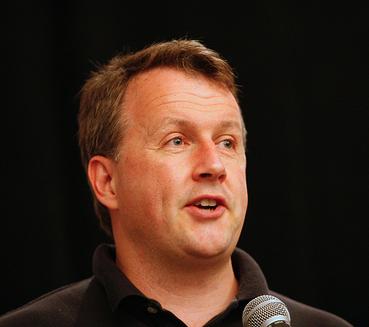
From Weymouth to Wall Street — and Back to Blighty
Born in a seaside town in Dorset, England, Paul Graham moved to Pittsburgh at age four — swapping the grey Atlantic for grey Pittsburgh skies. Not a dramatic upgrade, but it did eventually lead to Harvard, Yahoo, and roughly $600 billion in portfolio companies, so we'll allow it.
At Cornell, he studied Philosophy. Then Harvard, where he picked up a Master's and PhD in Computer Science. Then — because apparently two elite degrees weren't enough stimulation — he headed to the Rhode Island School of Design and Florence's Accademia di Belle Arti to study painting. Because why be one kind of genius?
In 1996, Graham and Robert Morris founded Viaweb, the world's first Application Service Provider — letting small businesses build online stores before "e-commerce" was even a word people used with confidence. They built it almost entirely in Lisp, a language most programmers considered eccentric. Viaweb sold to Yahoo in 1998 for $49.6 million. The Lisp turned out to be quite the competitive advantage.
By 2001, Graham started posting essays on his personal website. They spread like wildfire through tech circles — incisive, funny, and refreshingly honest. By 2005, those essays had attracted enough credibility that when Graham, Jessica Livingston, Trevor Blackwell, and Robert Morris started Y Combinator, the world paid attention.
At the age of 13, Paul Graham decided to stop watching television entirely. A child in the 1970s voluntarily giving up TV. In retrospect, this is the least surprising fact in this entire article.
Graham literally studied fine art in Florence, Italy. His book is called Hackers & Painters because he genuinely considers the two pursuits deeply similar. He's not wrong. He's never wrong. It's annoying.
Graham used Lisp — a language invented in 1958 — to build one of the first internet companies, then wrote an essay explaining why this gave Viaweb an insurmountable advantage over competitors. He called it his "secret weapon." He was right.
Having spent 48 years in the US, built a world-changing accelerator, and become one of Silicon Valley's most influential figures, Graham moved his family back to England in 2016. He does not appear to miss the weather.
"The most important thing is to be excited about what you're working on. If you're not excited, you're probably not going to do it well."— PAUL GRAHAM · ON STARTUPS, PASSION, AND EVERYTHING ELSE
THE ESSAYS
THAT BROKE
SILICON VALLEY
How to Start a Startup
The essay that launched Y Combinator. Still required reading 20 years later.
Maker's Schedule, Manager's Schedule
Why a 30-minute meeting can destroy a whole day of deep work. Founders wept.
Do Things That Don't Scale
Airbnb photographed apartments themselves. Graham told them why that was correct.
Superlinear Returns
Why success compounds and what that means for how to live your life.
Founder Mode
The essay that dismantled conventional wisdom about running a company. Brian Chesky reposted immediately.
The PG Meter
"The best ideas look like bad ideas at first."
"Writing is thinking."
"Work on hard problems."
"Hire good people and get out of their way — or don't, if you're a founder."
"Lisp is still underrated."
"The web is still young."
FUN FACTS
His Zodiac: Scorpio ♏
Intense. Perceptive. Opinionated. Occasionally stinging. Deeply loyal. Obsessively curious. Would absolutely write 10,000 words about why Scorpios are misunderstood.
"Instead of good writers, ok writers, and people who can't write, there will just be good writers and people who can't."— PAUL GRAHAM · "WRITES AND WRITE-NOTS" · 2025
THE PHILOSOPHER
WHO CODES.
THE PAINTER
WHO INVESTS.
Paul Graham defies every category Silicon Valley tries to put him in. He's not a typical VC — he doesn't wear fleece and give TED talks about disruption. He's not a typical programmer — he studied Renaissance painting in Florence and writes about the aesthetics of code. He's not a typical essayist — his day job was building a billion-dollar accelerator.
His superpower is seeing things simply. In a world of jargon and complexity, Graham writes plain sentences about hard problems — and they land like hammers. His essays don't age because they're not about technology; they're about human nature applied to technology.
He stepped down from YC in 2014 and moved back to England in 2016 — and somehow became more influential. The essays kept coming. The internet kept listening. "Founder Mode" in 2024 broke the internet harder than most product launches.
- 📱 World's most influential tech thinker uses zero social media plugins on his site
- 💻 Invented a programming language (Arc) that most people have heard of but few use
- 🎨 Said "programming and painting are alike" — and proved it by doing both professionally
- 🏴 Spent 48 years in America building American tech — moved back to England
- 📝 Gets 15M page views/year on a website with less CSS than a 1996 Geocities page
- 🦄 Funded 4,000+ startups starting at $6K a pop — now a multi-millionaire
- 📺 Quit TV at 13 — became the person everyone else watches (metaphorically)
"If there's one piece of advice I would give about writing essays, it would be: don't do as you're told. Don't believe what you are supposed to."— PAUL GRAHAM