Person / Founder / Physicist
Paul Taylor
He once trapped a single atom to tell time. Now he cuts copper with light.
CEO & Founder - Laser Wire Solutions - Wales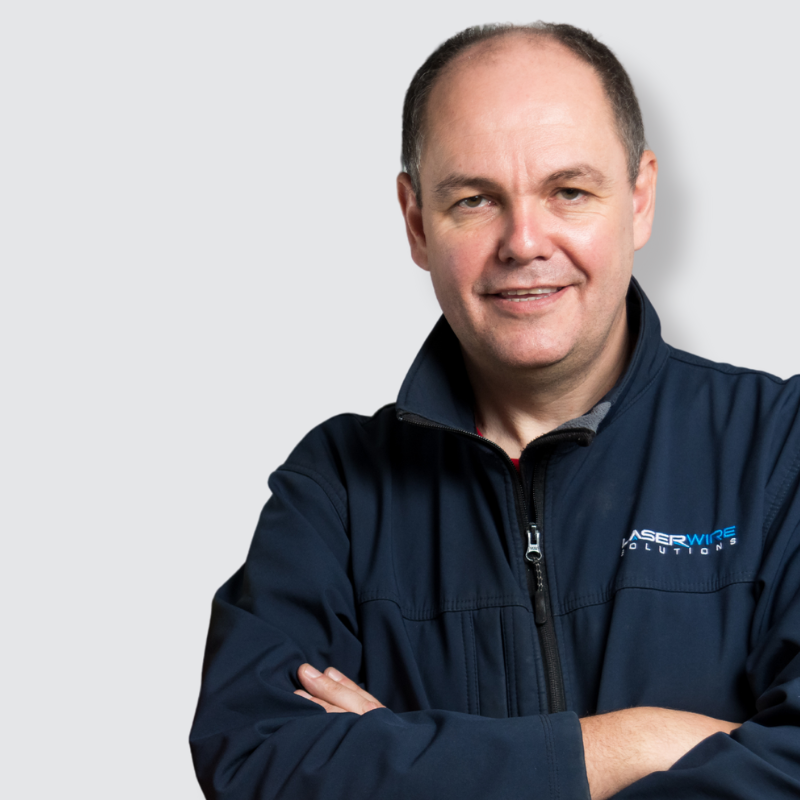
Paul Taylor. The lab coat is optional; the lasers are not.
He once trapped a single atom to tell time. Now he cuts copper with light.
CEO & Founder - Laser Wire Solutions - Wales
Paul Taylor. The lab coat is optional; the lasers are not.
Inside a pacemaker is a coil of wire finer than a human hair. Inside an MRI scanner, more of it. Inside the electric car in your neighbour's driveway, aluminium cabling so delicate a knife would nick it and ruin it. Somebody has to strip the insulation off all of that without touching the metal underneath. Paul Taylor builds the machines that do it with a beam of light.
From a unit in Pontypridd, Wales, his company Laser Wire Solutions designs and manufactures laser wire-stripping systems - kit precise enough for medical devices, tough enough for aerospace cable, and fast enough for the data centres and car factories now wiring up the electric age. Roughly 99% of what the firm builds leaves the country, most of it bound for high-tech manufacturers in the United States.
The pitch is almost philosophical: a blade removes insulation by force, and force is exactly the wrong tool when the conductor is thinner than thread. A correctly tuned laser vaporises the coating and stops at the metal. No nick, no scrape, no scrap. Taylor has spent his career on the side of precision, and the wire market turned out to be the place that needed it most.
He came to it sideways. The technology at the heart of the business traces back to lasers developed for NASA's Space Shuttle programme. Taylor's own route ran through one of the most exacting corners of physics there is - and then through a garage.
A focused beam targets only the insulation - polyamide, enamel, fibreglass, the coating on microcoax.
The laser ablates the coating and stops at the conductor. The metal underneath is never touched.
Robots move the beam. No human hand, no blade fatigue, no nicked wire, the same result every time.
Taylor graduated in physics from the University of Oxford in 1993. His PhD took him to the National Physical Laboratory and into a problem of almost absurd delicacy: building an optical atomic clock. He was responsible for the laser systems used to trap and probe a single atom of ytterbium - one atom, held still by light, made to serve as the time reference for the next generation of atomic clocks. It is hard to imagine a better apprenticeship in controlling a laser precisely.
From there he followed the beam into industry. First came laser mastering equipment for the CD and DVD business. Then, in 2005, Spectrum Technologies recruited him to develop laser cable-marking systems for aerospace. That was the doorway. Marking aerospace cable taught him the wire market, and the wire market introduced him to laser stripping - the technique he would later build a company on. He spent around six years there, leading the engineering team that built out its product range.
In October 2011 he left to do it himself. Laser Wire Solutions started as a two-man band in a garage in Merthyr Tydfil, founded on a single observation: there was a gap in the market for high-end laser stripping systems for medical device manufacture. The plan was to build bespoke machines that could strip hair-fine wires and aerospace cables for microwave assemblies, pacemaker coils, medical devices and mobile phones.
The garage did not last. Grants from SMARTCymru, equity from Finance Wales, the Wales Business Angel Network and Xenos, and a place on the Welsh Government's Accelerated Growth Programme moved the firm into a 5,000 sq ft unit and then doubled it. In 2016 the Swiss-listed group Schleuniger bought a 20% stake, betting that a partnership would best position it for the automotive market. The garage idea had become a strategic asset.
Trebled to £5.1m and staff doubled to 28 in a single twelve-month stretch around 2018.
Listed among the FT1000 - the fifth fastest-growing manufacturer in Europe.
15th overall in Deloitte's UK Technology Fast 50 with 1,944% growth; regional and hardware winner.
Around 99% of revenue comes from exports, the bulk of it to the United States.
Mission-critical kit for medical device, aerospace, data centre and electric-vehicle makers.
A Queen's Award for International Trade - the UK's highest business honour.
Ask where this is going and Taylor points two ways at once: outward to the world's factories, and inward to his own region. The ambition he states plainly is to make Laser Wire Solutions a leading light in the Welsh technology industry - a phrase that, from a man who built laser clocks, is either a pun or a mission statement, and probably both.
The technical frontier is automation of human skill. In medical device manufacture, the finest work - micro-soldering and stripping at a sub-0.1 mm pitch - still depends on people working under microscopes, where dexterity decides quality. Taylor wants laser and robotic systems to do that work repeatably, and has pulled UK innovation funding to build the soldering capability for it. The bet is that as devices shrink, the human hand becomes the bottleneck, and light becomes the answer.
Then there is the electric car. EV wiring uses large amounts of aluminium cable that is too sensitive to be stripped with a blade without nicking it - which makes a laser, in his words, the only effective solution. The greener the world's vehicles get, the more wire there is that only Taylor's kind of machine can finish. He spotted that tailwind early and built toward it.
On raising money, he is unsentimental. Value your worth, he tells other founders, but be realistic - half a pie is better than no pie - and never forget you are selling the company, not giving it away. It is the same instinct that runs through the engineering: be exact, be patient, and don't waste the material.
He went from building a clock accurate to a single atom to building machines that strip wire thinner than a hair.
The stripping technology traces its lineage to lasers developed for NASA's Space Shuttle programme.
His machines help finish the coils inside pacemakers and the cables inside MRI scanners.
Aluminium EV cable can't be cut with a blade without nicking - so the laser is the only effective way to strip it.
He has given a "Laser Wire Stripping Masterclass" at the Electrical Wire Processing Technology Expo.
A firm in Pontypridd that sends roughly 99% of its output to the rest of the world.