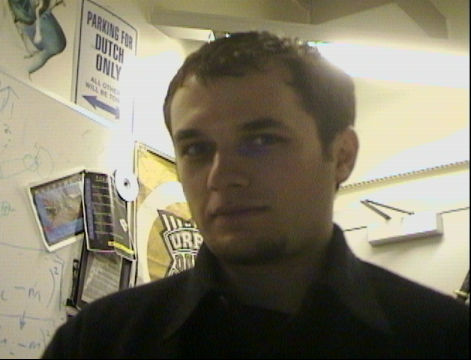
Long before he was decoding billions of online conversations, Nemirovsky was a working musician and composer. He wrote for bands, for ballet, for film, for projects that lived somewhere between the experimental and the commercial. He sang. The early MIT bio that described him put it plainly: he "makes interactive stuff, plays music and sings beautiful hymns." It reads less like a resume line and more like a dare.
He arrived at the MIT Media Lab and refused to pick a lane. His 1999 master's thesis carried the title "Aesthetic Forms of Expression as Information Delivery Units" - which is academic for: what if beauty could carry data? The proof was GuideShoes, an audio wearable that walked you through a city using musical cues instead of a robotic voice barking left and right. You did not read the map. You heard it.
The work kept its strangeness as it deepened. There was the Emonic Environment, a system for improvising and steering information through emotion. There was the Emonator, a gesture instrument for emotional expression, and a string of pieces with names like EmoClothes, InterElastique, and ViroTree - a digital plant you grew by pouring water. His art moved from the lab to the gallery, with interactive work shown at venues including the Centre Pompidou in Paris and the DeCordova Museum outside Boston. He kept a quote from John Cage close, the one about opening your ears to a sound "before one's thinking has a chance to turn it into something logical, abstract or symbolical." For an engineer, it is a heretical thing to admire. For Nemirovsky, it is the through-line.
Then he finished the PhD around 2006 and pointed all of that pattern-finding at a different kind of mess: human language at scale. In 2009 he cofounded dMetrics with fellow MIT researcher Ariadna Quattoni. The first vision was almost utopian - "use big data to make everyone experts." The first proving ground was health care, where the signal hides inside the chaos of how real people actually talk about how they feel.
The early engine, called DecisionEngine, was built to do something most software of its era could not: read unstructured human writing and find the decisions buried inside it. The company assembled a database of public comments about patient-reported experiences, drawn from more than a million online sources and covering over 14,000 health-care products. Roughly two million lines of code sat underneath it. One pharmaceutical client used the system to demonstrate that an allergy medication helped a specific subgroup of patients - and folded the result into a regulatory submission. That is the moment the toy became a tool.
The company moved from Boston to Brooklyn and kept growing the hard way. No venture capital. Four National Science Foundation grants instead, and revenue from customers who needed the work to actually function. By the time DecisionEngine matured into Minsky, the customer list had widened from pharma into finance, then into the public sector, then into defense. The thesis never changed: put the expert in control, and make the machine show its work.
Nemirovsky speaks four human languages and four programming languages, which feels less like trivia and more like a job description. His company's entire reason for being is translation - from the slippery way humans write to the structured certainty a decision-maker needs, without losing the meaning in transit. He lists sushi-making, sailing, and filmmaking among his pursuits. He cites Cage and the video artist Nam June Paik as influences. None of it is a detour. It is the same person, solving the same problem in different materials: how do you take something formless and let a human shape it without flattening it?
The no-venture-capital part deserves a second look, because it is rare and it is deliberate. Plenty of AI companies raise enormous rounds and chase scale before they have proof. Nemirovsky did the opposite: he let the research grants and paying customers fund the build, which meant every feature had to earn its place against a real requirement. The discipline shows up in the product. Minsky is not a demo that dazzles and disappoints; it is a workbench that analysts return to because it answers the question they actually asked. Growing to roughly forty people on that basis is slower, and it is also sturdier.
It also clarifies the philosophy dMetrics keeps repeating: distributed control, AI as a tool for scaling human excellence rather than replacing it. The fashionable version of artificial intelligence in 2024 hands you an answer and asks you to take it on faith. Nemirovsky's version hands the subject-matter expert the controls and the reasoning, then gets out of the way. For a defense buyer worried about third-party risk and training transparency, that is not a philosophical nicety - it is the difference between a system you can deploy and one you cannot. The same logic sells to a bank or a pharmaceutical firm. Trust is the feature everyone forgot to build.
The 2024 Defense award is the loudest validation yet, but it lands as a continuation, not a pivot. A platform that lets a non-technical analyst interrogate tens of millions of data points and trust the answer is the same idea as a shoe that sings you home. Both refuse the false choice between power and comprehension. Both insist the human stays in the loop. The instruments changed. The composer did not.