Company Profile / Fintech
Panax
The finance-native AI that runs the cash desk so lean teams don't have to.
The finance-native AI that runs the cash desk so lean teams don't have to.
It is the last Friday of the quarter, and somewhere a finance team has 40 browser tabs open. Bank portals, ERP exports, a spreadsheet held together by a macro nobody dares touch. They are not closing the books. They are trying to answer one embarrassingly simple question: how much cash do we actually have, right now, across every account and entity. Panax exists because that question should not be hard.
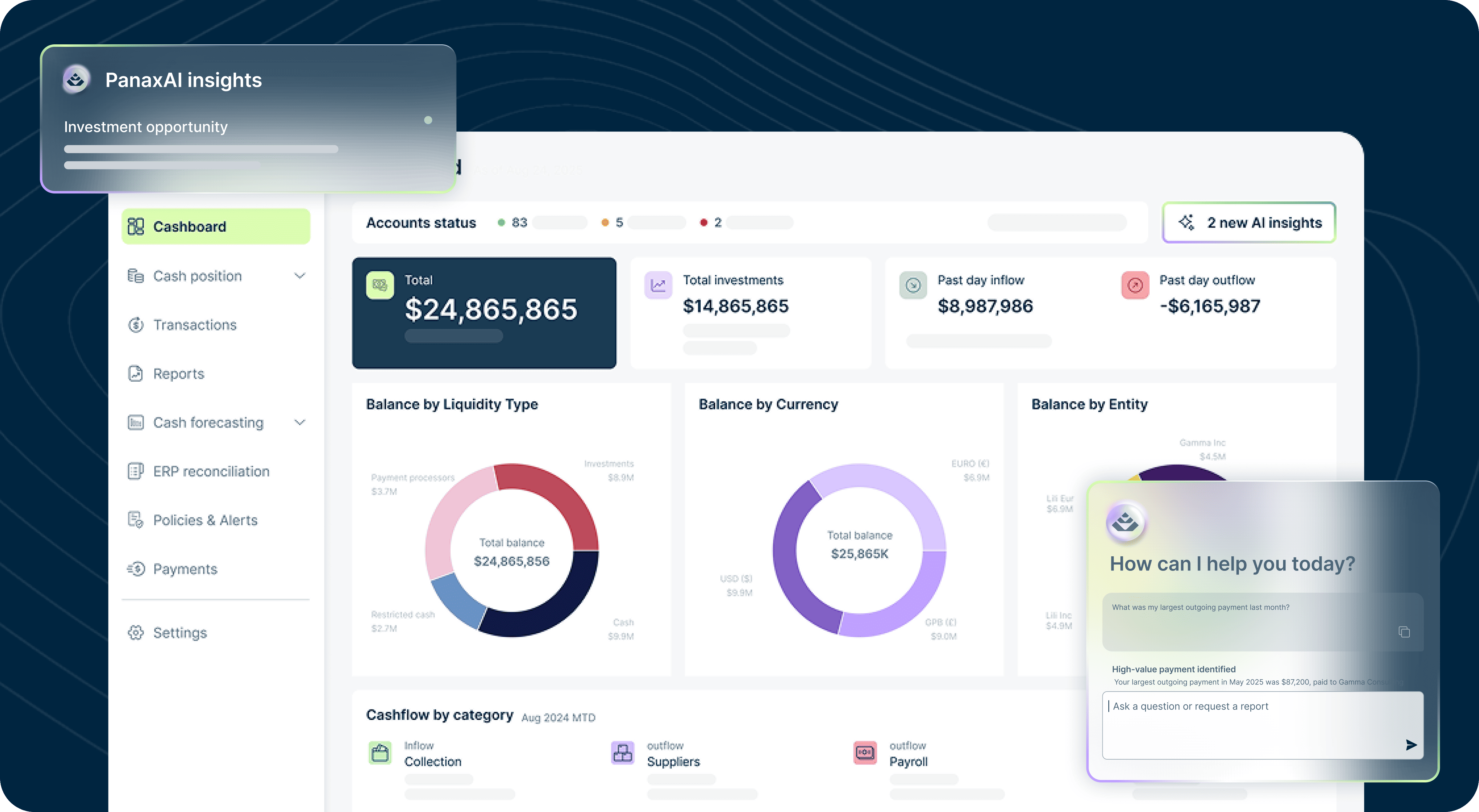
Panax is an AI-native cash management platform. It connects to a company's banks and its ERP, pulls the raw transaction data, and turns the whole mess into one live financial picture - cash positions, forecasts, categorizations, reconciliations and alerts, updated as the money moves. The pitch is not "we replace your treasury team." It is "we replace the part of the job that nobody went to finance school to do."
Treasury software has existed for decades. The catch is who it was built for: enormous corporations with dedicated treasury departments, full-time analysts, and budgets to match. If you are a mid-market manufacturer, a logistics operator, or a real estate group, you have the same tangle of bank accounts, currencies and entities - but a finance team of three. You have the complexity of a giant and the headcount of a startup.
So the work falls through the cracks, and then it falls on a spreadsheet. Cash categorization done by hand. Forecasts that are stale the moment they are built. Reconciliation that eats the first three days of every month. It is, to borrow a phrase, the kind of honest tedious labor that builds character and destroys evenings.
Panax was founded in 2022 by people who had personally suffered the problem. CEO Noam Mills came from private equity and corporate finance - and, in a detail that is too good to leave out, fenced for Israel at the Olympic level before any of that. Her co-founder Niv Yaar, now Chief Business Officer, shares the private equity background and the firsthand familiarity with treasury pain. The third founder, CTO Sefi Itzkovich, worked on machine learning at Facebook and was previously CTO of Otonomo, which went public via SPAC.
The bet was specific. Not "AI will run finance." Rather: AI is finally good enough to do the reading, matching and forecasting that swallows a finance team's week - while the humans keep the final say on every decision about the money. It is an unfashionably modest claim in a market that prefers the word "autonomous."
Private equity and corporate finance background. Former Olympic fencer for Israel. The reason Panax sounds like it was built by someone who has done the job.
Private equity veteran who relocated to build out the New York office. Carries the customer and commercial side of the business.
Ex-Facebook machine learning, former CTO of Otonomo (SPAC). The engineering muscle behind the AI agents.
What Panax actually does is unglamorous in the best way. It aggregates bank data through open banking and connects directly to ERPs, then layers AI on top to do four things finance teams hate doing by hand: categorize transactions, forecast cash flow, reconcile accounts, and report. Add proactive alerts for liquidity and risk, plus scenario modeling for the "what if a big customer pays late" questions, and AI agents that handle the routine cash operations.
The result reads less like a new tool and more like the removal of an old burden. Multi-entity, multi-currency cash visibility - the thing that used to require a consolidation spreadsheet and a prayer - becomes a screen you glance at. The interesting move is restraint: Panax surfaces the recommendation and the projection, then stops, and lets the person decide.
A company milestone timeline // 2022 - 2025
Three founders - two from finance, one from machine learning - set out to fix treasury for companies too complex for spreadsheets and too lean for legacy systems.
Early capital to build the core platform: bank and ERP aggregation plus the first AI-driven forecasting and categorization.
Demand from mid-market industrials, logistics and real estate validates the wedge. The teams of three start showing up.
TLV Partners returns. Panax expands its New York office while keeping R&D in Tel Aviv.
A cash management partnership extends cross-border and multi-currency reach for global finance teams.
Investors are not subtle signals, but they are signals. Panax raised a $5.5M seed led by TLV Partners, then a $10M Series A in May 2024 led by Team8 with TLV returning - more than $15M in committed capital aimed squarely at an unglamorous problem. The customer base, including names like the beauty company Oddity, doubled in a single quarter. None of that proves a category winner. It does prove the pain is real and someone will pay to make it stop.
Disclosed rounds, USD millions // source: company + press reports
Bars are proportional to disclosed amounts. Figures are approximate and based on public reporting.
The mission underneath the product is almost old-fashioned: give finance teams total control over cash, by taking the manual work away rather than taking the decisions away. In an era when "agentic" usually means "we removed the human," Panax's design choice to keep the finance team as final decision maker is either a competitive weakness or its single sharpest differentiator. The bet is that the people signing off on millions of dollars would prefer a trustworthy assistant over an autonomous one.
There is an irony worth naming. The most ambitious thing Panax does is refuse to be the most ambitious version of itself. It automates the boring 80% and hands back the consequential 20%. That is harder to market and easier to trust.
Most fintech aims at the obvious targets - startups, consumers, the already-digital. Panax aims at the companies that quietly run the physical economy: the manufacturer with eleven bank accounts, the logistics firm with operations in four currencies, the real estate group with a separate entity for every building. These are not early adopters. They are the late majority, and they are exactly where a tool that removes spreadsheet labor compounds the most.
If the bet pays off, the change is not flashy. It is the disappearance of a chore. The finance lead who used to lose three days a month to reconciliation gets the three days back. The forecast stops being a guess. And that quarter-end Friday looks different.
Back to those 40 tabs. With Panax doing the reading and matching, there are not 40 tabs - there is one screen, current, with the cash position already calculated and the odd transaction already flagged. The finance team still makes the call. They just make it before lunch, with their evening intact. That is the whole point, and it is a more useful ambition than most.