
A freight bill arrives with an ordinary word attached: reclass. To one shipper, it is a routine correction. To another, it means stop, collect the inspection ticket, check the customer’s tolerance, obtain approval and only then draft the invoice. The pixels look identical. The next move is not.
That small gap—between recognizing a term and knowing what it means here—is where supply-chain automation tends to come unstuck. Logistics does not suffer from a shortage of data. It suffers from context that changes by account, lane, facility, product and Tuesday-afternoon exception. A liftgate can be a standard charge for one customer, a pre-approved accessorial for another and a relationship-threatening surprise for a third. The word has a dictionary definition. The business has a memory.
Pallet’s wager is that a general-purpose model cannot simply be handed a few documents and expected to inherit that memory. Its agent platform instead builds a custom AI model from each customer’s data and joins it to a customer-specific Memory layer. The company’s promise is unusually direct: the resulting corporate intelligence belongs to the customer. It is not pooled into another shipper’s system or surrendered to an AI lab.
That sounds like a technical architecture. It is better understood as an ownership argument. In an industry where operating know-how is often the margin, Pallet is asking a basic question: if your people taught the machine how your company works, who should own what it learned?
“The word has a dictionary definition. The business has a memory.”The case for customer-specific intelligence
Every company speaks a private language
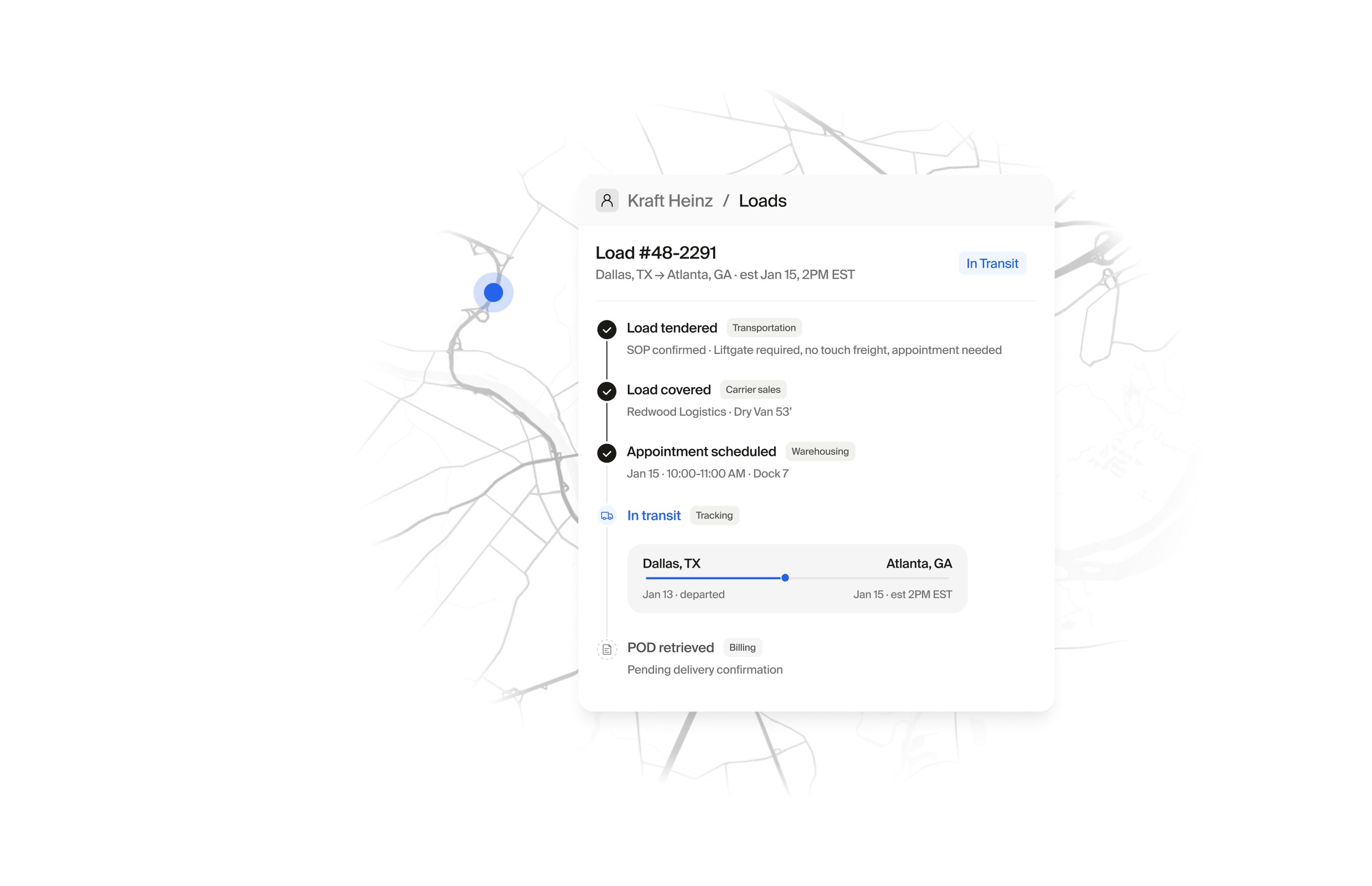
Consider the phrase “late delivery.” For a grocery distributor it may mean a shelf-life risk and an immediate search across nearby distribution centers. For an industrial supplier it may mean a production line is about to stop. For a freight broker it may start a sequence of calls, appointment changes and detention calculations. Even a lane is not merely two points on a map. It carries preferred carriers, equipment constraints, dock hours, seasonal hazards and a history of promises made to a particular account.
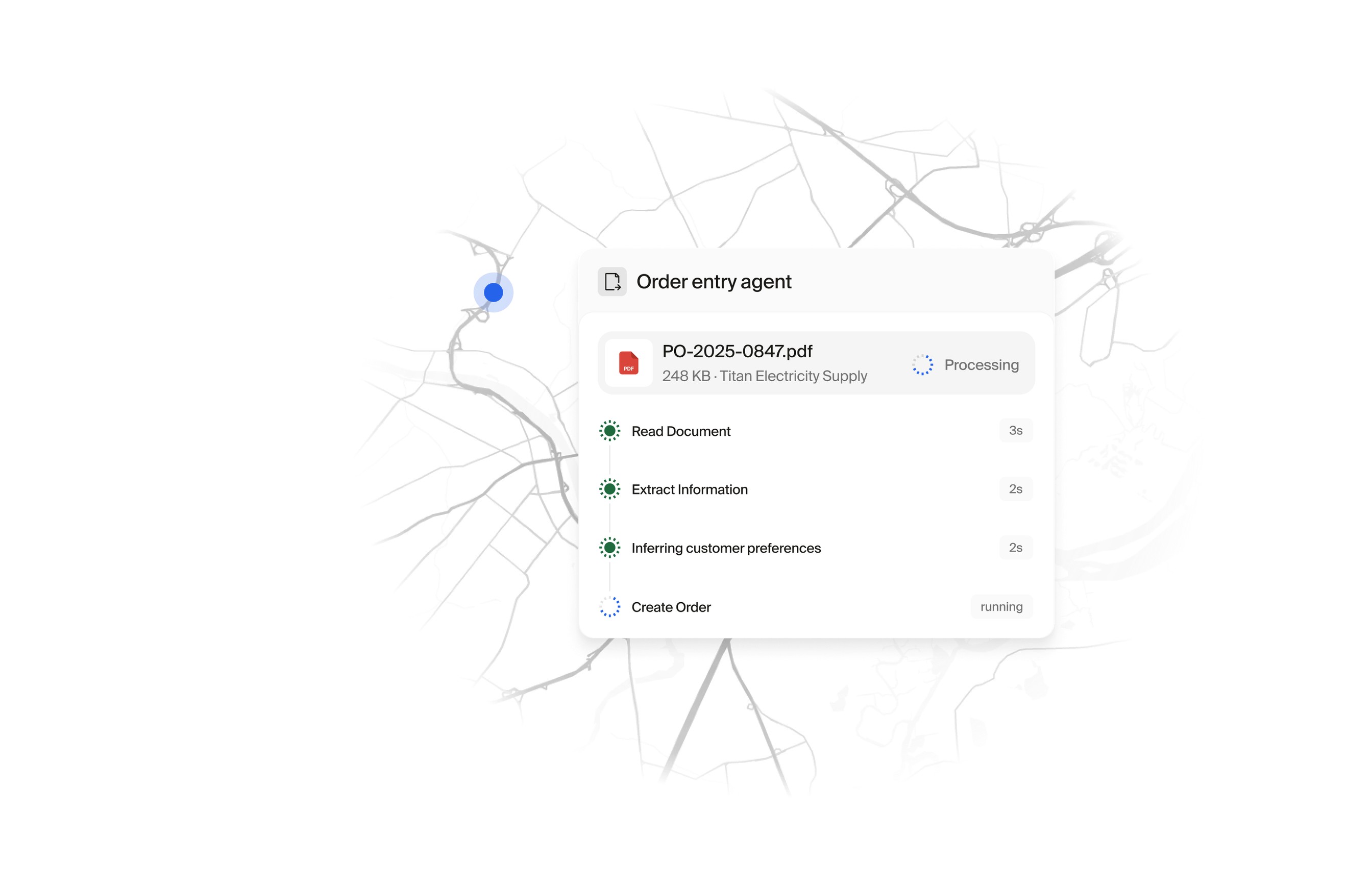
Traditional software handles this diversity by turning it into brittle branches: if this, then that. People handle it differently. An experienced operator recognizes the account, retrieves a half-remembered exception and applies judgment. Pallet’s product page says its Memory system stores SOPs and operating instructions in one place, indexed through a knowledge taxonomy. When an agent needs to act, the relevant customer knowledge is brought into context.
The scale of that hidden rulebook can be startling. In a Pallet article about agent architecture, the company says it has seen brokerages average 20 custom rules per customer across 200 customers: 4,000 rules before the first new exception arrives. The lesson is not that 4,000 is an especially large number. It is that none of those rules is safely interchangeable.
Fine-tuning by customer matters because the model learns the patterns of that private language: which document fields matter, which ambiguous phrases tend to signal which workflow and what good judgment looks like in that operation. Memory then supplies the explicit rule at the moment of action. One provides specialized reasoning; the other provides inspectable instructions.
A model is not a filing cabinet
The distinction between the custom model and Memory is the quiet center of Pallet’s design. A model can become better at interpreting the forms, vocabulary and recurring decisions of a business. But a model is a poor place to keep a rule that an operator needs to inspect, debate or change before tomorrow’s first pickup.
Memory is meant to keep those rules legible. Pallet describes plain-English memories organized by customer, location and topic. A rule such as “obtain approval before billing detention” can remain visible and editable instead of disappearing into model weights. Human interventions are committed back to the enterprise Memory layer, Pallet says, so a corrected exception becomes reusable operating knowledge.
Reasoning that learns. Rules that stay visible.
This produces a useful division of labor. The private model learns how this operation reasons. Memory says what this operation currently requires. If a customer changes its free-time allowance or a warehouse changes receiving hours, the business should be able to update the instruction without retraining an entire model—or trusting that a chatbot will somehow infer the new policy.
There is also a governance benefit. An auditor can read a rule. An operations leader can challenge it. A new employee can understand why an agent escalated a charge. The intelligence does not become less proprietary because it is inspectable; it becomes more governable. The model may be the engine, but Memory is the service manual kept in the customer’s own glovebox.
The 70 percent claim
Private intelligence would be an elegant idea and a difficult business if every routine classification required the largest model money could buy. Frontier models are broad by design. They are built to write poems, debug software and explain medieval trade. A logistics workflow may need something narrower: read this bill of lading, recognize this account’s conventions, validate six fields and choose the next approved action.
Pallet says its custom models cost roughly 70% less to run than frontier models on the same workflows. The company has not published the benchmark methodology on the live product or security pages.
The logic behind the claim is important. When a model is specialized for a bounded operating domain, the customer need not rent maximum general intelligence for every repetitive task. At volume, inference is not an abstract cloud expense. It is a toll paid on every email read, document parsed, status checked and response drafted. A 70% reduction, if it holds across a customer’s workflow mix, changes which automations can cross the line from impressive demo to economical production.
The savings also strengthen sovereignty. Pallet says it can swap between frontier and open-source models. That makes the underlying model a replaceable component rather than a permanent landlord. The best model can handle the hardest step; a smaller or open model can take the routine work; a future model can replace either. Portability is not the absence of vendors. It is the ability to change them without abandoning the operating knowledge accumulated above.
The locks around the lesson
A private model is only as private as the system around it. Pallet’s security page makes the surrounding controls concrete. The company lists SOC 2 Type II, GDPR compliance and CCPA alignment. It says customer data is encrypted at rest and in transit, backups are encrypted, and each organization’s data is kept logically separate in a multi-tenant environment. Its infrastructure runs on Google Cloud with VPC network isolation, DDoS protection and sandboxed compute for workloads.
Access is constrained through role-based permissions; secrets sit in a centralized manager with rotation and identity-controlled access. Pallet says it monitors authentication attempts and API activity, scans containers for vulnerabilities and conducts penetration testing. At the model boundary, it describes input sanitization, prompt-injection defenses, structured-output validation and rate monitoring. Customer-controlled deployment options add another lever for organizations whose security or architecture requirements demand more control over where the system runs.
None of these controls can prove that an AI system will never fail. They do make the ownership promise testable in ways that a slogan is not. Encryption addresses exposure. Tenant isolation addresses accidental mixing. Access controls address internal reach. Deployment choice addresses organizational control. Model swapping addresses dependency. Memory’s visibility addresses operational accountability.
The pattern matters: sovereignty is not one feature. It is a chain. Break tenant isolation and the private rulebook is not private. Hide the rules inside an opaque model and the asset cannot be governed. Bind the system to one model provider and ownership begins to resemble a long lease.
“Fluency is abundant. Faithfulness to the way one particular company works is scarce.”The operating advantage
The intelligence that stays behind
The most valuable person in a logistics office is often the one who knows that a certain consignee closes the receiving door early, that a certain charge must be phrased carefully and that a certain customer would rather get a phone call than a perfect email five minutes later. Companies call this tribal knowledge because it lives socially—passed from desk to desk, vulnerable to turnover and rarely captured in the system of record.
Pallet is trying to turn that fragile inheritance into infrastructure. On its product page, it says agents can work across email, voice, documents, APIs, EDI, browsers and remote desktops. That breadth matters because the rules do not live in one database. They appear in inbox replies, corrected forms, phone calls and the moment an operator overrides the obvious answer.
The private model notices the patterns. Memory preserves the instructions. Human review adds corrections. Simulations test behavior before production. Together, those layers aim to let an agent behave less like a visiting chatbot and more like an operator who has spent years on the account. Crucially, the knowledge gained from that apprenticeship is supposed to stay with the company that paid for it.
That is the sharper version of Pallet’s pitch. It is not merely “AI for logistics.” It is a claim that the next durable corporate asset may be a machine-readable account of how the company makes thousands of small decisions—and that giving up control of that asset would be like giving away the playbook with every load.
The real lock-in is forgetting
Software lock-in is usually described in terms of contracts, integrations and migration costs. In agentic operations, there is a subtler danger: the longer the system works, the more it learns, and the more expensive it becomes to leave. If that learning is trapped inside a vendor’s black box, success itself tightens the lock.
Pallet’s answer is to separate the durable asset from the replaceable machinery. Keep customer rules in an inspectable Memory layer. Build a model around the customer’s own data. Allow the reasoning substrate to move among frontier and open-source options. Protect the whole arrangement with enterprise security controls and deployment choice. The architecture turns portability from a procurement promise into a design constraint.
The idea will ultimately be judged in production: accuracy on exceptions, the clarity of memory changes, the real cost per completed workflow and the practical ease of switching models or deployment modes. Those are better questions than whether an agent can produce a fluent email. Fluency is abundant. Faithfulness to the way one particular company works is scarce.
Back at the freight bill, the agent does not merely need to know what reclass means. It needs to know what it means to this customer, on this lane, under this SOP, today. Pallet’s private-model strategy starts from that difference. In supply chain, intelligence is not knowing the common answer. It is knowing who owns the exception.
Reporting is based primarily on Pallet’s Agent platform, security architecture and its published explanation of Memory and reasoning.