The revealing number was $395. In June 2015, that bought a homeowner six months on a multiple listing service through Owners.com. Add another $395 for help with pricing, negotiation and a contract. A transaction associated with a percentage of a house’s value had acquired something resembling a restaurant menu. You could see the parts. You could choose.
- Owners.com sold home buyers and sellers a choice of digital tools and professional help.
- Its offer evolved from flat-fee listings and buyer rebates toward local agents, financing and closing services.
- Altisource closed the business in 2019 after deciding against the investment needed to make it independent.
That last detail matters before anyone starts house hunting. This is the story of a discontinued brokerage. Its appeal lies in a question that remains useful: when customers take on work themselves, how much of the saving can a business afford to give back?
A house sale, taken apart
Owners.com’s web service began in 1996. Co-founders Hans Koch and Jack Reibling were pursuing people prepared to sell their own homes. In a 1999 account, Koch’s interest in property stretched back to watching contractors build an addition to his family’s house. The business turned that practical curiosity into online tools and information for sellers.
The customer was a person with an unusually expensive asset and a willingness to participate. Access to buyers, information about value and help completing a transaction could be offered separately. The seller who needed a listing did not necessarily need every service traditionally wrapped around it.
By the time Altisource bought the business in November 2014, Owners.com had substantial listing activity. The acquisition announcement reported approximately 35,000 properties listed during the previous year, with aggregate asking prices of approximately $11.5 billion. Asking prices describe inventory, of course. They do not establish completed sales or brokerage revenue.
The buyer had already done some homework
Altisource paid $19.8 million in cash at closing, with up to $7 million in additional performance-related consideration. It already owned the auction marketplace Hubzu. Owners.com brought another route into residential transactions: the homeowner who wanted more control over the process.
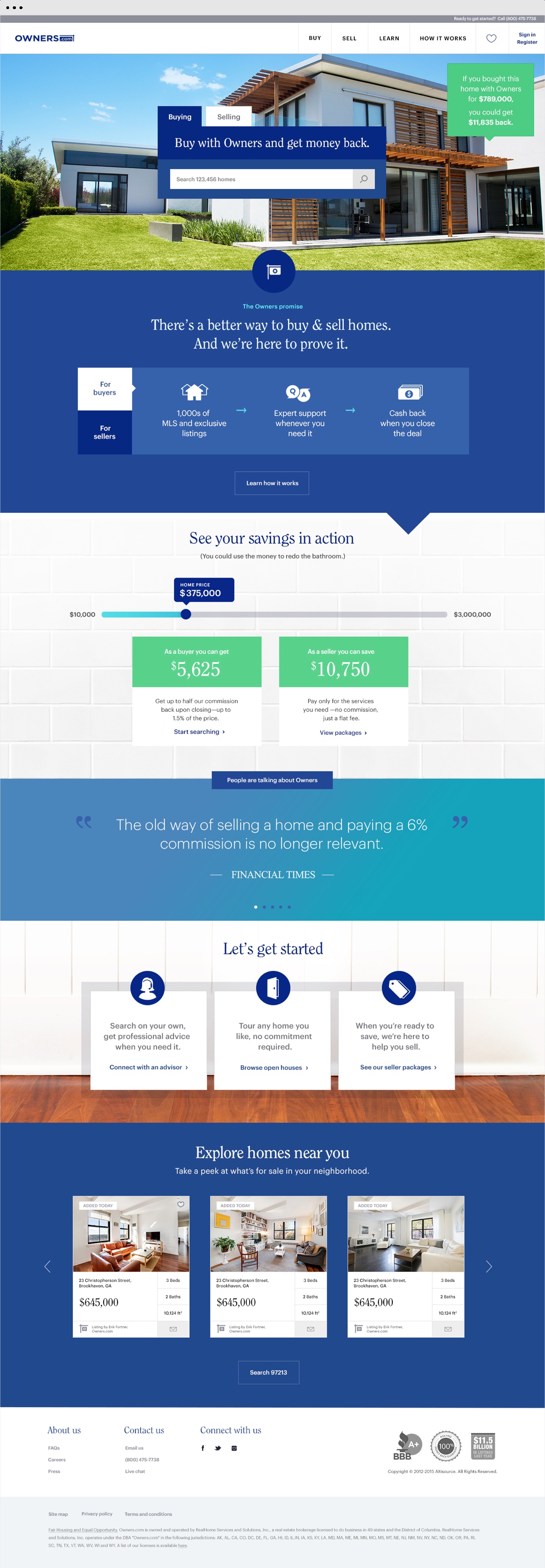
The 2015 brokerage relaunch extended that logic to buyers. Someone who had searched listings, compared neighborhoods and selected a property had already performed part of the search work. Owners.com proposed returning half its buyer-side commission, advertised as up to 1.5 percent of the purchase price, in eligible transactions.
“Consumers should be financially rewarded for the work they do themselves”Steve Udelson, Owners.com president, 2015
The company illustrated the proposition with a $300,000 home and an approximately $4,500 rebate. Eligibility depended on location and other restrictions; it was never a universal promise. The flat-fee seller package similarly bought specified services, rather than erasing every possible selling expense.
Historical example. State, lender and transaction restrictions applied.
Owners.com occupied an interesting middle ground. Traditional brokerages supplied local expertise; listing portals helped people discover homes. Owners.com wanted to combine discovery, a licensed transaction service and a smaller bill. Redfin and Xome were competing around overlapping territory, with different operating arrangements.
The calendar became part of the product
Finding an attractive listing leaves a surprising amount unresolved. Someone has to arrange a viewing. Someone has to remember which kitchen belonged to which address. A buyer may enjoy searching at midnight and still want an agent when an offer becomes real.
Owners.com’s own 2018 research captured this combination. Among 1,214 recent home buyers surveyed by Echo Research, 83 percent had worked with an agent. Forty-six percent wanted an agent to keep appointments, viewings and follow-ups together; 42 percent wanted online showing appointments. The survey was company-sponsored, but the demands were concrete.
That September, Owners.com introduced preference-based property rankings, tour scheduling and tour reports. The ranking detail was particularly useful: homes were ordered by their match to preferences instead of simply disappearing when they missed a requirement. A house with one compromise could remain in contention.
- 01Rank the homesKeep trade-offs visible.
- 02Book the toursArrange multiple viewings.
- 03Keep the reportReview notes and details.
Tour reports brought photographs, property details, neighborhood information and viewing notes into one place. These features addressed the coordination surrounding a decision. For a buyer, that could mean fewer scattered messages and less reliance on memory after several similar houses.
First the menu. Then the bundle.
By December 2018, the company was offering selected customers up to $2,150 in closing savings through bundles and preferred providers. Owners.com Loans supplied financing options; Premium Title supplied closing and escrow services. The initial offer covered eight states, with savings varying by state.
The direction had changed. After making individual services easier to choose, Owners.com was giving customers reasons to buy several together. Mortgage brokerage had also been introduced to increase revenue per transaction. More of the journey could stay within the same family of businesses.
The product lesson is practical: identify the tasks customers willingly perform, then make the handoffs easier. A cheaper listing suits a seller prepared to manage more work. A buyer who needs extensive guidance requires a service capable of funding that attention. Restrictions on rebates and financing further limit where a particular savings formula travels.
The investment clock ran out
In August 2019, Owners.com announced that select Atlanta and Chicago agents had received Best of Zillow recognition based on customer feedback. Less than two months later, Altisource announced the closure. Good customer experiences and a parent company’s willingness to keep investing are separate tests.
Reported by Altisource. Loss is a separate measure, not an expense total.
Altisource cited cash burn, the time required and the additional investment needed for Owners.com to operate independently. It expected a $5.9 million non-cash impairment, alongside wind-down and severance costs. Closure was completed by December 31, 2019.
What gave way was the parent’s appetite for that remaining journey. The evidence supports a financing and strategic decision, without proving that one feature or fee caused the outcome. Owners.com made the customer’s work visible in the price. Its ending makes the company’s remaining work visible too.