Consider the journey of a mortgage document. At Standard Chartered, an account of the old process describes paperwork emailed or couriered to customers, a video call to witness signing, a scan or return delivery, and another call to confirm receipt. The signature occupied a moment. Everything around it occupied people.
SC Ventures worked with OneSpan to put that journey inside a browser. Staff uploaded documents; customers received notifications, reviewed the paperwork, and clicked to sign. Completed records returned to a central platform. By October 2021, SC eSign was live in 21 countries. The interesting invention was the disappearance of all those handoffs.
THE QUICK READ
- OneSpan connects digital agreements with identity and authentication.
- Banks are a core market; the company also serves government, healthcare, and insurance.
- Its 2023 reset shows why useful software does not automatically produce fast growth.
Who, exactly, clicked?
OneSpan occupies a peculiar corner of enterprise software: the place where convenience must leave evidence. A loan application should feel straightforward to the borrower. Behind it, the lender needs confidence about identity, consent, and the integrity of the completed document. Those are different problems, even when they appear on the same screen.
OneSpan Sign handles document preparation and electronic signatures, with authentication options, digital seals, and audit trails. Smart Forms guides data collection. Notary capabilities address transactions requiring notarization, where available. Developers can embed signing inside their own applications. The appeal is that a customer can finish a consequential transaction without learning another company’s interface.
“puts customer experience at the centre of performing document signing”
Thorsten Neumann, SC Ventures
Customer account, originally published November 2021
The other portfolio, Cybersecurity, tackles access and transaction security. It includes authentication software, Digipass devices, and mobile application protection. Transaction signing adds a useful distinction: authorizing particular transaction data goes beyond proving that somebody successfully logged in. A bank wants assurance about the instruction as well as the visitor.
- 01IdentifyWho is here?
- 02AuthorizeWhat did they approve?
- 03PreserveWhat can you prove?
That leaves a useful procurement question: how much assurance does this particular agreement need? The answer can change between an internal acknowledgment and a customer moving money. OneSpan’s configurable signer authentication supports that choice. Buyers should ask which controls are included, which require additional configuration, and which records remain accessible afterward. The product demonstration should follow the actual customer journey, including the person who will eventually have to investigate a disputed transaction.
The little device with a long shadow
The company’s security roots explain this combination. Founded by Ken Hunt, OneSpan was previously VASCO. Its 2015 purchase of Silanis Technology for $85 million brought the electronic signature business that became OneSpan Sign. In 2018, VASCO adopted the OneSpan name as its strategy moved further toward software and cloud services.
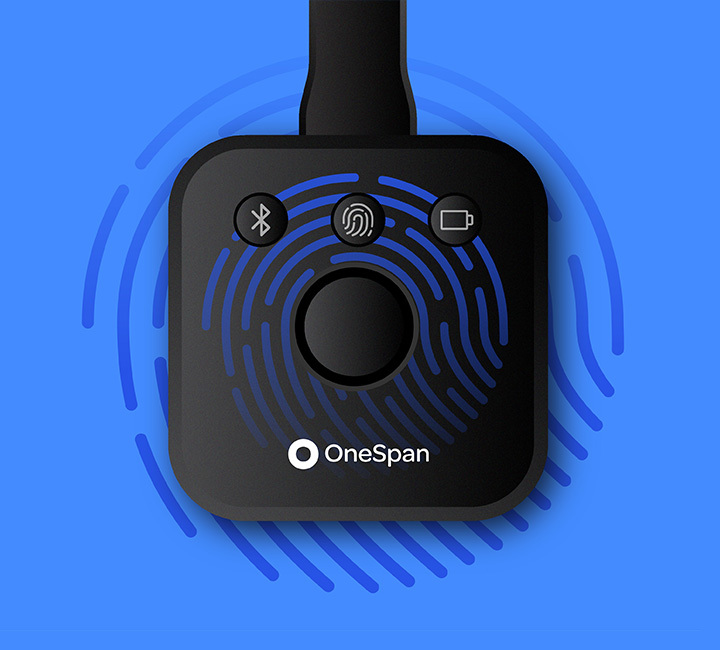
Yet the physical authenticator never vanished. The Digipass FX1 is a FIDO2-certified security key with fingerprint authentication and USB, Bluetooth, and NFC connectivity. It makes an abstract security requirement rather tangible: a small object, a finger, an authenticated session. OneSpan also sells software authentication, allowing organizations to support different devices and customer preferences.
That breadth is its market position. Docusign and Adobe are the familiar alternatives for electronic signatures. OneSpan brings a separate authentication and mobile security business to the conversation. Its stated customer base includes more than 60% of the world’s 100 largest banks. That is a company-reported adoption measure, not a market-share calculation.
Then the growth plan met reality
The corporate story becomes more revealing in 2023. OneSpan had expected faster Digital Agreements growth. By the second quarter, it concluded that the planned revenue trajectory was unlikely within its three-year timetable. Its filings identified longer sales cycles, price sensitivity, limited brand awareness, and aggressive competition. Customers already had signing tools woven into their operations.
The response was a pivot toward profitability and further cost reductions. Restructuring and related charges totaled $17.3 million in 2023. This was a real expense involving people, offices, and vendor commitments. The early failure was a growth assumption: having a capable product did not make replacing an incumbent easy.
By 2025, revenue was $243.2 million, essentially unchanged from 2024, while operating income rose 8% to $48.4 million. Subscription revenue increased 12% to $156.1 million. The business had improved its mix and profitability without producing overall revenue growth. All three facts belong in the same sentence about progress.
The latest reported quarter keeps that tension alive. In the second quarter of 2026, revenue rose 1% to $60.5 million, while operating income fell 17% to $8.7 million. Digital Agreements grew 25%; Cybersecurity declined 7%. A company can have an expanding signing business and still face pressure elsewhere. The portfolio does not move in lockstep.
What the next signature costs
For a buyer, the entry point is concrete. OneSpan Sign Professional lists $22 per user per month, billed annually, with up to 1,000 transactions per user each year. That is $264 annually per seat. Enterprise pricing depends on volume; integrations and optional capabilities can change the bill. A seat price is not an implementation budget.
The practical lesson is to copy the workflow analysis. Map each upload, identity check, reminder, approval, and transfer into the next system. Then test one complete transaction in a sandbox. OneSpan’s March 2026 Workato integration offers a low-code route between signing and enterprise applications. The value depends on which manual steps it actually removes.
For the team running that trial, the awkward cases matter most. Try the wrong recipient, an incomplete form, an expired invitation, and a customer changing devices halfway through. Decide who owns the exceptions and where the completed evidence will live. Those are evaluation tasks, not promised results. Automating a process still requires somebody to understand it.
Modernize without pulling out the floor
In July 2026, OneSpan introduced DigipassONE, bringing authentication, transaction security, mobile protection, analytics, and digital credentials into a common platform. Its October announcement expanded the ambition around OneSpan Sign, describing new and planned capabilities beyond signing. Buyers should distinguish available functions from the roadmap. A platform announcement is a starting point for evaluation.
The fit is strongest when identity, evidence, and integration materially affect the transaction. A team sending occasional simple documents may have little reason to replace a tool that already works. For a bank wrestling with authentication methods and document handoffs, the calculation changes. Start with the mortgage journey: count the calls, the scans, the waiting. That is where the signature business gets interesting.
KEEP EXPLORING