Company • Climate • AI • Retail Media
Olyns
The reverse vending machine that pays cash for your empties - and lets the ads on top pay for the recycling.
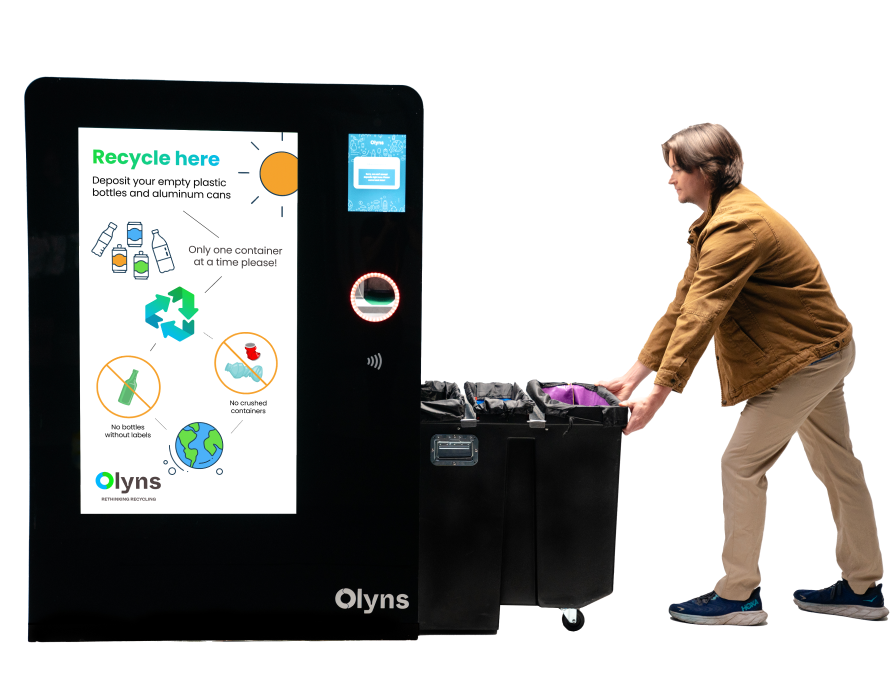
The reverse vending machine that pays cash for your empties - and lets the ads on top pay for the recycling.
Walk into a grocery store in California and you may pass a glowing box the size of a phone booth. A 65-inch screen plays a soft-drink ad. Below it, a slot waits. You feed it an empty bottle, a camera looks at it, an algorithm decides what it is, and a few cents land in your phone. The machine is called the Cube. The company is called Olyns.
It is, depending on who you ask, a recycling appliance, an advertising network, or a small act of optimism about the circular economy. Olyns would say all three, and would not apologize for it. The pitch is unusually blunt for a climate startup: recycling, done the normal way, loses money. So Olyns stopped trying to make money on the plastic.
Recycling, done the honest way, has always been a charity dressed as a business. Olyns just sent the bill to the advertisers instead. - The central bet, in one sentence
It is not that people hate the planet. It is that recycling a bottle is mildly inconvenient and pays almost nothing, while the material itself is worth less than the cost of collecting it. The economics quietly refuse to add up, and have for decades.
Meanwhile brands face a different headache: regulators and consumers want recycled content - food-grade rPET - and there is roughly a billion pounds of unmet demand for it. The supply is sitting in living rooms and trash cans, one empty bottle at a time, because nobody built a convenient enough on-ramp.
Founder Philip Stanger, an engineer who had worked at Apple, kept arriving at the same question. The recycling business was broken at the level of the model, not the machine. Subsidies and guilt were doing the heavy lifting, and neither scales.
So he reframed it. If the bottle can't pay for its own collection, what can? The answer was hiding in plain sight: the foot traffic. A recycling machine at a store entrance is, accidentally, prime advertising real estate.
Can we alleviate recycling issues through a different business model? - Philip Stanger, Co-Founder & CEO
Stanger and co-founder John Buchowski started Olyns in 2019 in the San Francisco Bay Area. The wager was simple to state and hard to build: combine a reverse vending machine with a digital out-of-home advertising display, and let advertising revenue cover the cost of collecting and sorting material. The recycling becomes free to the retailer and rewarding to the shopper, because the brand on the screen is quietly paying for all of it.
Most startups add a screen to sell you something. Olyns added a screen so it could afford to take something off your hands. - On the inversion at the heart of the model
The Cube fits in about 12 square feet, plugs into a normal outlet, and holds upwards of 2,200 containers. A shopper opens the Olyns app, deposits a bottle or can, and AI image recognition identifies and sorts it into plastic, glass, or aluminum - then crushes it. In deposit states, refunds route through the app. Where there is no deposit, recycling is gamified into rewards, leaderboards, and the occasional small dopamine hit.
AI reverse vending machine that recognizes, sorts, and compresses containers, and issues cash or rewards on the spot.
The retail-media screen on every Cube. Brands run full-motion ads at the point of recycling; that revenue covers collection.
Touchless deposits, recycling history, reward redemption, and bottle-deposit refunds - including a Coca-Cola co-branded version.
B2B dashboards giving brands and retailers recovery rates, recycling behavior, and compliance reporting.
When a Cube fills up, Olyns pings a network of gig workers, who haul the material to recycling centers. Olyns handles installation, maintenance, certification, and the unglamorous compliance paperwork. The retailer mostly just provides the floor space.
Philip Stanger and John Buchowski set out to fix the recycling business model, not just the bin.
CleanTechnica profiles the reverse vending machine that pays cash for plastic.
Early capital to accelerate the consumer recycling rollout; Closed Loop Partners provides financing for food-grade rPET collection.
Led by Vanedge Capital, to expand the dual recycling-and-media network.
Coca-Cola showcases the Olyns Cube at the convenience-store industry's marquee show in Atlanta.
Deployed at Walmart, Target, Safeway, Lucky, and Foodmaxx across multiple states.
A self-funding recycling network sounds nice until you check who is actually buying the ads. Olyns lists Coca-Cola, PepsiCo, Mars Wrigley, Molson Coors, Meta, T-Mobile, and Yves Saint Laurent among its brand partners - the same companies under pressure to show recycled content and recovery data. The Cube gives them both: a place to advertise and a measurable recovery rate per brand.
The bottom two bars are the problem Olyns exists for. The top two are how it pays to chase it. Ad revenue is the load-bearing wall; the bottles are the bonus. (Bar widths illustrate the argument; recycling-rate figures are widely cited industry estimates.)
The Olyns platform is a proven, effective, and profitable model that shifts the consumer recycling paradigm. - Paul Lee, Managing Partner, Vanedge Capital
Olyns frames its purpose in two halves that turn out to be the same business. People want recycling to be convenient and rewarding. Brands want consumers, recycled material, and proof they are doing something. Stand a Cube at a store entrance and both wishes are granted at once.
The deeper goal is a circular economy that does not depend on subsidies or scolding. If recycling can pay for itself, it can scale on its own logic. That is the quiet radical claim under all the bright screens.
It is a tidy piece of judo: the advertising industry, usually accused of selling people things they don't need, ends up bankrolling the disposal of the things they already bought.
Whether that scales to thousands of stores is the open question. Olyns has 12-plus million containers and a list of marquee logos arguing that it might.
Momentum is growing, and this funding will help us expand our network, which is proven to be both profitable and scalable. - Philip Stanger, Co-Founder & CEO
Return to that grocery entrance. The screen is still playing an ad. Someone still feeds the slot an empty bottle and watches a few cents arrive. Nothing about the moment looks like climate policy or retail-media disruption. It looks like a person throwing something away slightly better than usual.
That is the whole point. Olyns did not ask anyone to care more. It made the convenient thing and the right thing line up, then handed the invoice to the advertiser. If that keeps working - if the screens keep paying and the Cubes keep multiplying - the boring economics that doomed recycling might finally, quietly, start to add up.