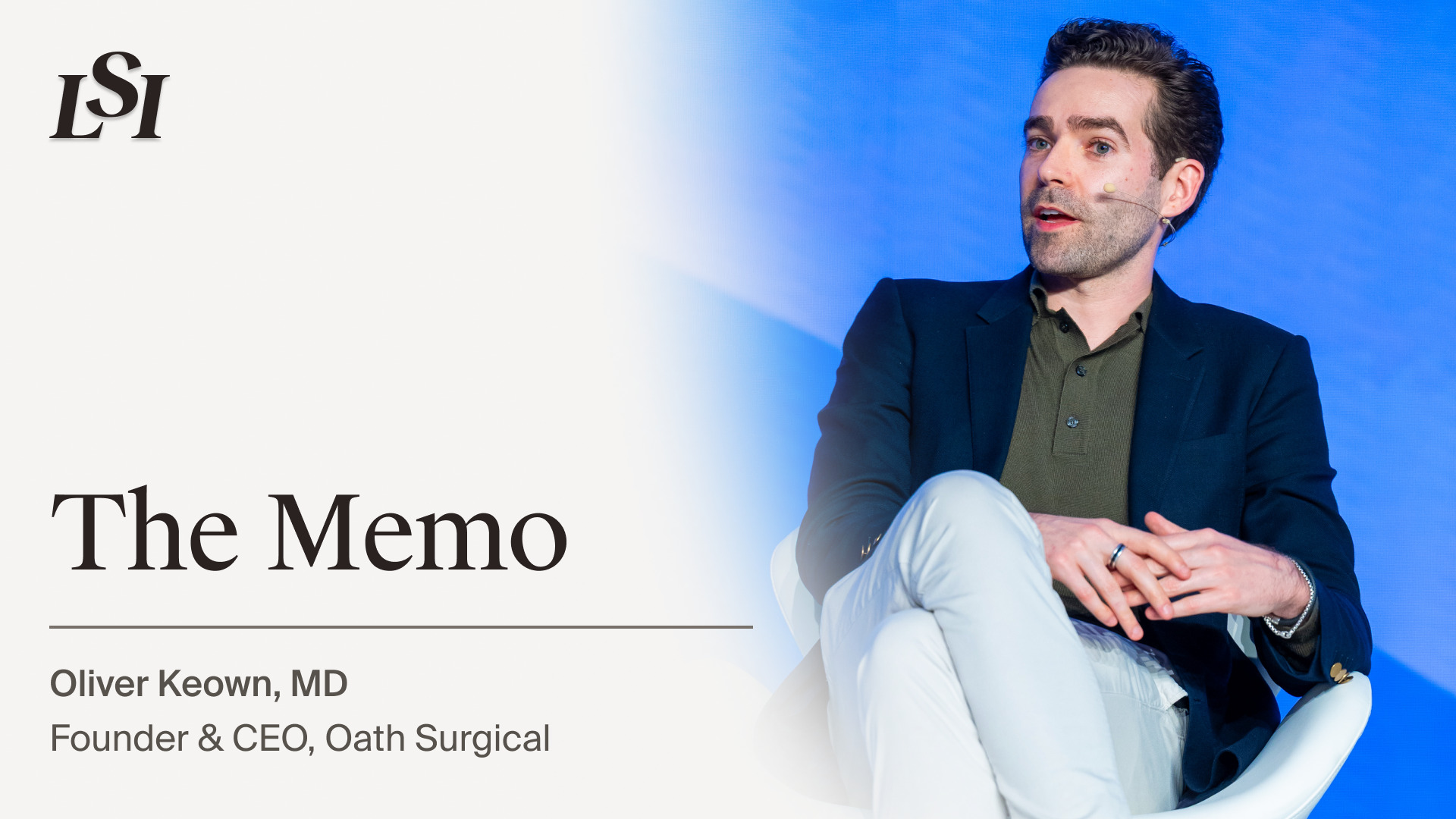
Oliver Keown spent years with an unusually good view of the operating room. He saw it first as a physician trained in Britain’s National Health Service, then from the policy offices of Imperial College London, then across investment tables at GE Ventures and Intuitive Surgical. Each seat offered a wider lens. Each also exposed the same irritating fact: the clever new thing is often the easy part. Getting it into the place where care actually happens is where optimism goes to fill out forms.
By late 2023, Keown had become accomplished at judging other people’s answers. He had helped found Intuitive Ventures, built a portfolio across medical technology, digital health, and artificial intelligence, and grown the platform beyond $250 million. Then he made what he called his toughest and most thrilling career decision. He stopped selecting companies and started one.
The startup was introduced as Cleo Surgical. It emerged publicly in 2025 as Oath Surgical, a name with less classical glamour and more moral weight. The word is a promise, and promises are inconvenient things. They demand evidence.
A physician learns to zoom out
Keown earned both an MD and a bachelor’s degree in pharmacology from the University of Edinburgh. His early clinical work in the NHS left him with a lesson that would later become a company premise: care does not have to be expensive to be good, but it does have to be efficient and focused on outcomes. It is the sort of sentence that sounds obvious until one notices how many systems reward activity, ownership, or habit instead.
At Imperial’s Institute of Global Health Innovation, he worked as a clinical and policy adviser. The job widened the frame from one encounter to the rules governing millions of them. GE Ventures widened it again. From 2016 to 2019, he worked with digital-health and medtech companies, watching teams cross the distance between an invention and a functioning business.
In 2019 he joined Intuitive Surgical, maker of the da Vinci surgical system, and helped establish its dedicated venture program. The first $100 million fund launched publicly in 2020. Keown’s remit included the continuum of minimally invasive care: devices, diagnostics, therapeutics, and software. Global Corporate Venturing placed him at number 39 on its 2022 Powerlist. The honor captured the investor he had become. It also arrived near the point when he was preparing to become something else.
“I’ve recognized that incremental, small steps are not enough to move the needle.”Oliver Keown
The patch had become the pattern
The venture years gave Keown a privileged tour of progress. They also showed him why progress could stall. A startup might improve one narrow task, only to meet a clinical environment assembled from incompatible systems, inherited workflows, and incentives pointing in several directions. In Keown’s description, software companies kept producing point solutions while established providers accumulated surgical assets without remaking the underlying model.
He began to see outpatient surgery as the opening. Minimally invasive tools were making more complex procedures possible outside large inpatient hospitals. Independent surgeons wanted autonomy and access to technology. Patients and payors wanted lower costs and clearer evidence of quality. Yet the setting meant to connect them often lacked an integrated digital backbone.
A conventional software founder might sell that backbone to existing centers. Keown chose the less convenient route. Oath would operate centers and build the software. It would arrange the physical environment and the digital one together, then recruit surgeons as partners rather than treating them as end users who happened to own scrubs.
Software with an address
OathOS is the software layer of the wager. It is designed to connect the work before, during, and after a procedure: referral intake, scheduling, preparation, documentation, coding, billing, recovery, and outcomes. Inside the operating room, the system is intended to work ambiently with video, audio, device, clinical, and operational signals. Outside it, the same record can follow performance over time.
The owned center matters because data architecture is easier to promise than to install. Oath can decide where equipment sits, which workflows are standard, and how information moves. The room becomes part of the interface. Walls, wiring, software, and staff practice are no longer separate negotiations.
This vertical integration is expensive, slow, and operationally fussy. Real estate has never accepted a software update. Clinical staffing cannot be summoned with an API. Each market brings licensing, contracts, equipment, and local relationships. Yet those difficulties are also the point. If the old environment is the constraint, building only a new interface leaves the constraint in charge.
Portland as proof
Keown launched Oath in November 2023 and spent roughly a year living in Portland while the team built its first centers. The choice gave the thesis an address. By the company’s public launch in May 2025, Oath paired its software with owned outpatient facilities and a broader network of affiliated centers and surgeons.
The company’s centers are multispecialty rather than devoted to a single procedure category. That makes the operating challenge harder, but it also turns each location into a broader test of the system. Oath’s public materials describe surgeon vetting, outcomes tracking, and facility co-ownership as central pieces of the model. The ambition is to make quality visible and economic participation more direct.
Capital followed the early evidence. In October 2025, Oath announced a $24 million Series A led by FPV Ventures, with McKesson Ventures and existing investors participating. The round brought reported total funding to $35 million. The number matters because this model consumes money in two dialects at once: software development and physical expansion.
The investor becomes investable
There is a pleasing reversal in watching a venture capitalist pitch a venture. Keown once sat on the side of the table that asks whether a founder has discovered a genuine wedge or merely renamed a crowded category. Oath gives him no shelter from the same test. Its wedge is control of the environment. Its claim is that connected centers can produce clearer outcomes, lighter administration, and a more aligned relationship among surgeons, patients, and payors.
His old investor habits remain visible. He speaks in systems, flywheels, incentives, and market structure. But Oath has forced those nouns to meet a timetable. A patient arrives. A room must be ready. A surgeon needs the right tools. A note must be completed. An insurer eventually has to pay. Operations are what happen when a thesis acquires opening hours.
Keown is also building through relationships formed across his earlier careers. The company’s backers include Oxford Science Enterprises, Black Opal Ventures, Tau Ventures, Rogue VC, FPV Ventures, and McKesson Ventures. Its advisers have included operators and health-industry leaders. Brand strategist Hilary Coles, a co-founder of Hims & Hers, helped shape Oath’s identity. The network is not decoration. A model this integrated requires fluency across medicine, technology, finance, and consumer trust.
An AI layer that cannot float away
In January 2026, Oath announced a collaboration with NVIDIA. The plan brought accelerated computing and spatial AI infrastructure into Oath’s centers, supporting analysis of surgical video and audio and the agentic workflows surrounding a procedure. Keown’s framing was careful: AI becomes more useful when the systems beneath it are rebuilt so knowledge and data can be analyzed at scale.
That formulation separates Oath from the fashion of sprinkling intelligence over any available noun. The AI is not the destination. It is a working layer inside an institution designed to capture the signals it needs. If the software can draft documentation, reduce repetitive administration, and connect procedure data with longitudinal outcomes, its merit will be measured in the minutes and decisions it changes.
“Surgery is entering an AI era, but it only works if the underlying systems are rebuilt.”Oliver Keown
Fast Company included Oath in its 2026 World Changing Ideas list. Keown directed the recognition toward the team, surgeon partners, and patients. That instinct is consistent with his public writing, which tends to name collaborators in generous batches. Founders often speak of assembling a movement when what they mean is filling a cap table. Keown’s list is more practical: the people required to open doors on Monday morning.
The next room
Oath’s ambition stretches well beyond Portland. Keown has described a nationwide network of quality-vetted surgeons and outpatient centers, connected through a common operating system. The aspiration resembles a trusted destination for surgery distributed across local markets rather than concentrated in one famous campus.
Expansion will test every part of the thesis. A repeatable software deployment is one thing; a repeatable clinical institution is another. New centers need capital, people, regulatory approvals, payor relationships, and local credibility. Hospitals will not become less entrenched merely because a startup’s diagram is elegant. The company must prove that its outcomes and economics travel.
Still, Keown’s career offers a useful pattern. He did not abandon medicine for policy, policy for investing, or investing for operations. He kept changing altitude around the same question. What helps promising surgical innovation move from possibility into ordinary practice? Oath is his most literal answer yet.
The investor’s balcony offered perspective. The clinic offered consequence. The founder’s job joins the two, then adds plumbing. Somewhere in Portland, a piece of software runs inside a room designed for it, and the grand theory has to survive another Tuesday.