BREAKING•
Notable Systems closes $12M Series B led by Harbert Growth Partners & Grotech Ventures•
From a couple of clients to two dozen-plus in 18 months•
98.5%+ field accuracy•
9 years, zero data breaches•
Apria · Enovis · Aeroflow · ElectroMed on the roster•
SOC 2 Type II · HIPAA•
BREAKING•
Notable Systems closes $12M Series B led by Harbert Growth Partners & Grotech Ventures•
From a couple of clients to two dozen-plus in 18 months•
98.5%+ field accuracy•
9 years, zero data breaches•
Apria · Enovis · Aeroflow · ElectroMed on the roster•
SOC 2 Type II · HIPAA•
Company Profile · HealthTech · Denver, CO
Notable Systems
It reads the medical paperwork that nobody else can - the faxed orders, the handwritten referrals, the scans that came through crooked - and turns it into clean, billable claims. Quietly. Accurately. Without the manual work.
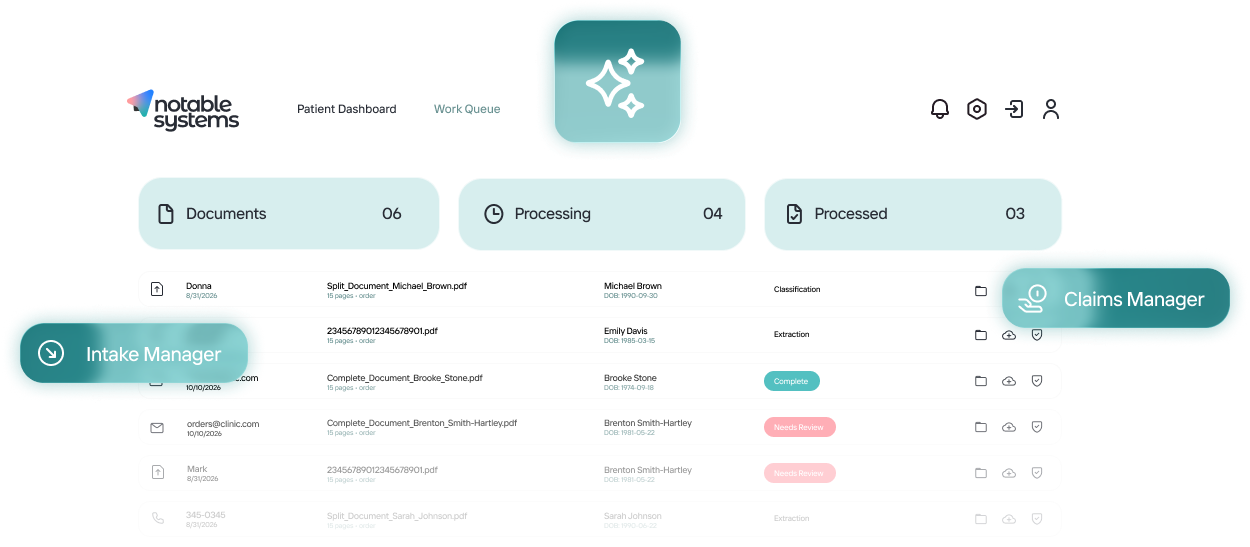
EXHIBIT A: The Notable Systems platform, where a fax that took a billing clerk twenty minutes becomes structured data in roughly the time it takes to sigh. Photographed in its natural habitat: the unglamorous middle of healthcare's revenue cycle.
Who they are now
The company that took the worst job in healthcare
Somewhere right now, a durable-medical-equipment provider is waiting on a fax. A doctor scrawled an oxygen order; a clerk will squint at it, retype it into three systems, and pray a payor doesn't reject it on a technicality six weeks later. This is the part of healthcare nobody puts on a brochure. Notable Systems built a business there on purpose.
From its base in Denver, Notable Systems sells AI automation to the unfashionable corner of medicine - the durable and home medical equipment world, DME and HME in the trade. Oxygen tanks, wheelchairs, CPAP machines, the infusion pump that lets someone go home from the hospital. The equipment is essential. The paperwork behind it is a swamp. Notable drained a piece of it, and in April 2025 investors handed the company $12 million to drain more.
“From referral to clean claim, without the manual work.”
// The Notable Systems pitch, in one line
The problem they saw
Handwriting is the last unsolved data format
Most software companies want clean inputs. Notable went looking for the opposite. Healthcare intake runs on documents that were designed by no one: a referral faxed at low resolution, a multi-patient roster on a single page, a signature that doubles as a diagnosis. Every one of those has to become structured data before anyone gets paid. For years the only reliable processor was a human being with good eyes and lots of coffee.
That human is expensive, slow, and - this is the part billing managers say quietly - inconsistent. A typo in a payor ID turns into a denial. A denial turns into a 45-day appeal. The appeal turns into revenue that may never arrive. The DME industry runs on thin margins and thick stacks of paper, which is a uniquely bad combination.
“People should spend less time on manual work and more time on meaningful work.”
// Notable Systems, company mission
The irony Notable noticed: the industry had spent two decades digitizing healthcare and somehow left the fax machine in charge. So the question wasn't whether to automate intake. It was whether anyone could build software patient enough to read the mess that real clinics actually send.
The founders' bet
Two AOL veterans walk into a fax queue
Notable Systems was founded in 2015 by Steve Johnson and David Lippke - not healthcare lifers, but infrastructure people. Johnson had built and scaled compression technology before AOL acquired it. Lippke had architected the core systems behind AOL's AIM platform back when it carried 53 million users. They had spent careers making enormous, messy data flows behave.
Their bet was specific: handwriting recognition and document understanding were finally good enough to attack a problem everyone else found too boring and too hard. Not general-purpose OCR - that already existed and disappointed everyone. Something narrower and stranger: a system that could read a degraded medical fax the way an experienced clerk does, with context, and flag what it wasn't sure about instead of guessing.
“By predicting compliance with near-perfect accuracy, Notable Systems empowers healthcare providers to transform paperwork into patient care.”
// Steve Johnson, CEO & Co-Founder
The team they assembled tells you where the bet really lives. The president, Brian Nannie, was a Chief Data Officer at Lincare who built OCR and NLP for healthcare operations. The bench carries veterans of Enovis, Numotion and Tactile Medical. Notable's own tagline is blunt about it: “Revenue Cycle AI Automation Built by Billing Experts.” The engineers know data. The operators know exactly which checkbox a payor will deny you over. That combination is rarer than it sounds.
The product
Two engines, one stubborn goal
Notable's platform does two things, and resists the temptation to do twelve. The first engine is intelligent document processing - the Intake Manager. It ingests faxes, scans, emails and handwritten referrals, including the degraded and multi-patient pages that break ordinary tools, and extracts structured data with field-level accuracy north of 98.5%. Where the model isn't confident, a human-in-the-loop annotation team checks it. The point isn't to remove people; it's to stop wasting them on transcription.
Engine 01
Intake Manager
OCR + NLP + machine learning read the order. Humans verify the edge cases. Days of typing collapse into minutes of review.
Engine 02
Payor Greenlight System
Validates each claim against payer-specific coverage rules before submission - predicting a denial so you can fix it first.
The second engine is the more interesting argument. The Payor Greenlight System - paired with the Claims Manager - checks a claim against payer-specific coverage criteria before it's ever submitted. Instead of discovering a denial weeks later, a provider sees the problem while it's still cheap to fix. It's a small shift in timing with a large shift in economics: prevention instead of appeal.
“The hard part was never the clean documents. It was teaching software to read the ones a human can barely read.”
// The engineering problem Notable chose on purpose
Intelligent Document Processing
OCR
NLP
Human-in-the-loop
Denial prevention
SOC 2 Type II
HIPAA
The mission
Less manual work, more meaningful work
Notable frames its mission in plain language - people should spend less time on manual work and more time on meaningful work - and the company's three stated values read like instructions rather than slogans: design for how people actually work, lead with care, keep improving. In an industry fond of disruption theater, that restraint is almost contrarian.
The human-in-the-loop choice matters here too. Notable didn't market itself as the thing that fires the billing department. It positioned itself as the thing that stops the billing department from drowning. There's a Chief Growth Officer at the company, Ruben Johnson, whose background runs through film studies and craft spirits before an MBA - a reminder that the people fixing healthcare's paperwork did not all arrive by the obvious door.
“Design for how people work. Lead with care. Keep improving.”
// Notable Systems, in three rules
Why it matters tomorrow
The fax queue, revisited
The $12 million Series B wasn't a victory lap; it was a runway. Notable has said the money goes toward expanding beyond order intake into the broader revenue cycle - more of the journey from referral to payment, automated end to end. As payors tighten rules and labor stays expensive, the value of predicting a denial before submission only grows. The boring corner of healthcare is about to get a lot of attention.
Go back to that clerk waiting on the fax. In the version Notable is building, the fax lands and becomes data before the coffee cools. The claim gets checked against the payor's own rulebook and flagged if something's off. The clerk spends the afternoon on a patient who needs help, not on a keyboard. That's the whole pitch, and it's a smaller, more honest promise than most AI companies make - which is exactly why it's worth taking seriously.
“Notable Systems didn't try to reinvent healthcare. It went after the paperwork - and that turned out to be the part holding everything up.”
// The closing argument