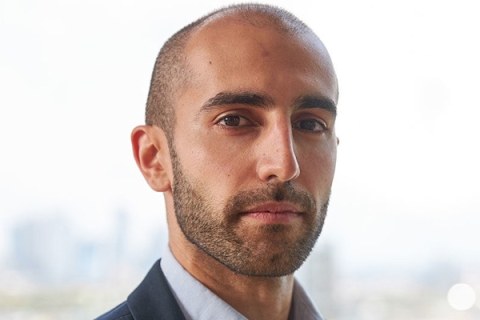
The Person Next to the Person
Muon Space builds satellites that measure the earth. Multispectral sensors, phased-array antennas, cloud-based mission control, software-defined spacecraft. In June 2025 the company closed a $45 million Series B, bringing the total raised to something in the neighborhood of $147 million. The office is on Charleston Road in Mountain View, which puts it walking distance from a Google campus and a Whole Foods, which is the correct geography for a company that talks about earth intelligence and edge computing in space in the same paragraph.
Somebody, at a company like that, has to run the CEO's Tuesday. That person is Niosha Kayhani.
Chief of Staff to the CEO is a title that reads like an assistant and works like something else. At a Series B hard-tech company, it is the seat immediately adjacent to the founder, which means it is the seat that decides which meetings happen, which board slides get finalized, which vendors get paid, which candidates get called back, which fires are actual fires. It is a job for a chartered engineer with an executive MBA, which is what Kayhani is.
Kayhani did not arrive at Muon Space by accident, but he did arrive by a route almost nobody plans. He grew up in the UK, took a BEng in Mechanical Engineering at the University of Portsmouth from 2007 to 2014 (with a year in industry, which is what British engineering degrees do instead of internships), ran the men's basketball team, sat on the student council, and was elected valedictorian of his subsequent Master's cohort. He also, on the recent record, remains the person who organized a 2022 reunion of that basketball team to honor a teammate, David Hyde, who died at 29. This detail is small and belongs in a footnote in most profiles. It belongs closer to the top here.
His first job was tuning fiber-optic lasers at SPI Lasers, a company most people have never heard of, which is often the sign of a good first job. From there he took what looked like a hard left into Google's Dublin office, where he worked on digital strategy for small and medium-sized businesses and, briefly, on autonomous vehicle projects. Ad ops to self-driving cars is a strange sentence, but it is Google's sentence, and Kayhani lived inside it long enough to get the flavor of software-scale.
Then he went back to hardware. In 2016 he joined the Cubic Innovation Centre in London as an R&D engineer. Cubic is a defense and transportation company that most people know, if they know it at all, because they have tapped a Cubic-built fare gate to get on the London Underground or the New York subway. In 2017 Kayhani was in Rome presenting a prototype called the gateless gateline, which used biometrics to let people walk through fare barriers without stopping. In 2018 he was posting on LinkedIn about vulnerability and Brené Brown. By 2019 he had been promoted and eventually ran a $55 million R&D portfolio with a hundred-plus engineers and product managers reporting up. Somewhere in there he flew to Niš, Serbia to work with the Cubic Digital Intelligence team, and posted a photo saying "it is an honor to be part of this talented group." He collected an executive MBA from Warwick Business School along the way.
Somewhere else in there, he became a named inventor on more than ten U.S. patents. This is the sort of thing a chief-of-staff bio usually buries at the bottom of a LinkedIn "About" section.
The move from Cubic to Muon Space is legible if you squint at it correctly. Cubic did defense electronics and transportation. Muon Space does spacecraft for earth observation, climate monitoring, wildfire detection, and national security customers. The overlap is the customer set. Government agencies with dense procurement rules who want reliable, standards-aligned, mission-critical data. Kayhani had spent years learning how those buyers think. Now he applies that knowledge one floor away from the founder.
Meanwhile, on the side
The other thing to know about Niosha Kayhani is that he is not only the chief of staff at Muon Space. Public records list him as the founder and CEO of Taurus Space, a separate San Diego-based company working on autonomous orbital intelligence and command-and-control software. In December 2025 Taurus Space announced that its architecture had achieved full alignment with Federated Mission Networking Spiral 4, which is a NATO-adjacent interoperability standard for coalition defense networks. The press release quoted Kayhani on the difference between shared cables and shared semantics, and the quote reads like a man who has spent a long time in procurement meetings.
Two jobs at once is a lot. A lot of people in Silicon Valley say they are doing two jobs and are actually doing one and a half. Kayhani appears to be doing two, and doing them at companies whose customer profiles overlap in a way that would be uncomfortable at some employers and fine at others. Muon Space, given its own defense-adjacent customer set, is presumably one of the ones for whom it is fine.
The pattern under the resume
If you line up Kayhani's jobs, they look like a random walk. Fiber-optic lasers. Google ads. Autonomous cars. Biometric fare gates. LEO satellites. Coalition defense standards. The through-line is a person who keeps picking the complicated thing in the room and staying with it long enough to file patents and give conference talks. That is not a career path. It is a personality trait.
The chief-of-staff role at a hard-tech Series B startup is a specific match for that trait. You need someone who can read a spacecraft integration schedule and a customer contract and a board memo in the same afternoon. Kayhani, based on the resume, can do that. He has done the engineering side (lasers, patents, R&D leadership) and the operations side (Cubic's international programs, ITS UK international directorship) and the sales-adjacent side (Google's small-business channel). Chief of staff is the job title where all those things add up.
The Brené Brown thing
Kayhani has published exactly one LinkedIn Pulse article, in October 2018, titled "7 Lessons Learned on Leadership & Culture." It is short. It cites Brené Brown. It includes advice like "don't blame failure on individuals" and "always leave with actions" and "be vulnerable." It is the kind of essay that many mid-career engineers write once, in the moment they realize the technical career and the management career are different careers, and then never write again. Kayhani wrote it and, based on his subsequent output, has been living it.