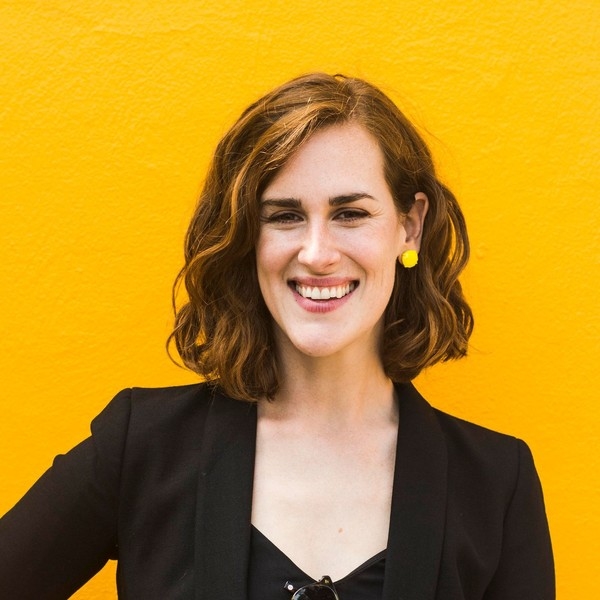
Van Der Tuin's day job, technically, is running the customer side of the largest nonprofit small business lender in the United States. Accion Opportunity Fund made her Chief Analytics Officer in 2021 and then, sensibly, Chief Experience Officer, because if you are going to hire someone who has spent a decade explaining credit models to Tanzanian loan officers, you may as well let her explain the loan process to a restaurant owner in Oakland too.
The other job - the one she does not seem willing to put down - is First Access. She co-founded the company in 2011 as a graduate student at Columbia's School of International and Public Affairs, and she is still Board Chair. First Access is a fintech, and fintech is a word that has been made to do a lot of work since 2011, so it is worth being specific: First Access is a piece of software that a bank in Tanzania, or Nigeria, or the Democratic Republic of Congo, points at a stack of loan applications. The software then goes and asks the applicant's mobile phone what kind of person they are.
The phone answers, in a way. It tells the software how often airtime is topped up, in what denominations, at what times of day, from what towers. The software feeds that into a scorecard and produces a number that a loan officer can act on. This is a small miracle because it is happening for people who have never had a bank account, never had a credit report, and in some cases never met their loan officer in person. It also happens to be a small miracle for the bank, whose per-application evaluation cost, by First Access's own reporting, has fallen about 65 percent.
First Access has, by its own count, analyzed more than 50 billion mobile transactions and scored over 500,000 loan applications. Numbers of that shape have a bureaucratic quality to them - the sort of numbers you find in a shareholder letter and skim - but they matter here because there is not really a private credit bureau covering the population First Access is scoring. If the software gets the score wrong the bank either turns away a viable business or lends to a bad one. Everyone loses in slightly different denominations.
The company raised a $7 million Series A in November 2017, bringing total funding to $9.25 million. This is not a heroic number by New York fintech standards. It is more or less what a decently pedigreed seed round buys in Manhattan. Van Der Tuin's version of First Access has been, from the beginning, uncomfortably capital-efficient. Twelve people, three continents, one long partnership with FINCA that both parties described at the time as the largest microfinance-fintech collaboration in the world.
The Kenyon Detour
She majored in cultural anthropology. This is not something one usually leads with in a fintech profile because the reader is meant to be reassured that the founder studied math, or physics, or at minimum wrote a compiler on a bet. Van Der Tuin studied people. Her senior thesis, at Kenyon, was described in a later interview as a culmination of community-engagement work - which is the polite academic phrase for spending a lot of time listening to strangers. She graduated with highest honors in 2007.
Then she went to Paris, and then to the Aspen Network of Development Entrepreneurs, and then to Columbia SIPA for an MPA in economic development and statistics. In Paris she worked with MicroWorld, a peer-to-peer microfinance platform. At ANDE she ran what she has described as the largest talent and salary survey of impact investors and capacity development providers in emerging markets - a sentence that reads like a resume line and is actually a spreadsheet with a lot of unanswered phone calls in it.
The First Access idea came together at Columbia. She built the company while still a graduate student, which is one of those origin stories founders tell that is often more grim than it sounds. The company did not stop being a company when she graduated. She has, in the years since, learned enough Swahili to be useful in Dar es Salaam and picked up basic working competency in French, Portuguese, Mandarin and Spanish. It is possible to be skeptical of a founder's language claims until you notice that she has actually done deals in most of them.
Fast Company, and Not the Company
In 2016 Fast Company put her on its list of the 100 Most Creative People in Business. She was the only fintech founder that year. This is the sort of laurel that most founders wear for approximately eighteen months and then put in a drawer. Van Der Tuin appears to have kept working. In 2017 she was speaking at the CEO Forum and the Fintech for Inclusion Global Summit and giving quotes about paper progressing to data to rails. In 2018 she was an Unreasonable Fellow. In 2019 she gave an interview to her college newspaper in which she said, "You go through a lot of iterations in a business and you will learn a lot - nothing ever goes exactly the way you planned." This is either the most obvious thing a founder has ever said or the most useful, depending on the day you read it.
Selected Timeline
What the Score Is Doing
The temptation with a company like First Access is to frame it as a technology story - the mobile phone as a proxy for a bank statement, the machine-learning model as a proxy for a credit officer. This is basically correct and also basically boring. The interesting part is what happens after the model returns a number. The loan officer still has to sit across from the customer. The customer still has to trust that the calculation the bank just performed is not arbitrary. Van Der Tuin has consistently framed the software as a decision-support tool rather than a decision-replacement tool. Human supervision, in her phrasing. This matters, because a lot of algorithmic credit systems in the past decade have gotten themselves into trouble by imagining they could leave the humans out.
Her time at Accion Opportunity Fund has, if anything, sharpened this instinct. AOF is a nonprofit CDFI that lends to small businesses - restaurants, salons, contractors - across the United States. The customer base is different from Tanzania, but the underlying problem is not: how do you underwrite a business that a mainstream bank has decided is too small or too weird or too foreign-sounding to underwrite? You do it with more data, better tooling, and a person on the phone who has time to answer questions. This is not glamorous work. It is what she has done since 2011.
Six Things She Has Actually Said
"I wanted to do something that would create more opportunities in places where they are scarce."
"For businesses and for families, the opportunities that credit enables are really critical."
"Financial institutions were struggling to scale and meet the huge amount of demand for credit from customers because they have really manual processes."
"We really look at financial technology, and specifically better use of data, as the critical way to bring that cost down."
"You go through a lot of iterations in a business and you will learn a lot - nothing ever goes exactly the way you planned."
"Most people value the same things." - on what her anthropology training left her with.
Quirks, and a Few Details Worth Keeping
Van Der Tuin studied at Tsinghua University in Beijing and at the School for International Training in Brazil before landing at Columbia. She speaks French, Portuguese, Mandarin and Spanish, plus basic Swahili. The languages are less a party trick than an operating strategy - fintech in emerging markets is a business that happens on the phone, in local terms, with local regulators, and a founder who can pick up the second half of a conversation is a founder who closes deals faster. She has been a mentor at Techstars since 2023. Her Twitter handle is quiet. Her LinkedIn is not.
The company recruits a specific kind of engineer - the kind who is willing to think about a Malawian mobile network operator's data schema on a Tuesday afternoon. The office is small. The customers are far away. This has been true for a long time now.
What She Is Trying To Do
The $5 trillion credit gap is Van Der Tuin's favorite statistic and probably her most useful one. It is the estimated shortfall between how much credit small businesses in emerging markets need and how much they get. It is a number that has been roughly stable for years, which is the sort of thing that makes economists uncomfortable and founders willing to spend a decade on the problem. First Access is a scoring engine and Accion Opportunity Fund is a lender, and both are, in different ways, chipping at the same wall. She has said in interviews that the point is not to displace loan officers but to give them a better instrument. This is the sort of unfashionable, patient answer that people who have been at this since 2011 tend to give.
There is a version of the fintech-founder story that ends with an IPO or an acquisition and a founder who becomes an investor and shows up on podcasts. Van Der Tuin's version has not ended. First Access still lists her as Board Chair. AOF still lists her as Chief Experience Officer. She is still using the anthropology.