The keys turn. The door opens. The apartment is already home - and nobody carried a single box.
EXHIBIT A: A room that arrived before its tenant did. No moving truck was harmed in the making of this living space.
The Scene
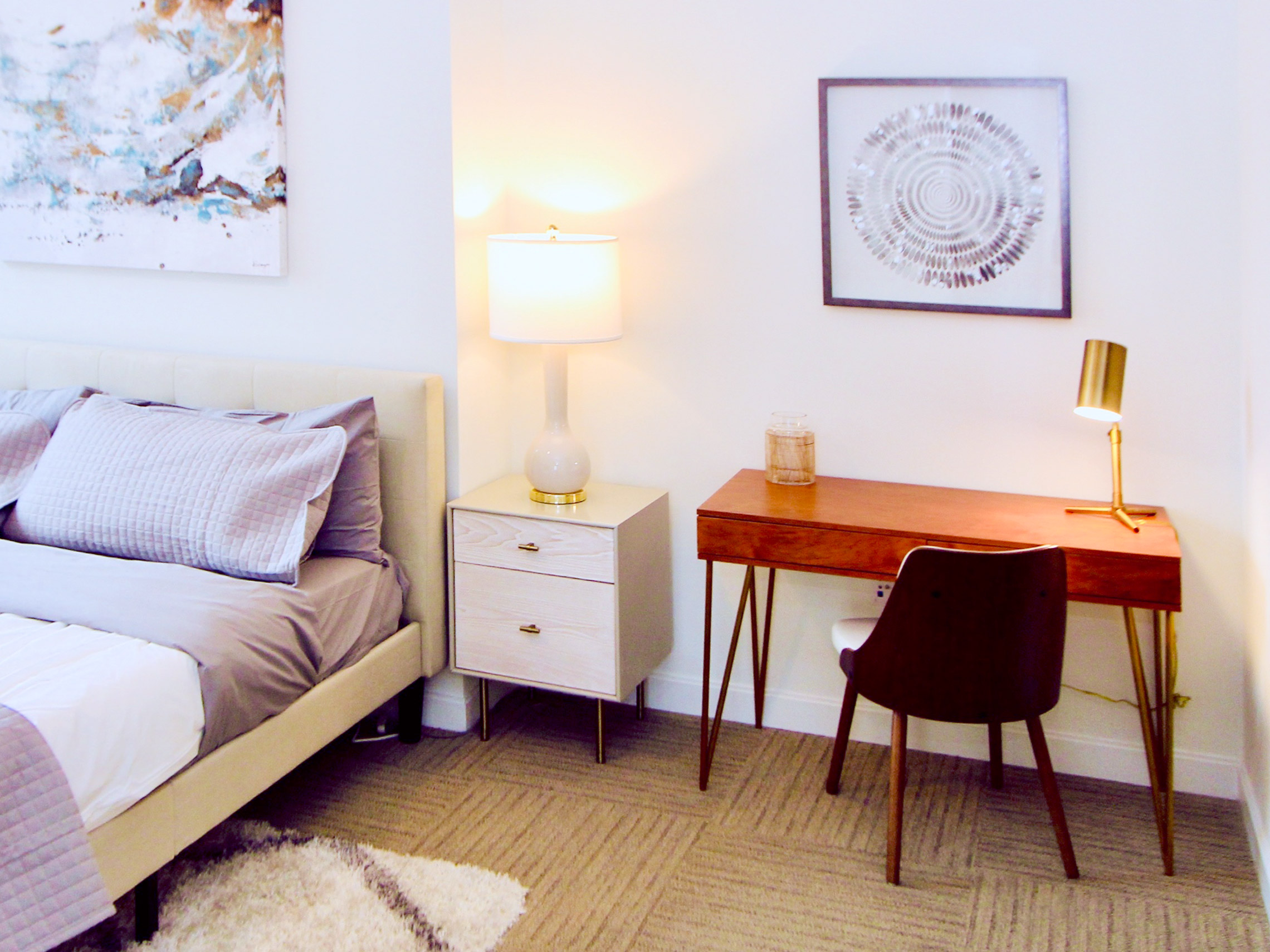
The lease starts on a Tuesday. By Tuesday afternoon, a stranger to the building lets herself in for the first time. There is a made bed. There is art on the wall, a sofa angled at the window, glasses in the cupboard, a TV that turns on. She did not pick up a box. She did not assemble anything with a hex key. She did not stand in a parking lot arguing with a delivery window. This is what Nickson sells: an apartment that was already a home before the tenant arrived.
Nickson is a Dallas company in the business of subtraction. It removes the worst week of renting - the moving week - and hands back a finished room. Renters pick a furniture package, take a style quiz, upload a floor plan, and Nickson's people handle the rest, from the layout to the silverware to hauling it all away when the lease ends.
"Life is hard and a place to call home should be easy."
Cameron Johnson, Founder & CEOThe Problem They Saw
Surveys keep ranking moving among life's most stressful events, somewhere near divorce and a new job. The renting economy had quietly accepted this as the cost of mobility: you want a new apartment, you will spend a weekend wrapped in packing tape. Furniture you bought for the last place rarely fits the next one. The couch gets sold at a loss. The mattress goes to the curb.
The furniture-rental industry had a half-answer - rent a couch, rent a bed, return them later. Useful, but it still left the renter to be their own interior designer, project manager and logistics coordinator. You could rent the parts. Nobody was renting the result.
"Why are people asking to rent the model?"
The question that started the companyThat question is the whole origin story. Working in multifamily real estate at Greystar, Cameron Johnson kept watching apartment shoppers fall for the fully-staged model unit and ask, more or less seriously, whether they could just take that one. The decorated model was the product people actually wanted. The empty box was what they were forced to settle for.
The Founder's Bet
Johnson is not the stereotype of a furniture entrepreneur. The resume reads Cornell, then Goldman Sachs, then Greystar and Walton Street Capital, then a Harvard MBA. He had spent a career around real estate capital, not throw pillows. What he also had, less visibly, was a childhood of frequent moves - enough firsthand experience with the misery of relocation to take it personally.
The bet was that renters would pay a monthly fee to never deal with any of it - design, delivery, install, teardown - the way they already pay monthly for streaming and phones. Not furniture as a product, but a furnished life as a service. He founded Nickson in 2017 to test it, and named it, fittingly, after the idea of a fresh start.
"The idea was to help people and empower their fresh start."
Cameron JohnsonBy the Numbers
The Product
The mechanics are deliberately boring for the customer, which is the point. You choose a furniture package, take a style quiz, and upload your apartment's floor plan. Nickson's designers build a custom layout around your actual dimensions and your actual life - whether you work from home, whether you have a dog that owns the couch. Then a crew of install specialists shows up and turns the empty unit into a finished home in as little as three hours, often before you ever set foot inside.
A style quiz plus your real floor plan feed a custom layout - pets and work-from-home corners included, not an afterthought.
Up to ~250 items go in fast: beds, sofas, art, TVs, kitchenware, linens, the small stuff most people forget to pack.
A monthly fee scaled to apartment size, plus a one-time install fee. No buying, no reselling, no curb mattress.
Lease ends, Nickson takes it all back and reconditions it for the next home - renting that doesn't end in a landfill run.
"Have everything. Do nothing."
Nickson's standing offer to rentersThe File, In Order
Cameron Johnson founds Nickson in Dallas, betting renters will subscribe to a furnished home instead of buying one piece at a time.
Johnson speaks at the 5th Annual Dallas Startup Week on changing the renting experience.
A model built to install without the tenant present turns out to be pandemic-proof. The user base grows roughly 700% year over year.
Pendulum leads, with Motley Fool Ventures, Steve Case's Rise of the Rest and Backstage Capital. Texas-wide expansion follows.
Operations span Dallas-Fort Worth, Austin, Houston, San Antonio and Oklahoma City, with growth cited near 400% after the raise.
The Proof
A subscription model lives or dies on whether people actually keep showing up. Nickson's most quoted figure is its 2020 growth - the year it accidentally proved its thesis. A service built to furnish an apartment without anyone in the room was exactly what a locked-down country needed.
Figures cited by Nickson and press coverage; revenue/headcount are third-party estimates
Bars scaled for comparison, not to a single axis. Growth percentages are year-over-year as reported.
"Realizing that we were uniquely suited to provide contactless moving was a key to our survival."
Cameron Johnson, on 2020The money agreed. The 2021 Series A pulled in a notable cap table - a lead from Pendulum, plus Motley Fool Ventures, Steve Case's Rise of the Rest Seed Fund and Arlan Hamilton's Backstage Capital. The customers agreed too: more than a thousand clients, spanning ages 18 to 80, which is a polite way of saying both the recent graduate and the downsizing retiree hate moving equally.
The Mission
Nickson's stated mission is to give every renter a shot at affording the custom-designed, fully-furnished apartment they actually want - the model unit, not the empty box. There's a quieter second mission tucked into the model: because Nickson owns the furniture and takes it back, it reconditions and reuses rather than sending a mattress and a sofa to the curb every time a lease turns over. A subscription that returns its inventory is, almost by accident, a less wasteful way to furnish a city.
"If no job is too big or too small, then let people see you take out the trash, because everything matters."
Cameron Johnson, on company cultureWhy It Matters Tomorrow
More people rent for longer, move more often, and own less on purpose. A generation that streams its music and subscribes to its software has fewer reasons to buy a sofa it will resell at a loss in eighteen months. That's the tailwind Nickson is leaning on - and the bet that a furnished apartment can be a service the way a phone plan is.
The competition is real. Fernish, Feather, CORT and others rent furniture by the piece. Nickson's wager is that people don't want pieces; they want to walk in and be home. Whether that scales city by city, state by state, is the open question - the kind no pitch deck settles in advance.
Back to that Tuesday afternoon. The renter sets her keys on a counter she didn't stock, in a room she didn't arrange, in an apartment that somehow already knows her. The boxes never came. The weekend stayed a weekend. That's the entire product, and it's a stranger thing to pull off than it sounds: Nickson sells the feeling of having already moved in.
"Knowing what to say 'No' to is extremely important, as many paths will seem attractive."
Cameron JohnsonFiled Under: Things We Liked
The Rolodex