A database has an awkward habit: it keeps working after the interesting part of the project is over. Someone must patch it, watch it, back it up and answer when it misbehaves. The software may be free. That person’s Tuesday is not. NetApp Instaclustr has made a business out of this gap between acquiring powerful technology and accepting responsibility for it.
- The product: open source data systems, operated by specialists.
- The trade: a management bill in exchange for engineering time.
- The distinction: upstream software, with deployment in your cloud account available.
The company underneath the idea
In Canberra, the founders originally wanted to build a data marketplace. They needed a scalable database and chose Apache Cassandra. Then came the inconvenient discovery: they could not find the managed Cassandra service they wanted. Their intended business now required another business underneath it.
Peter Lilley, Doug Stuart, Ben Bromhead and Adam Zegelin founded the company in 2013. According to Lilley’s account, conversations in technical forums revealed other developers asking for the same service. The team packaged its Cassandra tooling with billing, attracted customers internationally and shelved the marketplace. Demand for the supporting machinery changed the plan.

There is a useful founder’s lesson here. A tool made to solve your own problem deserves attention when strangers start asking for it. Instaclustr’s first customers wanted to spend their energy on applications. The founders had just experienced exactly why.
When adding a node means moving the house
Years later, Pega encountered a different version of that problem. Its Cassandra infrastructure was embedded tightly in its wider platform. Increasing database capacity meant scaling more than the database.
“Anytime we scaled Cassandra nodes, we had to scale the entire Pega platform. It was time and resource-intensive.”
Ramzi Souri · VP of Cloud Technologies, Pega
Pega adopted Instaclustr to manage Cassandra, Kafka and OpenSearch within its own AWS and Google Cloud environments. The point was to make the data services easier to operate independently. In Instaclustr’s published account, Pega reports approximately 60,000 hours of management time saved annually. That is a customer-reported outcome, with no reason to assume every deployment will reproduce it.
Management time returned to the team.
Operata, a contact-center observability business, offers the smaller-team version. In 2022, five engineers faced an expected fivefold traffic increase after winning a major bank customer. Its hosted Elasticsearch service had suffered instability and inadequate support. The constraint was engineering capacity. Instaclustr helped move it to OpenSearch and PostgreSQL, later managing its ClickHouse analytics environment. Operata reports reclaiming more than 6,200 engineering hours a year.
The work after the download
The portfolio makes more sense as a set of jobs than a collection of names. Kafka moves events. Cassandra stores distributed, high-volume data. PostgreSQL handles relational workloads. OpenSearch makes information searchable. ClickHouse supports analytical queries. Cadence coordinates workflows. Instaclustr provides the operating layer around these technologies, including provisioning, monitoring, maintenance and expert support.
Its expertise is partly visible in public. The company’s GitHub organization includes Cassandra backup and repair tools, a Terraform provider and code samples. These are tangible artifacts of an engineering culture organized around operating systems other people depend on. Enterprise support, consulting and training extend that expertise beyond the managed platform.
The distinguishing promise is upstream open source, combined with a choice of hosting models. Customers can use their own cloud accounts, Instaclustr’s account or supported on-premises deployments. Keeping infrastructure in your account can preserve visibility and existing cloud relationships. It also means access permissions and networking remain part of the decision.
That puts Instaclustr between several familiar purchases: software, cloud infrastructure and specialist labor. The customer is buying an operating arrangement across them. A successful setup needs a clear boundary between the application team and its database operator. Handing over maintenance does not decide how an application models its data or which queries it sends.
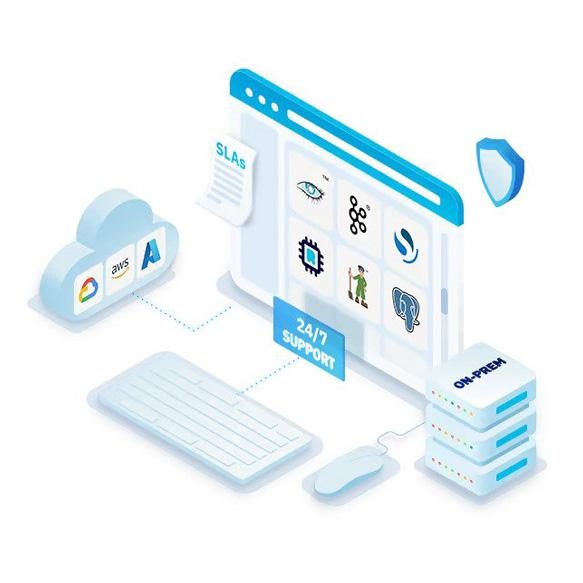
For a buyer, this makes the support conversation part of the product demonstration. Ask who notices a deteriorating cluster, who chooses the response and who communicates with the application team. Then ask what happens when the application itself causes the trouble. A dashboard can show a red light. The value of an operating partner depends on what follows that light: diagnosis, a workable intervention and an explanation the customer can use before the next incident arrives.
The second invoice
Open source describes the software. Instaclustr charges for running it. Pricing depends on the technology, cloud, region, node configuration and consumption. Its BYOC pricing excludes infrastructure: virtual machines, storage and networking are paid to the cloud provider. Enterprise features and add-ons can increase the bill; annual commitments may reduce it.
Compare the complete bill with your operating costs.
The alternatives include an internal operations team, a cloud provider’s managed services and other independent platforms such as Aiven. The comparison depends on which technology and responsibilities you need. Instaclustr’s breadth is useful when several data systems need attention. A modest database with a capable internal operator may make the extra management expense harder to justify.
A useful evaluation would test an upgrade, a restore and an incident escalation, alongside the initial cluster launch. These are the ordinary events that expose the division of responsibility. Teams should also check supported versions and extensions before committing. Using upstream software helps preserve options, but moving a live application still requires planning, validation and time. Portability is a property to exercise, rather than a promise to file away.
A bigger owner, the same chore
Expansion required money and people. A $15 million growth investment led by Level Equity arrived in 2018. In March 2021, Instaclustr acquired credativ’s German and US operations, adding PostgreSQL expertise. NetApp completed its purchase of Instaclustr on May 20, 2022, for approximately $500 million in cash, according to its financial disclosure.
Recent additions follow the same operating logic. The June 2026 product update describes generally available AI Search for OpenSearch, including semantic and hybrid retrieval. August brought Zero Inbound Access: eligible customer-cloud and on-premises clusters can use outbound management connections without publicly routable cluster IPs. It is unavailable for deployments in Instaclustr’s account.
The practical thing to copy is a measurement. Count the hours spent maintaining data services. Identify what scales together unnecessarily. Price a representative workload, including infrastructure. Then decide where your engineers’ attention belongs. Instaclustr’s proposition becomes persuasive when that accounting reveals how much of the product team’s week is already committed to the database.