Consider two trucks pulling into the same fuel stop. Each buys 150 gallons. Each leaves with the same diesel. Yet a difference of 40 cents a gallon means one driver keeps $60 the other driver spends. The engines do not know the difference. The businesses certainly do.
That is an illustrative calculation, not a promised Mudflap discount. But it explains why a phone app can become consequential in a business conducted with enormous machines. A trucker cannot negotiate every bill. Fuel, however, is purchased again and again. Change the price of that recurring transaction and the benefit is visible before anyone has finished a presentation about digital transformation.
- Mudflap pools demand from independent drivers and fleets to negotiate fuel prices.
- The app handles discounted purchases; the separate Visa card adds credit and fleet controls.
- Truck stops pay for the business Mudflap brings them.
- The 2026 Parade acquisition extends the company into freight brokerage software.
The price on the pump is only half the story
Mudflap’s useful trick is to put another price beside the familiar roadside one. A driver finds a participating stop, obtains a fuel code, redeems it inside or at the pump, and fills up. Mudflap handles the payment. The pump can still display the retail price; the receipt records the app price. For someone trying it for the first time, that distinction deserves attention. The discount lives in the transaction.
The company currently advertises more than 3,600 partner stops and more than 515,000 drivers. Those are company figures, and they describe different things: places offering negotiated prices and people using the service. The network includes independent businesses and recognizable chains. Size gives the proposition weight, but a driver needs the useful stops to sit along an actual route. A plentiful map elsewhere is a decorative object.
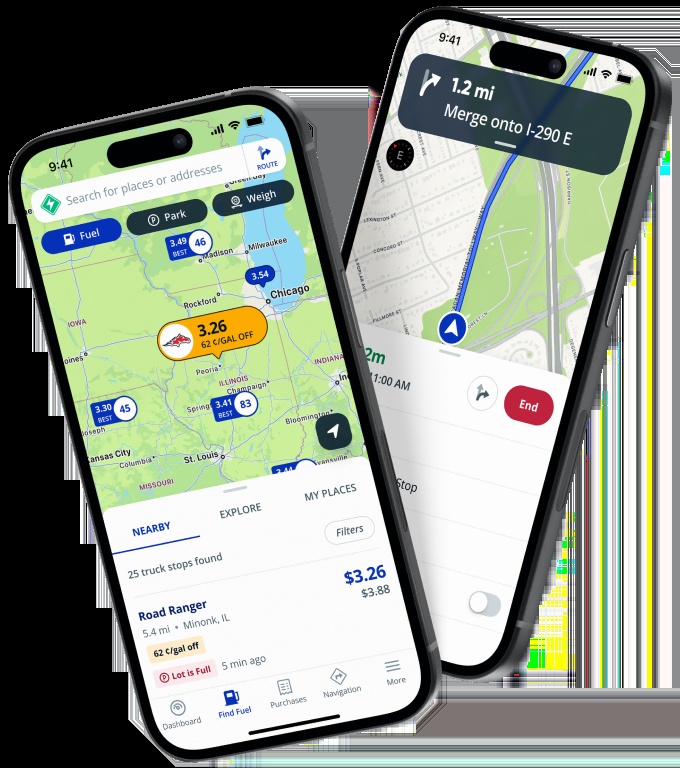
A fuel marketplace has to solve the problem on both sides. Drivers want a lower bill. A stop wants a reason to offer one. Mudflap supplies access to customers who are still deciding where to pull in, rather than merely rewarding the people already parked beside its pumps. That is the economic argument behind the cheerful green buttons.
Two underdogs, one useful bargain
Sanjay Desai and Sharon Yapp previously worked at Trucker Path, the navigation and load-management business. They had spent time with truckers before offering to alter how truckers paid. Investor profiles date Mudflap’s founding to 2016; its free app launched in January 2020. Company formation and a product reaching the road are different milestones.
Their opening was a mismatch. A small carrier could buy diesel regularly without having the bargaining position of a large fleet. An independent stop could have fuel to sell without the marketing reach of a national chain. Bringing these two groups together offered a trade: better prices for pooled demand, better access to that demand for merchants.
Mudflap also took responsibility for the transaction. In a 2022 interview, Desai described the company as merchant of record, collecting from drivers and settling with stops. He said it guaranteed payment to the merchant once the driver had fueled. That makes the business more involved than a directory of coupons. The simple interface sits on top of payment collection and settlement risk.
“We take all the risk, by the way.”Sanjay Desai / PYMNTS, October 2022
For a merchant, speed matters alongside price. Marion Travel Plaza’s president told NATSO that lower transaction costs and faster access to money made discounts attractive. This is a useful reminder: the two parties do not have to value the same thing. The driver can prize the price per gallon while the stop prizes cash arriving sooner.
More volume still has to earn its keep. NATSO’s reporting also describes the risk of discounting existing sales without winning enough extra gallons to compensate. A busier forecourt can flatter the eye and disappoint the accountant. A merchant should measure additional contribution after discounts and costs, rather than treating every gallon routed through an app as a newly acquired gallon.
The app opens the door. The card adds a ledger.
For an owner-operator, the app’s appeal starts with a modest commitment: download it, add a payment method, and compare stops. The app does not require a credit application. For a manager responsible for several drivers, the problem expands. Who bought the fuel? Which receipt belongs to which truck? Who can spend what?
The Mudflap Fuel Card addresses that administrative burden. It is a Visa business charge card, subject to credit approval, with weekly credit, spending controls and digital records. The fleet product also advertises fraud alerts that can cross-check a purchase against a truck’s electronic logging device location. The attraction is a combination of purchasing and oversight, rather than a discount alone.
Bring your payment method
Find a partner stop and pay through a fuel code.
Apply for credit
Use Visa acceptance and manage driver spending.
The card’s acceptance footprint is broader than the negotiated-discount network. Outside partner stops, the card FAQ lists a two-cent-per-gallon fuel reward. That is a different proposition from the discounts displayed at participating stops. When comparing Mudflap with WEX, Comdata, AtoB or a chain’s own program, the useful questions concern the places you actually use, the final bill and the controls you need.
The word “free” also needs its unit attached. Mudflap’s app costs nothing to download and charges no app fee for debit or ACH payments. Using an existing credit card through the app adds 1.9%. Separately, the Mudflap charge card advertises no recurring card fees or interest, while its disclosures allow fees for late or returned payments and payment methods other than ACH. The two products have different payment rules.
Against a hypothetical $4.00 pump price, the $60 gross saving becomes $49.74 before any extra driving costs.
This is arithmetic a driver can reuse with a current quote. A discount deserves to be compared with the alternative’s final cost, including the payment fee. Add any extra miles and time. A headline discount cannot pay for a detour merely by looking impressive.
The map is becoming a freight network
Mudflap’s next move makes more sense when the map is viewed as a gathering of businesses. On April 15, 2026, Parade announced its acquisition by Mudflap. Parade makes capacity-management software for freight brokerages: finding carriers, automating outreach and managing those relationships. Its announcement described Mudflap’s network as 515,000-plus drivers across more than 100,000 carriers.
The strategic idea is straightforward. Brokers need reliable carriers; Mudflap already has relationships with carriers through a recurring operational purchase. Putting the businesses together could make that network useful beyond fueling. It also changes the work required. Negotiating diesel prices and helping a broker book suitable capacity are related activities, but one does not automatically establish competence in the other.
Parade says its platform has facilitated more than $40 billion in freight transactions. That figure measures activity through Parade, not Mudflap revenue or the acquisition price. The deal’s price was not disclosed in the public announcement. A platform’s transaction volume is evidence of use; it is not money the company gets to keep.

The company’s careers page describes a majority-remote workforce, regional meetings and an annual gathering called Mudfest. Its stated values include attention to detail and curiosity. Those are employer statements, but the product gives them a practical test: can a driver complete the purchase, and can a merchant reconcile it? Fuel is an awkward place to hide an unfinished workflow.
A lesson you can use at the next stop
One of the better details in Mudflap’s early history concerns age. Desai told NATSO that the team had wondered whether veteran drivers would adopt the app. Drivers in their sixties and seventies did. The useful observation is that a readily understood financial benefit can outrun an assumption about who likes technology. The lesson is to test the assumption with customers.
Another lesson concerns recommendations. A driver can hear about the app at a pump and try it during the same visit. There is little distance between the recommendation and the result. A company serving small businesses can copy that sequence: identify a frequent expense, remove unnecessary enrollment friction, and give the customer something measurable on the first use.
For the person buying diesel, the test remains pleasantly unromantic. Check a stop on your route. Compare the total cost. Choose the payment method deliberately. Examine the receipt. For the merchant, check whether the traffic earns enough after the discount. Mudflap’s bargain works when both sides have a reason to return. The next fill-up is the review that counts.