200,000+ users worldwideFDA & CE registered99% reported clinical accuracy4 hormones, 1 device: FSH · LH · E3G · PdGFounded 2016 in Pleasanton, CA$8.8M raised to dateCEO Sylvia Kang trained as a concert pianistFeatured in Forbes, TechCrunch, Vogue, Healthline
YesPress Dossier · Women's Health
Mira put a hormone lab in a bathroom drawer.
An at-home device the size of a deck of cards now hands 200,000 people the kind of fertility data that used to require a clinic, a blood draw, and a week of waiting.
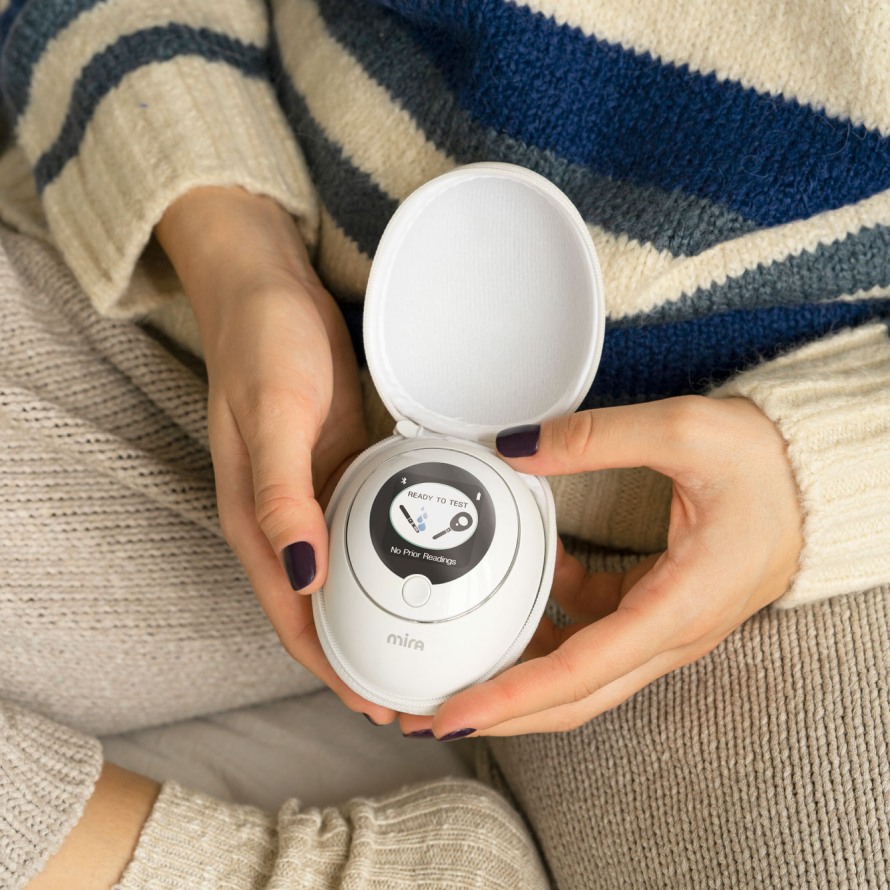
It's six in the morning somewhere, and someone is peeing on a wand. Not to get a yes or no. To get a number. The wand goes into a small white reader, the reader talks to a phone, and a few minutes later the phone returns four numbers: LH, E3G, PdG, FSH. That is Mira in 2026 - a hormone laboratory the size of a cinnamon roll, sitting on a bathroom shelf in 40+ countries.
Mira is a women's health company that builds the connected hardware, the chemistry, and the AI that interprets it. The device reads quantitative hormone values from urine using fluorescent immunochromatography - the boring, beautiful technology that also powers clinical labs. The app turns those values into a chart your OB-GYN can read. The company has 140-ish people, $8.8M in venture funding, and an unusually loyal user base of more than 200,000 women.
A pee stick gives you a smiley face. Mira gives you a chart your endocrinologist can read.
- YesPress, summarizing five years of femtech in one sentence
The problem they saw
The hormone knowledge gap.
For most of the twentieth century, the hormonal lives of half the species were tracked with a calendar and a thermometer. In the twenty-first, they were tracked with apps that pulled predictions out of averages and called it personalization. None of it actually measured anything.
The truth, inconveniently, is that hormones do not behave like calendars. Cycles vary. PCOS hides in subtypes. Perimenopause sneaks in over a decade. Two people with identical 28-day cycles can ovulate eight days apart. The standard answer was: go to a clinic, get a blood draw, repeat it tomorrow, and the day after that, and the day after that. Almost nobody does this.
That gap - between what your body is doing and what you are allowed to know about it - is the thing Mira was built to close.
Most fertility tech tells you what your cycle should look like. Mira tells you what it is doing, today, in nanograms per milliliter.
- The Mira pitch, distilled
The founders' bet
A pianist walks into a biomedical lab.
Sylvia Kang's first career was the piano. Conservatory training, the works. She switched to biomedical engineering - the kind of switch that on paper looks improbable and in practice mostly means trading one set of obsessive rehearsals for another. She landed in the world of medical device design, where she noticed that the most sensitive diagnostics in the world were locked behind appointments most women could not get.
In 2016, Kang co-founded Mira with Zheng Yang. The bet was specific and a little contrarian: people would pay for hardware - not just an app - if the hardware gave them numbers a doctor would trust. The femtech wave at the time was pouring into period-tracking apps. Mira poured into chemistry.
She used her own product to get pregnant after 35. That is either the best founder story of the decade or the most unfair user testimonial ever recorded.
- Vogue Singapore profile, paraphrased
Founders Sylvia Kang, CEO, biomedical engineer, ex-pianist. Zheng Yang, co-founder. The two of them spent the first years explaining to investors that yes, urine, and yes, on purpose.
The product
Four hormones. One small box.
The Mira Monitor is a Bluetooth analyzer. Single-use wands - Max, Plus, Ultra, Confirm - test combinations of luteinizing hormone, estrogen metabolite (E3G), progesterone metabolite (PdG), and follicle-stimulating hormone. The numbers land in the Mira app, which threads them through an AI model that maps the user's actual cycle - not a model cycle - and predicts the next one.
4
Hormones measured
LH, E3G, PdG, FSH - the four endocrine signals that map ovulation, conception window, and menopause onset.
// quant, not qualitative
99%
Clinical accuracy
Mira reports 99% accuracy versus lab reference in clinical trials. The wands use the same chemistry as professional immunoassays.
// per company data
16min
Per-test runtime
Wand in, reader on, kettle for tea, done. Result lands in the app with a value and a trend line.
// fluorescent immunochromatography
3
Life stages
Trying-to-conceive, PCOS management, perimenopause & menopause. One device, three radically different problem spaces.
// Mira Clinic + supplements
Inventory The thing about Mira's product line is that nobody set out to build four product lines. They built one device and discovered, slowly, that women in their thirties, forties and fifties were all asking it different questions.
Milestones
The receipts.
Nine years, one bathroom shelf at a time.
2016
Sylvia Kang and Zheng Yang co-found Mira (Quanovate Tech). Prototyping begins in Pleasanton, California.
2018
Mira closes $4.5M in Series A capital led by Gopher Asset Management, alongside earlier seed backers Launchpad Digital Health and CSC UpShot Ventures.
2019
Mira Hormone Monitor ships to consumers. FDA and CE registration follow, putting Mira inside the regulated medical-device tent.
2021
PdG (progesterone metabolite) measurement added - Mira can now confirm ovulation, not just predict it. TechCrunch covers Mira's role in closing the hormone knowledge gap.
2023
Ultra wand launches with FSH detection, extending the platform into menopause and perimenopause monitoring.
2024
Mira launches an integrative hormone health clinic - virtual consultations with OB-GYNs, naturopaths and fertility coaches built around Mira data.
2026
User base passes 200,000 globally. Mira data quietly shows up in fertility-clinic intake forms across the U.S.
The proof
The numbers do most of the talking.
Mira's pitch sounds slightly too good. So here is what holds it up: regulatory clearances, a clinical-trial accuracy figure, a six-figure user base, and a quietly growing list of clinicians who now ask new patients whether they have a Mira at home.
Mira, by the digits
A sketch of the company in 2026 / sources: company & Crunchbase
Users (k)
200K+
Team
~140
Funding
$8.8M
Hormones
4
Accuracy
99%
Countries
40+
Bars are scaled illustratively. Funding bar = $8.8M of an arbitrary $20M reference. Accuracy is company-reported.
The first at-home hormone monitor validated for use alongside fertility treatments. Doctors now read Mira charts the way they used to read basal-body-temperature graphs - with considerably more trust.
- Press coverage, Forbes & Healthline
The mission
Hormones, decoded.
Mira's stated mission is not subtle: empower people to understand their hormones with lab-grade precision so they can make decisions about fertility, PCOS, conception and menopause. What is interesting is what the mission omits. It does not promise pregnancy. It does not promise a cure for PCOS. It promises information - the kind of information women have been politely refused for a very long time.
Try-to-conceive
Map the ovulation window with quantitative LH and confirm with PdG. Share the chart with your fertility clinic.
PCOS management
Track hormonal subtypes across full cycles. Identify patterns clinicians can act on, instead of "irregular".
Perimenopause
FSH and estrogen patterns across months - early-warning data for a transition that usually arrives unannounced.
Why it matters tomorrow
A data set nobody else has.
Every wand Mira ships - opted-in and anonymized - adds a cycle to one of the largest longitudinal hormone datasets in the world. That data feeds the AI, which feeds the predictions, which improves the next user's experience. It is the dull, virtuous flywheel of any real medical-data company, and it is the unsexy thing that will matter most in five years. Hormonal subtype research, AI-detected PCOS variants, personalized therapy - the field is wide open and Mira is the company sitting on the cleanest dataset.
The skeptical question is fair: can a $200 box really replace a clinic? It cannot. But it can fill the eleven months and three weeks of the year you are not at the clinic, and that is the part the clinic was never going to fix.
The future of women's health is not a smarter pee stick. It is a longitudinal hormone record - yours, dense, and finally readable.
- The thesis Mira has been quietly executing since 2016
Back to the bathroom shelf.
It is still six in the morning. The wand still goes into the white box. The phone still hums. But the person holding it now has nine years of company history behind that hum - a pianist who became an engineer, a Series A in Pleasanton, a chemistry trick borrowed from clinical labs, a regulatory file, a six-figure user community, and a chart that an OB-GYN will read at 9 a.m. with a cup of coffee and a nod. Mira's product is small. The thing it actually delivers is not.