The expensive art of waiting
An AI accelerator can be magnificently powerful and magnificently idle. Before it answers a question, somebody must find the information, prepare it and arrange the work. The glamorous machine gets the applause; the less glamorous machines determine whether it deserves any.
That is the useful way to read Microsoft’s July 20 announcement. Azure is bringing in AMD’s Helios platform and next-generation EPYC processors through three upcoming virtual-machine families. HDv2 handles AI data systems. HXv2 serves chip design and scientific computing. ND MI455X v7 takes on production-scale inference. A single shopping list conceals three quite different jobs.
The inference hardware catches the eye. The surrounding CPU capacity explains the ambition. Microsoft is selling a place to run the whole operation, including the work that happens before a model produces its first word. For a cloud provider, an answer is the visible end of a much longer transaction.
Reporting source: Microsoft’s announcement ↗
Nearly 500 physical CPU cores
4 TB RAM · 32 TB local storage
176 CPU cores · above 5 GHz
800 Gb InfiniBand
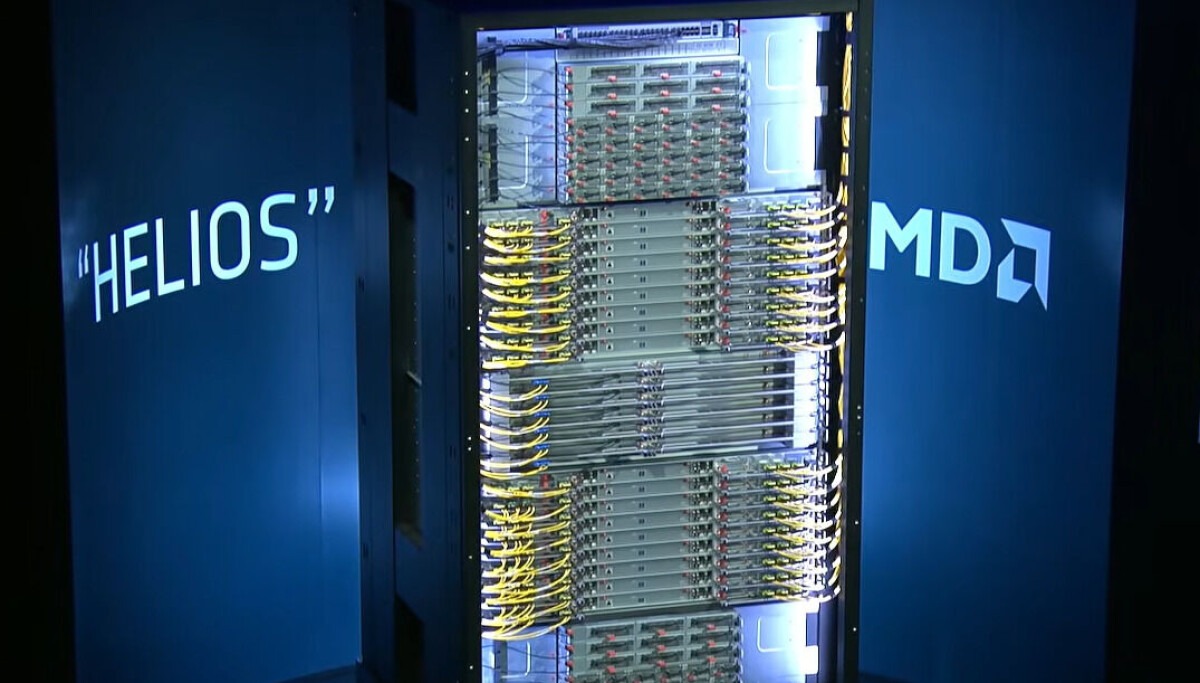
AMD Helios rackscale platform
Reasoning, search & agentic workloads
Announced Azure offerings, July 20, 2026. These are distinct workload roles, not benchmark rankings.
First, feed the machine
HDv2 is the provisioner in this arrangement. Its announced specification puts nearly 500 physical CPU cores beside 4 TB of RAM and 32 TB of local storage. The size is striking, but the purpose is more revealing: data preparation and agent coordination need room of their own.
Consider an AI service asked to investigate a customer’s problem. It may need to retrieve records, clean up text, assemble context and dispatch several tasks before the model can offer anything useful. This is an illustrative workflow, rather than a Microsoft performance demonstration. It shows why buying more accelerator capacity need not cure every delay.
Large CPU machines give operators another place to address that work. Memory can hold substantial working data; local storage can accommodate intermediate material. Neither specification guarantees a quicker answer. The practical question is whether these resources match the particular stage holding a service back.
There is a pleasing indignity here. An industry enchanted by machines that reason still has to make sure they are fed. HDv2 turns that mundane obligation into a distinct Azure offering.
Reporting source: HDv2 specification ↗
Then, design tomorrow’s chips
HXv2 enters a different workshop. Chip designers and scientific-computing teams need to run demanding calculations, often under unforgiving schedules. Microsoft’s announced configuration combines 176 CPU cores, clock frequency above 5 GHz and 800 Gb InfiniBand networking. It is aimed at electronic design automation as well as scientific and engineering workloads.
The original HX family provides useful context. Microsoft’s documentation describes up to 176 Genoa-X CPU cores with 3D V-Cache, 1,408 GB of memory and 400 Gb/s InfiniBand. The family arrived in 2023 alongside HBv4. These are specialized CPU machines with substantial memory resources, not simply AI GPU servers wearing a different badge.
Why should an AI infrastructure story pause at chip design? Because the next generation of AI hardware must itself be designed and checked. Simulation and verification consume computing resources before a finished processor ever reaches a datacenter. The cloud can earn its keep while the future hardware is still a collection of engineering decisions.
Clock rate, core count and networking describe different capabilities. An application with a stubborn serial stage will judge a machine differently from a simulation spread across many nodes. Reading those figures as one universal speed score would be a splendid way to buy the wrong computer.
Reporting source: Current HX specifications ↗
Helios makes the rack the unit
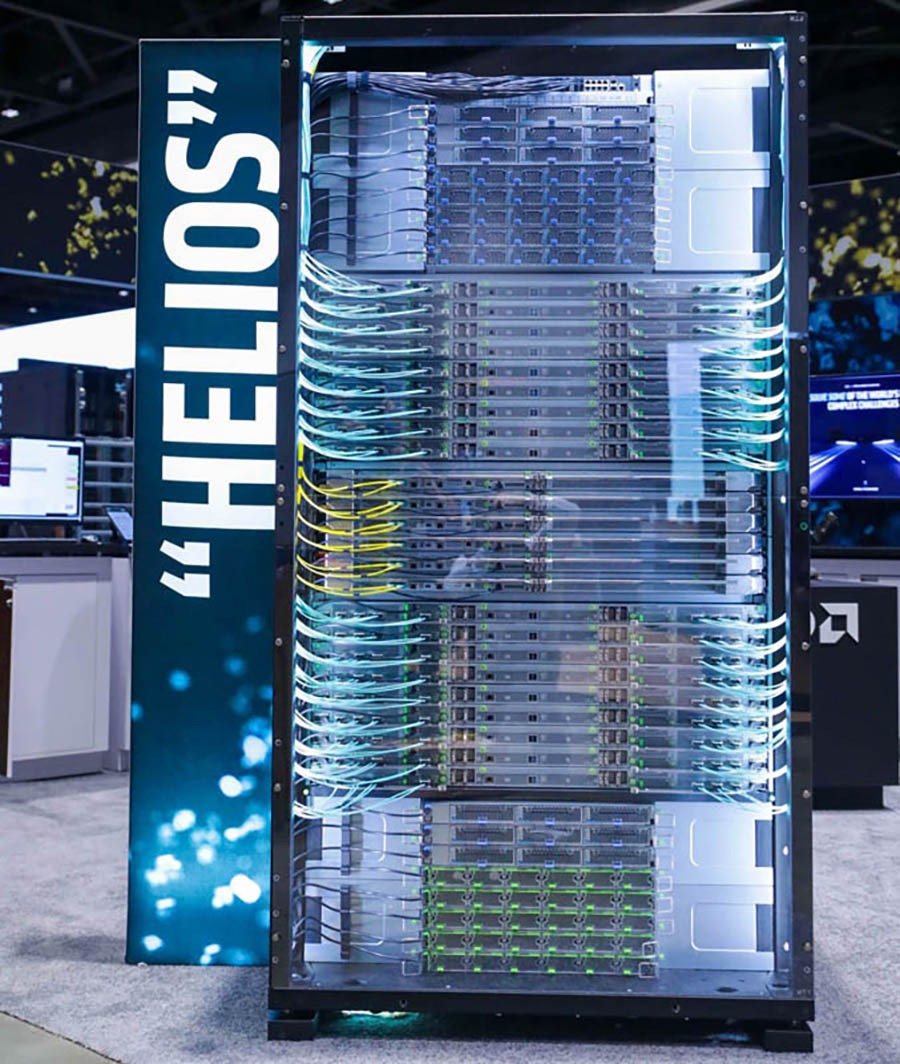
The third family, ND MI455X v7, is where Helios enters Azure’s inference story. Microsoft positions it for reasoning, search and agentic workloads at production scale. Inference is the running of a trained model to produce results; it is the recurring work behind a service that customers actually use.
Helios is broader than a single chip. AMD describes a rackscale design combining 72 Instinct MI455X GPUs with EPYC CPUs and Pensando networking. Its product material lists about 31 TB of HBM4 GPU memory. Those are AMD’s rack specifications; they do not establish how much hardware an individual Azure VM will expose.
The distinction matters. A rack is an engineered system with data moving between accelerators, processors and memory. Customers ultimately rent an Azure configuration, with its own resource boundaries and operating conditions. The attractive number on a hardware diagram is only the beginning of the buying decision.
AMD’s technical account emphasizes liquid cooling, serviceable trays and rack management alongside computing power. These sound like backstage concerns until something fails. A production AI service must keep answering while operators monitor heat, isolate faults and replace equipment. The most impressive calculation is of limited charm if the system cannot stay in service.
Reporting source: AMD’s technical account ↗
The supplier becomes the customer
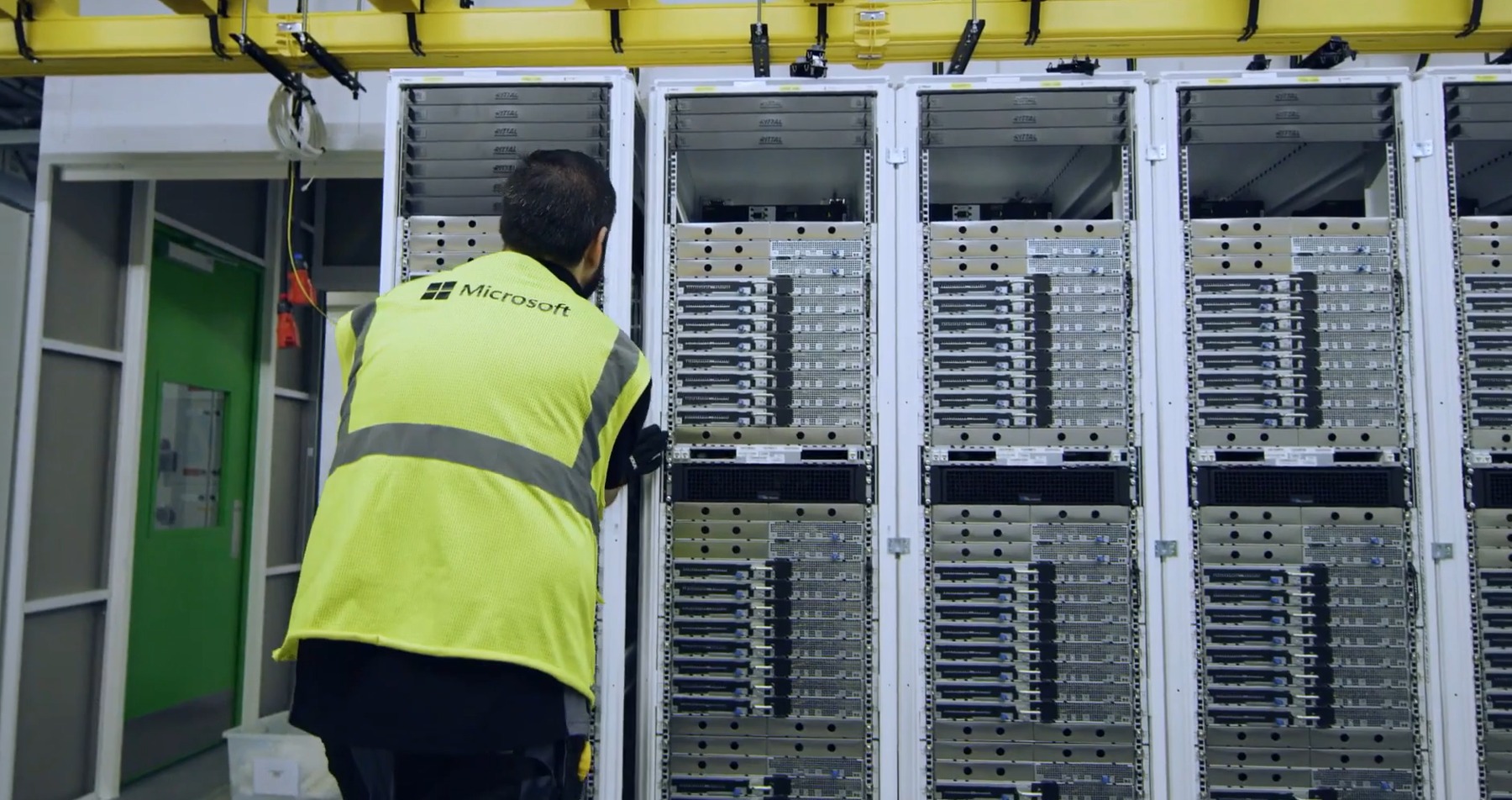
The neatest turn in this story is AMD’s position on both sides of the transaction. It supplies the silicon and uses Azure HX for electronic design automation. Its engineers are cloud customers while developing the processors and accelerators cloud providers will later purchase.
“Azure HX is an important platform for scaling complex EDA workloads,” AMD chief technology officer Mark Papermaster says in Microsoft’s announcement. It is a precise description of the relationship: the hardware maker buys access to hardware while designing more hardware.
That loop gives the partnership a practical character. A supplier that runs engineering work on the service encounters questions about capacity and performance as a customer would. It does not prove that every customer will see the same result, or that HXv2 has already delivered on its promises. It does show why the collaboration extends beyond placing a purchase order.
For Microsoft, the appeal is clear as an interpretation of the plan: Azure can host chip development, the preparation of AI data and the eventual operation of AI services. Each stage presents a separate opportunity to sell computing time. AMD participates in the supply chain and the demand at once.
Reporting source: AMD’s customer statement ↗
“Azure HX is an important platform for scaling complex EDA workloads.”
Mark Papermaster AMD executive vice president & CTO
Azure supplies compute to AMD.
What the announcement actually buys
Microsoft’s strategy appears to be specialization with choice. A customer need not treat every slow AI workflow as a request for another GPU. Data preparation, technical simulation and model serving can be considered separately, then matched to the appropriate infrastructure.
That is a sensible architecture argument, rather than a settled economic verdict. The July announcement presents upcoming offerings; it does not give customers a complete price list, regional rollout schedule or measured comparison covering all three families. A purchasing team still needs to test its software, inspect availability and compare the cost of completing its own work.
The telling measure will be useful output for the money: prepared data, completed simulations, or answers delivered at an acceptable latency. Raw specifications help explain what a machine might do. A workload establishes whether it does the thing a customer needs.
Helios gives Microsoft another route to large-scale inference. HDv2 and HXv2 explain why that route has company. The model may deliver the answer, but Azure wants to rent the workshop, the pantry and the machinery that make the answer possible.
Reporting source: The announced plan ↗
Your questions, answered
Why is Microsoft bringing AMD Helios to Azure?
Microsoft positions Helios-powered ND MI455X v7 VMs as another option for production-scale inference, including reasoning, search and agentic workloads.
What are the three announced Azure VM families?
HDv2 for AI data systems, HXv2 for chip design and technical computing, and ND MI455X v7 for AI inference.
What is AMD Helios?
An integrated rackscale AI platform combining Instinct MI455X GPUs, EPYC CPUs, networking and software. AMD describes a 72-GPU reference rack; Azure per-VM allocations are separate.
Does AMD use Microsoft Azure itself?
Yes. AMD’s CTO identifies Azure HX as a platform for scaling its electronic design automation workloads.
When will these Azure VMs be available?
Microsoft described the three families as upcoming in its July 20, 2026 announcement, without a detailed regional availability schedule or price list.