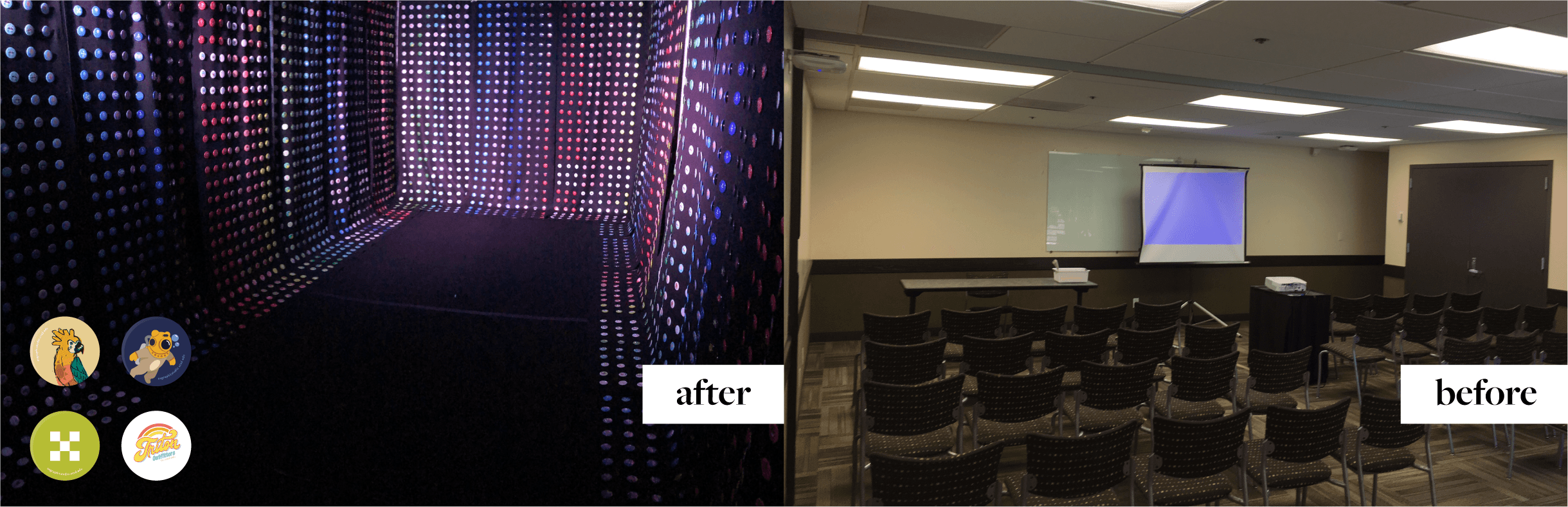
A button is a small thing to build a studio around. It fits in a palm, costs little to give away, and offers just enough room for a joke, a cause, or a bear. Melissa Ewart helped turn that small object into a room. For AS Graphic Studio’s tenth-anniversary celebration at UC San Diego, the team and its volunteers made more than 3,500 buttons. Guests could take one and leave one. An anniversary became an exchange.
Ewart fabricated the button walls and did the sewing, with production guidance from Nelson. Emily handled the exhibit’s curation and design. The room’s name was “All buttoned up.” The pun had earned its place. Here was a founder marking a milestone by making something other people could touch, choose, and carry home. The studio had been founded partly around the idea of making buttons for students; the celebration gave that beginning a physical form.
She led the wider Make Art Celebration, a collaboration between AS Graphic Studio and Triton Fest. Its program included artisans, installations, performances, a film screening, and a reception. The work extended from branding and curation to production schedules and event operations. It is a useful place to meet Ewart: somewhere between the invitation, the sewing, and the timetable that allows the invitation’s promise to come true.
Before the campus, the guest list
Ewart graduated from UC San Diego’s Revelle College with a bachelor’s degree in visual arts, studying Interdisciplinary Computing and the Arts. The combination suits a career that moves between an image and the machinery needed to make it useful. Her later work travels across printed material, screens, merchandise, and spaces people enter. A medium is often a practical choice: what does this particular occasion require?
Her career began in hospitality, at a destination management company. She planned and staffed special events and designed their collateral. That is a revealing combination of responsibilities. A printed piece belongs to a larger occasion, with guests to guide, a schedule to follow, and people depending on one another. Attractive artwork has to arrive in time to do its job. Someone also has to know where everybody is supposed to stand.
She went on to manage a student-centered design and communications studio and advise a student-run apparel and promotional-products business at UC San Diego for almost fifteen years. AS Graphic Studio dates to 2008. Its student community changes as people graduate and new designers arrive. The work therefore involves a recurring handover: people learn the place, make work for it, and leave some part of their experience with those who follow.
A title with room for “Mom”
At AS Graphic Studio, Ewart’s title includes founder and chief executive consultant. It also includes “Mom.” Her colleagues call her the studio’s “main character,” describe her as someone they turn to for practically anything, and place her at the center of its life since 2008. The affectionate language sits comfortably beside the professional title. In a student workplace, knowing whom to ask can matter as much as knowing which software to open.
The studio’s work starts with a conversation and develops through sketches and collaboration. It serves students, faculty, and staff, producing everything from posters and invitations to digital artwork and logos. That variety makes the setting interesting. A client may arrive with a clear idea, a half-formed one, or a deadline that has become unexpectedly close. Listening and deciding what to make are part of the design work.
Ewart’s colleagues also give the portrait ordinary pleasures: crafts, the beach, time with friends and family, and Diet Pepsi. Her own business biography adds checklists, voicemails, fresh bread and butter, and a childhood soundtrack that includes 1990s hip-hop and R&B. These details have the welcome specificity of a person rather than a job description. The checklist enthusiast and the craft enthusiast are allowed to occupy the same desk.
A birthday party with a production schedule
Return to the anniversary and the scale becomes clearer. More than fifteen booths brought together student, staff, and community makers, offering activities and things to take home. A decade of studio posters became a display arranged by year. Illustrated bears from Bear Garden events filled another room. The archive was being used as material for an event, giving earlier student work another audience.
Ewart’s account names the collaborators and assigns credit generously. Angela, Leo, and Katy led the bear room. Amy led a room built around the studio’s familiar candy offering. Alfredo designed and operated an escape room using Sun God Festival artwork. Christian produced the performance lineup, with Eunsoo supporting the stage. The founder’s contribution included directing operations and preparing production schedules for the different areas.
There was even a mascot to bring into three dimensions. Ewart art-directed and managed the fabrication of Fluffy, using Jordan’s original character artwork, updated by Joshric and made into a costume by Promo Bears. Triton Outfitters ran a booth where visitors could choose a design and have it heat-pressed onto a shirt or tote. Each activity asked the guest to do something. Looking was only one way to attend.
The celebration gives substance to the word collaborative. The names remain attached to the work, while the schedule holds the separate pieces together. A visitor can enjoy the posters without thinking about installation, or pick up a shirt without considering the decisions behind the booth. Ewart’s portfolio lets us see both the pleasure and the preparation. Even a room full of buttons needs somebody to keep track of the loose ends.
The flamingos go vertical
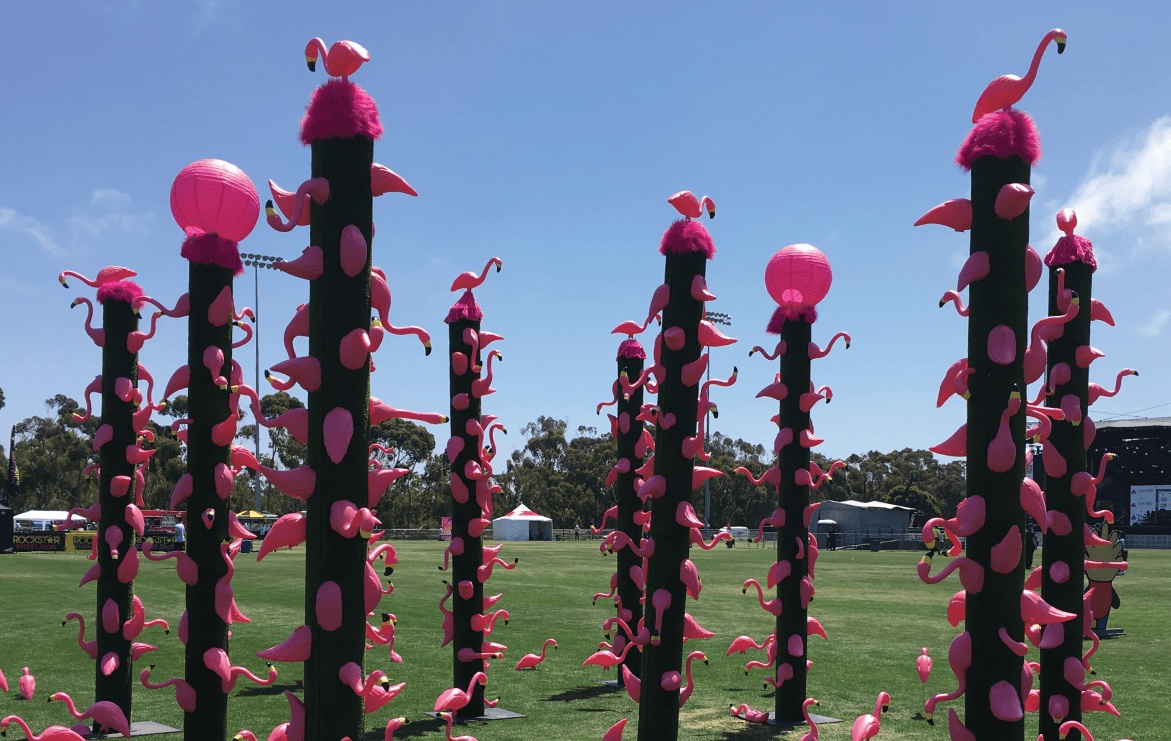
For another campus assignment, Ewart worked on the entrance area of the Sun God Festival and Triton Outfitters merchandise tent. The festival’s visual theme mixed Torrey Pines beach imagery, digital distortion, green palms, and a pink flamingo pool float. She took the flamingo idea into the physical setting, attaching lawn flamingos to upright columns. A familiar garden ornament acquired a rather improbable new habitat.
The photographs show bright birds climbing green columns across the festival grounds. Their function was decoration and a photo opportunity, connected to the merchandise area and the festival’s existing visual language. Ewart’s roles covered concept, art direction, and production. The idea needed to work at the scale of people walking toward a tent, where a tiny detail on a page would scarcely register.
It is a compact demonstration of her range. The printed identity supplies an ingredient; the installation turns it into a place to stop. Visitors can carry away a photograph as well as something from the store. The humor is direct enough to survive a crowded event. A lawn flamingo is already faintly ridiculous. Giving it several upstairs neighbors is an economical way to continue the joke.
Other duties, chosen on purpose
Her independent studio, Other Duties as Designed, puts a knowing twist on the catch-all phrase from a job description. Its services include branding, print and digital work, illustration, invitations, promotional products, and event design. There is also room for crafting and an invitation to ask about other tasks. The business was founded in 2023. Its name makes room for the mixture of planning and making already visible in her campus work.
The studio offers help with both expansive ideas and repetitive production work, including small edits across a hundred files. That pairing is candid about how creative work gets done. The imaginative assignment and the patient correction both need attention. Ewart presents herself as a problem solver who likes checklists and trusts the possibilities of cardboard, a craft knife, and a glue gun. It is a practical inventory for a business with an open-ended name.
Her portfolio includes an experiential event for a film release with Blue Revolver Inc. The assignment ranged across maps, signage, invitations, tickets, and giveaways. She designed an experience passport and illustrated a map; she also developed sticker ideas connected to the film’s imagery. The printed objects helped guests navigate and participate. The hospitality work at the beginning of her career has a recognizable cousin here: design accompanying people through an occasion.
“Believes in the DIY power of an exacto knife, cardboard, and glue gun.”Melissa Ewart’s studio biography
The teacher keeps a seat in class
Making also travels into Ewart’s teaching. At the Athenaeum Music & Arts Library, her faculty biography lists a Fall 2024 class called The Art of Play: Making Paper Toys. It also describes her enjoyment of taking watercolor classes there herself. There is something appealing about that arrangement. The person guiding a craft session can return as a student, with another material to understand and another set of instructions to try.
In May 2026, UC San Diego scheduled her to lead a free paper-toy workshop through the Acts of Kindness project. The listing connected her current business with her role as AS Graphic Studio’s founder. Materials were supplied, the audience was open, and registration was limited by space. It offered a modest, concrete invitation: come and make something. The professional history behind the invitation was considerably longer than the afternoon.
Across those settings, the recurring action is participation. A guest exchanges a button. A festival visitor poses among flamingos. A student chooses a design for a shirt. A workshop participant starts with paper. Ewart’s projects give people a way into the work and something to do once they arrive. The scale changes; the attention to that first step remains visible.
The anniversary’s button room remains a good ending because it refuses to behave like a trophy case. Its objects were made to circulate. People could leave with a small piece of a celebration that took many hands to assemble. For a founder whose colleagues have made “Mom” part of the title, that seems fitting: make the thing, organize the occasion, and let someone else take something home.