Breaking
FDA De Novo, 2021: first digital therapeutic cleared for a neuro-visual disorder
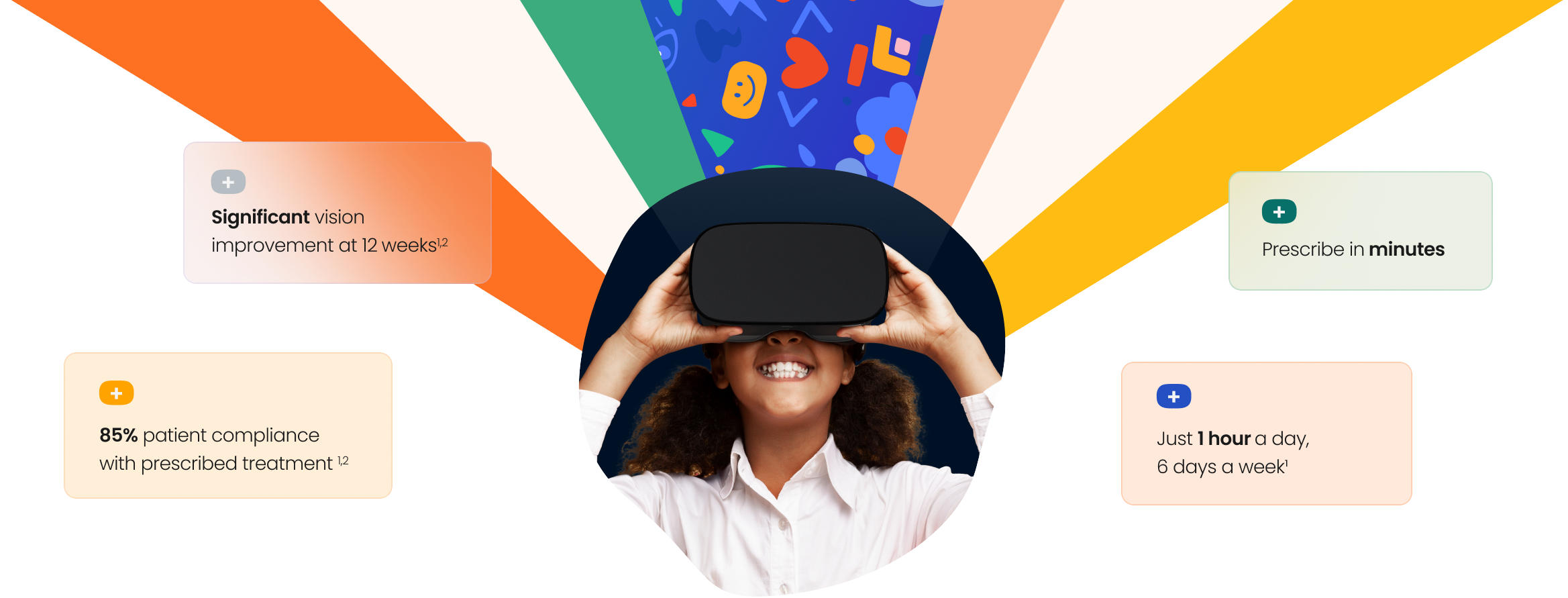
Treatment plan: 1 hour/day, 6 days/week, cartoons included
2025: label expands to ages 4 to under 13
Content roster: Sesame, Nickelodeon, PBS Kids, Pokemon, Crunchyroll
Series A: $16M oversubscribed, 2023
FDA De Novo, 2021: first digital therapeutic cleared for a neuro-visual disorder
Treatment plan: 1 hour/day, 6 days/week, cartoons included
2025: label expands to ages 4 to under 13
Content roster: Sesame, Nickelodeon, PBS Kids, Pokemon, Crunchyroll
Series A: $16M oversubscribed, 2023
Dispatch 01Who they are now
A child sits cross-legged on the living-room floor, headset on, watching an episode of something loud and animated. To the parent in the doorway, it looks like screen time. To an ophthalmologist, it looks like a prescription being filled. This is Luminopia, and it has spent a decade arguing that those two things can be the same.
Luminopia is a commercial-stage company in Cambridge, Massachusetts, with roughly two dozen employees and one very specific idea: that the most stubborn problem in pediatric eye care is not the eye, but the patient's willingness to cooperate. Their answer is Luminopia One - a prescription-only, FDA-cleared digital therapeutic that turns curated TV shows into binocular vision training. The company is small. The claim is not.
Most medical devices ask children to suffer quietly. This one asks them to pick an episode.- The Luminopia premise, plainly stated
Dispatch 02The problem they saw
A cure that only works if a kid follows the rules
Amblyopia - lazy eye - is the leading cause of preventable vision loss in children. It affects roughly three percent of kids, about a million of them in the United States alone. The brain quietly favors the stronger eye and lets the weaker one drift toward irrelevance. Caught early, it is treatable. The catch is in the word "treatable."
For generations, treatment meant an adhesive eye patch over the good eye, worn for hours, every day, for months. It is hard to imagine a therapy more perfectly designed for a child to refuse. Patches are uncomfortable, visible to every classmate, and offer no reward for compliance. Atropine drops, the other option, blur the strong eye to similar effect and similar resistance. The medicine worked. The adherence did not.
The patch was never the problem. The problem was convincing a six-year-old to wear it.- The gap Luminopia decided to close
This is the tension the entire company hangs on: a treatable condition, sabotaged by the most predictable force in pediatrics - a child who would rather not. Solve the eye, and you have solved nothing if the patient won't comply. Luminopia decided the real engineering challenge was motivation.
Dispatch 03The founders' bet
Two Harvard students, one computer-science assignment
Luminopia traces back to around 2015 and a Harvard computer-science project. Scott Xiao and Dean Travers were undergraduates when the idea took shape - reportedly sparked by a classmate's frustrating childhood with lazy-eye therapy. They built an early prototype, took it to clinicians at Boston Children's Hospital, and made the kind of decision business-school brochures love in hindsight and parents dread in real time: they left school to chase it.
Their bet was almost insultingly simple. If kids won't wear a patch but will happily watch television, then put the therapy inside the television. Show each eye a slightly different, algorithmically modified version of a real program. Dial down the dominant eye, lift the weaker one, and force the brain to combine both signals to see the full picture. The work happens because the child wants to keep watching, not because anyone made them.
They didn't invent a way to fix the eye. They invented a reason to use it.- On the actual innovation
It is the sort of idea that sounds obvious only after someone has spent years and millions getting a regulator to agree. Which, conveniently, is exactly what happened next.
Dispatch 04The product
How an hour of cartoons becomes medicine
Luminopia One is a prescription a doctor writes and a kid actually wants to fill. The patient wears a VR headset - over their glasses - for one hour a day, six days a week. Inside, they watch shows from a curated library. Dual-acting algorithms modify each video in real time: contrast and overlays are tuned per eye so that neither eye alone can assemble the complete image. To follow the story, the brain has to use both.
1 hrper day
6 daysper week
4–12ages covered
~3%of children affected
The content matters as much as the code. Luminopia licensed programming from Sesame Workshop, Nickelodeon, and PBS Kids early on, and kept going - adding The Pokemon Company and Crunchyroll in 2025. The pitch to a child is not "do your therapy." It is "what do you want to watch?" Compliance, the original villain of this story, gets quietly recruited to the other side.
Sesame Workshop
Nickelodeon
PBS Kids
Pokemon
Crunchyroll
A prescription where the side effect is asking for one more episode.- The compliance problem, inverted
Dispatch 05The proof
The part where the numbers have to show up
A charming idea is not a medical claim. The FDA does not clear products for being delightful. What moved Luminopia from clever to credible was a Phase 3 trial - and a regulatory pathway, De Novo, reserved for genuinely novel devices with no predicate to copy.
Visual acuity gained at 12 weeks
Lines of improvement on a logMAR eye chart, treated eye
Luminopia group~1.8 lines
Source: Phase 3 results reported around FDA authorization. Roughly twice the gain of the control arm at the primary 12-week endpoint.
At the trial's primary endpoint, children using Luminopia gained about 1.8 lines of visual acuity in the weaker eye, against roughly 0.8 lines in the control group. In a field where adherence usually erodes the result, a therapy kids actually finished produced a measurable, roughly two-fold difference. The 2021 De Novo authorization followed, and in 2025 the FDA widened the approved age range - the regulatory version of a vote of confidence.
Twice the improvement, from the patients least likely to quit. That is the whole thesis on a chart.- Reading the Phase 3 data
The investors noticed too. A $16 million oversubscribed Series A in 2023, led by U.S. Venture Partners with Broadfin Advisors, ShangBay Capital, and The Vertical Group, came on top of strategic backing that included the Sony Innovation Fund and, fittingly, Sesame Workshop. Total funding sits in the neighborhood of $34 million - modest by health-tech standards, pointed by the standards of a company with one product and a clear job for it.
Dispatch 06The mission
Amblyopia first. Then the rest of the brain.
Luminopia describes amblyopia as a starting point, not the destination. The stated mission is to pioneer a new class of treatments for neuro-visual disorders - conditions where the problem lives in how the brain processes sight, not just in the optics of the eye. Lazy eye is the proof of concept. The category is the ambition.
That ambition is grounded by the company's clinical roots. The therapy was shaped alongside Boston Children's Hospital, and the team carries the slightly unglamorous discipline that medical regulation demands. There is a reason the marketing leans on phrases like "safe and effective" rather than the usual startup adjectives: in this business, the FDA writes your superlatives for you.
The eye is the easy part. Luminopia is betting the brain is the real frontier.- Where the company says it is headed
Dispatch 07Why it matters tomorrow
A blueprint for medicine kids don't resist
The interesting thing about Luminopia is not the headset. It is the principle. Pediatric medicine is full of treatments that fail not because they don't work, but because children won't do them. Luminopia's real contribution may be a template: design the therapy around the patient's actual behavior, not the behavior you wish they had.
If that template holds, the curated library of cartoons is just the first version of a much larger idea - that engagement is a clinical variable you can engineer, not a lucky accident you hope for. For now, the proof is narrow and the company is small. But the question it answers is not.
Now look back at that child on the living-room floor. The headset is still on, the show is still loud - but the weaker eye is working, the brain is learning, and nobody had to win an argument to make it happen. The treatment got filled because the patient wanted it filled. That, quietly, is the whole revolution.- Back to Exhibit A