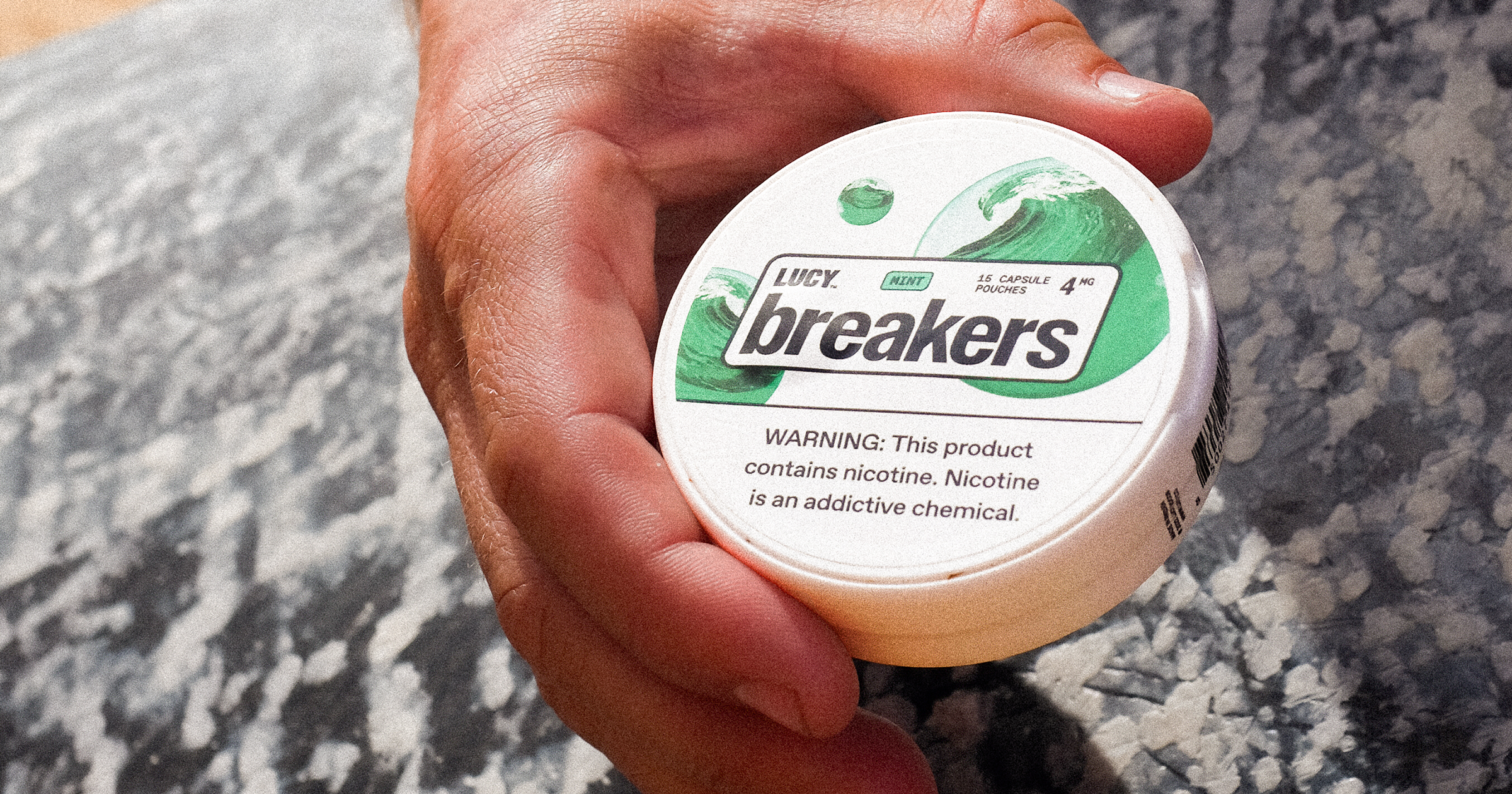
Somewhere right now an adult is reaching for a tin instead of a lighter. Lucy is the company betting that small swap is a business.
A nicotine company that talks like a lab
Walk into the world of Lucy in 2026 and the first thing you notice is what is missing. No cowboy. No menthol-green packaging pretending to be fresh air. No tobacco, for that matter. Lucy Goods Inc. makes nicotine gum, pouches, lozenges, and a pouch called Breakers that hides a crushable flavor capsule inside it. Everything is tobacco-free. Everything is sold to adults who have already decided they want nicotine and would simply prefer it not taste like a punishment.
The company is small - roughly 48 people, headquartered in Los Angeles - but it has a clear identity. It sells direct to consumers online, behind a 21-and-over age gate, and stacks up over a hundred thousand customer reviews. It speaks in the language of formulation and research rather than rebellion. For a category historically built on swagger, that restraint is the whole brand.
The middle of the market was empty
Here is the tension that runs through everything Lucy does. On one side sat cigarettes and smokeless tobacco - effective at delivering nicotine, catastrophic at everything else. On the other side sat the pharmacy aisle: nicotine gum and lozenges engineered for quitting, which is to say engineered to be unpleasant enough that you would want to stop using them too. One side was dangerous but enjoyable. The other was safer but joyless.
Nobody, the founders argued, was making a tobacco-free nicotine product that an adult might actually look forward to. The clinical stuff tasted clinical on purpose. The tobacco stuff was the tobacco stuff. The space in the middle - good engineering, good flavor, no tobacco - was wide open, mostly because the people who knew nicotine were tobacco companies and the people who knew consumer design were busy selling everything else.
Three people who had done this before
In 2016, three executives left Soylent - the meal-replacement company that turned a deeply unsexy idea, food you drink, into a brand - and pointed the same playbook at nicotine. David Renteln became CEO. John Coogan, the engineer, became CTO. Samy Hamdouche, who holds a PhD in biophysics and biochemistry from Caltech, ran research. The shared thesis was almost suspiciously simple: nicotine is a manufacturing and formulation problem, and consumer-products people are better at those than tobacco people are.
It was not a quick win. Lucy spent years building manufacturing capacity before it publicly launched its first gum in 2019 - an eternity in startup time, and a tell. You do not spend years on supply chain unless you intend to actually make the thing yourself. Y Combinator backed them early. Then the money that is comfortable with awkward categories showed up: Greycroft, FundRx, and Vice Ventures, a fund built specifically for businesses polite capital avoids.
The Lucy timeline
// From Soylent alumni to FDA filings
Four ways to take your nicotine
The catalog is the argument made physical. A Lucy pouch contains no tobacco at all - the pouch is plant-fiber cellulose holding a blend of nicotine powder, sweeteners, and flavor. Reviewers note it lands moister than the dominant brand and releases a little faster. And then there is Breakers, the product that gives the design thesis a punchline: a nicotine pouch with a tiny crushable capsule inside. You pop it with your fingers, mid-use, for a second burst of flavor. It is the kind of detail nobody asks for and everybody remembers.
Gum
Tobacco-free nicotine gum, 2 / 4 / 6mg, across roughly seven flavors. The product that started the company.
Pouches
Slim cellulose pouches, 4 / 8 / 12mg. Moist texture, quick release, fruit and mint flavors.
Breakers
Pouches with a crushable flavor capsule. 4 / 8mg across six flavors including Espresso and Apple Cider.
Lozenges
Nicotine lozenges in the NRT lane - mint, cherry & mint, citrus - at 4mg.
Reviews, research, and the long regulatory grind
Lucy's evidence comes in three flavors. First, demand: more than 100,000 customer reviews across the line, a subscriber model, and storefronts now serving the US, Canada, and UK. Second, credibility: the company published nicotine research accepted by the Society for Research on Nicotine and Tobacco, which is an unusual sentence to write about a consumer brand and exactly the point. Third, the moat almost nobody talks about - regulation. Lucy filed Premarket Tobacco Product Applications with the FDA for dozens of products. PMTAs are slow, expensive, and brutal, which is precisely why they keep casual competitors out.
Strength, by format
Nicotine options across the Lucy lineup (mg)
// Bars scaled to the top of each format's strength range. Pouches reach highest at 12mg.
"Reducing nicotine-related harm to zero"
It is a big sentence for a small company, and Lucy knows it. The mission - reduce nicotine-related harm to zero - is the kind of line that invites scrutiny, because a company selling nicotine talking about reducing harm is walking a genuinely fine line. Nicotine is addictive; Lucy is not pretending otherwise behind its age gate and its strength options. The bet is narrower and more honest than abstinence: that adults who are going to use nicotine anyway are better served by a tobacco-free, flavor-forward, transparently formulated product than by a cigarette or a tin of dip.
Critics, fairly, point out that good flavors and clean design can also make nicotine more appealing - a tension academic researchers have flagged in print. Lucy's answer is the regulatory paper trail: the PMTAs, the published data, the 21+ wall. Whether that is enough is a question the FDA, not a profile page, gets to answer.
07 / Why it matters tomorrowThe un-cigarette, still being built
The modern-nicotine market is no longer empty. ZYN, owned by a tobacco giant, sells pouches by the hundreds of millions. Velo, Rogue, and On! crowd the convenience-store counter. Lucy is the smaller, weirder, more design-led player in that fight - the one with the PhD on staff and the capsule you pop. Its edge is not scale. Its edge is that it acts like a consumer-products company that happens to sell nicotine, rather than a tobacco company in a lab coat.
Tomorrow's version of this story is mostly a regulatory one. If the FDA authorizes its products, Lucy's slow, expensive groundwork becomes a durable advantage. If it does not, the years of manufacturing and filings become a cautionary tale. Either way, the company has already made its point: nicotine, the product, could have been designed better all along. Somebody just had to treat it like a design job.
That adult reaching for a tin instead of a lighter? Lucy is betting the tin keeps getting better - and that better is a category all its own.
Five things that stuck with us
- All three founders came from Soylent. They swapped food science for nicotine science and kept the playbook.
- Co-founder Samy Hamdouche has a Caltech PhD in biophysics and biochemistry - the rare nicotine brand with a published-researcher cofounder.
- Lucy pouches contain zero tobacco; the pouch itself is plant-fiber cellulose.
- Breakers hides a tiny crushable capsule inside the pouch. You pop it for a second hit of flavor.
- The brand's social handles are simply @lucynicotine. No euphemisms.