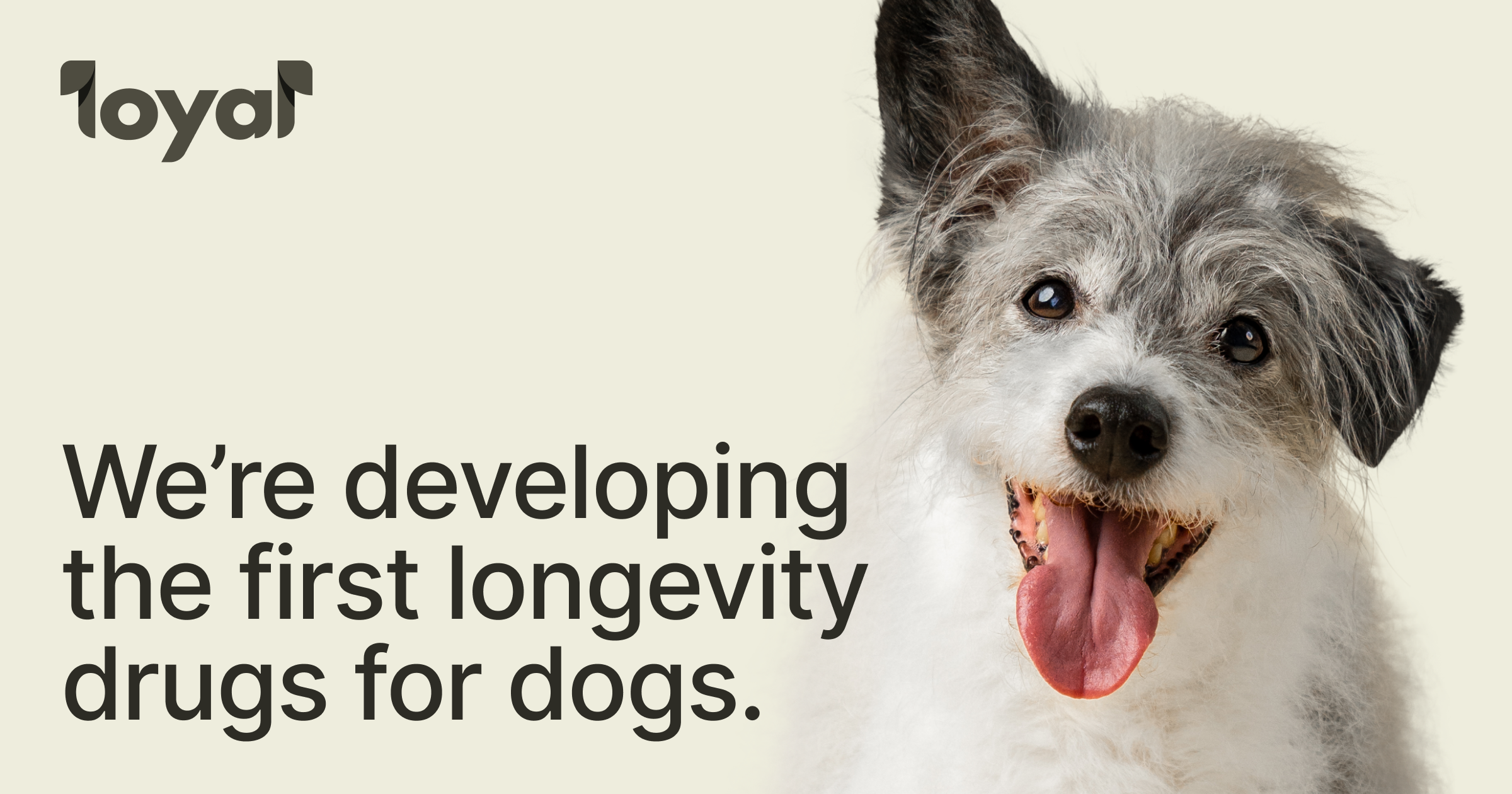
The dog at your feet
In a converted office in San Francisco, somebody is feeding a beef-flavored pill to a Labrador named Buck. Buck is eleven years old. He has a slightly cloudy left eye and the kind of patient resignation that comes from being weighed too often. Around him, scientists are watching a clock that does not exist on any wall - the one that decides when a healthy dog stops being a healthy dog. Loyal exists to push the hands of that clock backward.
This is a 210-person clinical-stage biotech with $238 million in venture funding, three drugs in development, and a regulatory file at the U.S. Food and Drug Administration that is, by the agency's own admission, the first of its kind in any species. The drug is for dogs. The implications are not only for dogs.
The company is currently working through the final third of an FDA technical review. Two of three sections - Reasonable Expectation of Effectiveness and Target Animal Safety - are accepted. The last is manufacturing. The last is also, somehow, the easiest. After six years of work, the existential risk has shifted from biology to logistics. Which is, in its way, the best news a biotech founder ever gets.
The problem nobody was treating
Here is a thing veterinarians have known and not really discussed: large dogs die younger than small dogs. A Chihuahua can drift past sixteen. A Great Dane is doing well to reach eight. This is not a quirk of breeding - it's a feature of the growth-hormone pathway, specifically IGF-1, which was bred upward in service of size and downward in service of years.
Here is another thing veterinarians have known: senior dogs - regardless of size - develop a set of metabolic problems that look suspiciously like the metabolic problems of senior humans. Slower metabolism. More inflammation. The body's machinery getting tired. And nobody had a drug for any of it. Aging itself, in animals, was not a treatable condition. It was just the weather.
This is the gap Loyal walked into. Not a new chemistry, exactly - the molecules involved are well-studied. The gap was regulatory imagination. The FDA had never been asked to approve a drug for "extending healthy lifespan." It approves drugs for diseases. So Loyal had to do something genuinely odd: convince an agency that aging was, in fact, a thing.
The founder's bet
Celine Halioua dropped out of an Oxford neuroscience PhD to start Loyal in late 2019. She was, at that point, mostly known among longevity researchers as someone who would not stop emailing them. The story she tells about the founding is one most founders would lacquer - a rescued dog, a vet appointment, a moment of insight. The story she actually tells is more honest: she liked the science, she liked the animals, and she could not find anyone else willing to do the boring, expensive, twenty-year version of the work.
The bet was specific. Not: "we will cure aging." More like: "we will convince a major regulator that lifespan is a legitimate clinical endpoint, and we will do it in the species where the trials are short enough that one company can survive the wait."
Dogs were the answer. They live alongside humans. They age in roughly the same patterns. And they do it in ten to fifteen years instead of eighty - which means a clinical trial can actually finish before its principal investigator retires. If aging can be drugged anywhere first, it will be in dogs. Loyal made that obvious, then made it inevitable.
Three drugs, three populations
The pipeline is unromantically named, in the manner of biotech, which prefers letters and numbers to brand poetry. The dogs do not care.
LOY-002
Daily pill. Beef-flavored. For senior dogs 10+ years and over 14 lbs. Targets metabolic dysfunction tied to aging. Currently in FDA conditional-approval review with two of three technical sections accepted.
LOY-001
Long-acting injection administered by veterinarians. Targets IGF-1 in large dogs (7+ years, 40+ lbs) - the pathway responsible for big breeds living shorter lives. The drug that earned the first-ever FDA lifespan-extension acceptance.
LOY-003
Daily pill version aimed at large- and giant-breed dogs (60+ lbs, 5+ years). The same therapeutic intent as LOY-001, delivered in a form your golden retriever can chew at breakfast.
FIG. 02 - The pipeline. Three drugs, three populations, one regulatory thesis. The names are unmemorable on purpose; the FDA prefers it that way.
There is no animal currently on a Loyal prescription. That changes if and when FDA conditional approval lands - a status that lets the company sell while completing the final efficacy study. The market is patient. The dogs are not.
The proof in the numbers
Funding is not validation, exactly. But it is a passable proxy when the FDA does not yet allow you to sell anything. By that measure, Loyal is the most well-resourced experiment in veterinary geroscience ever attempted.
Funding history
Cumulative, that is $238M put into a clinical bet that nobody had ever made before. Bain Capital Ventures, Khosla Ventures, First Round, Valor Equity Partners, and most recently age1 and Baillie Gifford are the names on the cap table. Baillie Gifford, in particular, is interesting - the Edinburgh firm that backed early Tesla and Amazon does not historically wander into veterinary medicine.
Beyond money: Loyal runs what is reported to be the largest companion-dog clinical trial of its kind, the STAY study for LOY-002, enrolling thousands of senior dogs at vet clinics across the United States. The trial is what scientific evidence looks like when it has fur on it.
The mission, plainly
Loyal says the goal is to extend the healthy lifespan of dogs. This is exactly true, and slightly understated. The unspoken second half of the mission is this: do it in dogs, learn what works, and watch the regulatory and scientific apparatus that gets built around canine longevity become the apparatus that eventually does the same for humans.
This is not a secret. The longevity-focused venture firm age1 led the most recent round on roughly that thesis. Dogs are the model organism that lives in the bed. If you can show real, measured, regulator-accepted lifespan extension in a beloved domestic mammal, you have not only built a real business in pet healthcare - you have established that aging itself is a treatable indication. The next species over is the obvious one.
Whether that precedent travels depends on the trial results, the manufacturing review, and the patience of an industry that historically reaches for the word "cure" before it reaches for the word "delay." Loyal's bet is that "delay" is the right word for now, and that the dogs will help us learn how to mean it.
Why it matters tomorrow
Most biotechs sell hope dressed in white-paper language. Loyal sells something more specific: a year. One additional year, perhaps, of a healthy dog. That is the central, measurable claim of the LOY-002 program - and the claim is being tested in tens of thousands of clinic visits across the country.
If it works, the consequences ripple outward. Veterinary medicine gets its first real geroscience tool. The pet-health market - currently worth tens of billions in the U.S. alone - gets a category that did not previously exist. Regulators get a precedent they cannot easily un-set. And the people designing future trials for human aging get to point at a real-world program and say "see, it can be done."
If it does not work, Loyal has still built the playbook. The next company will have an easier path because Loyal walked the first one.
Back in San Francisco, Buck the Labrador finishes the pill, gets a chin scratch, and lies down on a beanbag that has seen better days. The clock on the wall does what clocks do. The clock that does not exist on any wall - the one Loyal is paid to slow down - is the one they're still working on. The pill is beef-flavored. The math, eventually, will tell us whether it worked.