The most important software in a home sale is rarely the software a buyer remembers. It is the machinery behind the agent: the lead record, the comparative market analysis, the state form, the signature packet, the compliance checklist, the commission split and the general ledger. Each step is ordinary. Together they are a relay race with expensive baton drops.
Lone Wolf Technologies built its business in those handoffs. The Dallas-headquartered company says more than 1.5 million real estate professionals use its products, which manage over 11 million transactions and 35 million digital signings a year. It is not a consumer portal like Zillow and it is not trying to replace the agent. It sells the working layer beneath agents, teams, brokerages, franchises, multiple listing services and trade associations.
The dull wedge that won
Lone Wolf began in Canada in 1989, before “proptech” was a pitch-deck category. Founder Lorne Wallace was a chartered accountant and a third-generation real estate professional - a nearly suspiciously exact résumé for the problem. With co-founder Des O’Kelly, he built back-office and accounting software to make brokerage transactions less chaotic. Front-office management followed in 1991.
Accounting was a canny entry point because it sits at the end of every deal and remembers every earlier mistake. A bad lead note is annoying. A missing signature, wrong commission or late reconciliation is operational. Once a brokerage trusts software with the ledger, adjacent workflows become plausible additions.
That origin still explains the product. Back Office handles accounting, commissions and financial reporting. Transact manages forms, documents, checklists and compliance. Authentisign gathers signatures. Relationships follows contacts. Cloud CMA makes property presentations. Spacio turns an open-house sign-in into a CRM record. Boost creates listing ads. BrokerMetrics turns MLS data into market-share, recruiting and retention intelligence. Front Office supplies brokerage websites, CRM and lead distribution.
Five companies, nine months, one integration bill
The company’s modern shape arrived through private equity and acquisition. Vista Equity Partners invested in 2015 and again in 2016. Stone Point Capital became lead institutional investor in 2020; the amount and valuation were not disclosed. Then Lone Wolf went shopping.
From December 2020 through August 2021, it bought five companies: W+R Studios for Cloud CMA; LionDesk for CRM; HomeSpotter for mobile search, advertising and Spacio; Terradatum for BrokerMetrics analytics; and Propertybase for websites, lead generation and enterprise CRM. It had acquired zipLogix, the forms and transaction software provider, in 2019. In nine months, Lone Wolf gained most of the pieces required to claim an end-to-end suite.
Acquisition tempo
Buying the boxes did not connect the data inside them. That was what failed first: the handoff. Separate products meant separate identities, records and interfaces. A broad portfolio can reproduce the same clutter it promises to remove, only now on one invoice. Lone Wolf’s own language changed accordingly. The company stopped talking merely about having every tool and started talking about a common foundation.
“Technology should simplify, not complicate, and empower real estate professionals with the freedom to choose the tools that work best for them.”Aaron Kardell, chief innovation officer
One data layer, not one vendor
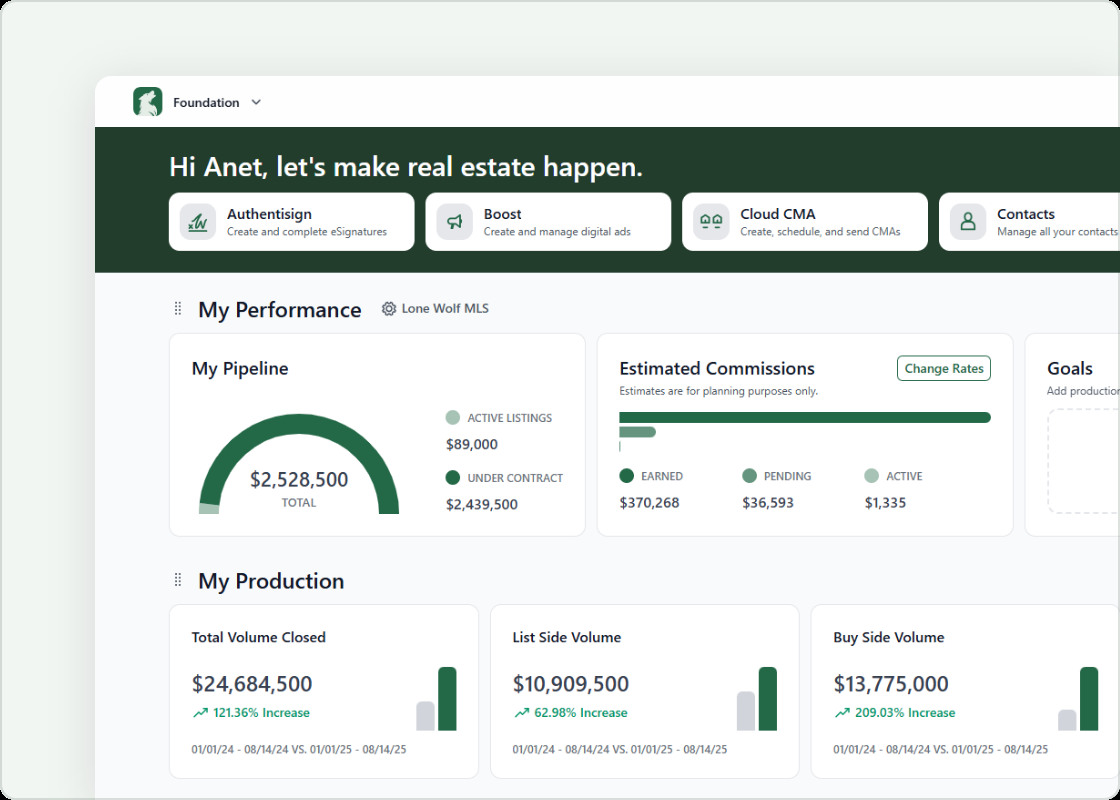
Launched in 2024, Lone Wolf Foundation is the repair job and the strategy. It supplies shared login, data, security and navigation for modular products. Newer releases make the idea tangible: Deal Tracker follows a client from prospect to close; Foundation Dashboard combines pipeline, goals, production and estimated commissions; Transact starts with the client rather than a property, useful when one house falls through and the relationship continues.
The revealing move came outside Lone Wolf’s walls. In 2025, the company integrated Foundation and then Transact with Follow Up Boss, a CRM owned by Zillow Group. In February 2026 it launched an API portal so customers and partners could connect third-party systems and move data in real time. One early partner told HousingWire it was live in two weeks and onboarding customers a month later.
That is what changed the company’s mind about the classic super-suite. Brokers may want one view of their business, but they do not always want one supplier for every function. Lone Wolf’s emerging position is more defensible: own the system of record and the connective tissue, then let specialist tools plug in. Its integration catalog advertises more than 100 partners.
Coldwell Banker agent Anita Miller says Lone Wolf Transactions cut scanning, emailing and signature chasing from her routine. Her published case study reports 6 to 10 hours saved each week, a 7.5 percent increase in transactions and 15 percent higher customer satisfaction. Those are self-reported figures, but the mechanism is easy to understand: documents move without a car ride, scanner or second round of data entry.
What the broker actually buys
Lone Wolf sells B2B software by subscription, enterprise agreement and association distribution. The customer can be one agent, but the strategic buyer is often a brokerage, MLS or association that needs standard forms, permissions, compliance and reporting across many offices. The 2025 renewal with the California Association of REALTORS covers more than 190,000 members for five years. Such arrangements are a distribution advantage a young point solution cannot quickly copy.
For the broker, the purchase is less about making an individual screen delightful than making the month close correctly. An agent can prepare an offer, gather signatures and update a deal; a reviewer can see whether the file is compliant; an administrator can calculate the split; leadership can compare production with goals. In July 2026, Transact added sequential, multi-tier reviews for brokerages with more complex approval chains, plus a PIN-protected portal where clients and title companies can exchange documents without holding a Transact account. Those are not glamorous releases. They are the small hinges on which brokerage risk swings.
The company also has to persuade acquired customers that modernization will not erase the workflows they depend on. Lone Wolf describes itself as remote-first and publishes mentorship, development, health coverage and retirement benefits. Its 2025 Great Place to Work survey said 71 percent of employees considered it a great workplace, compared with 57 percent at a typical U.S. company. Culture matters here for a practical reason: migrations, support calls and product consolidation are human work. A unified login is only impressive if the person locked out of it can reach someone who understands a closing deadline.
Most core-product prices are quote-based or bundled through a member benefit, so there is no honest universal sticker price. The exception is Inkless, launched in 2025 from the Authentisign infrastructure. Its API pricing starts at $0.75 per completed envelope without a commitment and falls to $0.30 with a 100,000-envelope monthly minimum. The sandbox is free. Lone Wolf says the underlying system processes more than 40 million envelopes annually and positions Inkless as a developer product beyond real estate.
The company’s competitive set changes by screen. SkySlope, dotloop and Paperless Pipeline compete in transactions. DocuSign competes in signatures. MoxiWorks, kvCORE, Follow Up Boss and Top Producer overlap in CRM and brokerage platforms. Brokermint and niche accounting products contest operations. Lone Wolf’s distinction is not that each module is alone in its category. It is the combination of residential specialization, association reach, transaction-to-accounting plumbing and enough APIs to coexist with the tools a brokerage refuses to give up.
The copyable playbook - and its limits
The lesson for another software company is pleasantly unglamorous. Start with the recurring workflow where errors become money. Learn the domain deeply enough to earn custody of its system of record. Expand along the path the data already travels. If acquisitions accelerate that expansion, budget years for identity, permissions, data models and interface repair. Finally, expose the integration layer as a product. An “ecosystem” that requires a services ticket for every connection is still a collection.
Lone Wolf’s current test is execution. Matt Fischer became CEO in February 2026 after 22 years helping Bullhorn grow from a single recruiting product into a multi-product platform. By May, Lone Wolf had installed a new CTO and chief customer officer and promoted Kardell to chief innovation officer. In July it announced Talent in BrokerMetrics, its first product in a broader AI roadmap, intended to help brokers identify recruiting and retention opportunities. The sensible question is whether unified data makes that intelligence useful rather than merely decorative.
Your market has repeat workflows, regulated handoffs, a trusted system of record and customers large enough to value standardization.
Your buyer needs one cheap function, your data cannot be standardized, or platform breadth adds more implementation work than it removes.
North American residential brokerages, teams, associations and MLSs coordinating forms, compliance, commissions and reporting.
Commercial-first firms, property managers, unsupported geographies or tiny operations content with a single lightweight app.
Lone Wolf’s name promises solitude, but its product thesis has arrived at the opposite conclusion. A home sale is a pack activity. Agents, clients, reviewers, accountants, associations and software partners all touch the same deal. The company wins when none of them has to notice the baton moving.