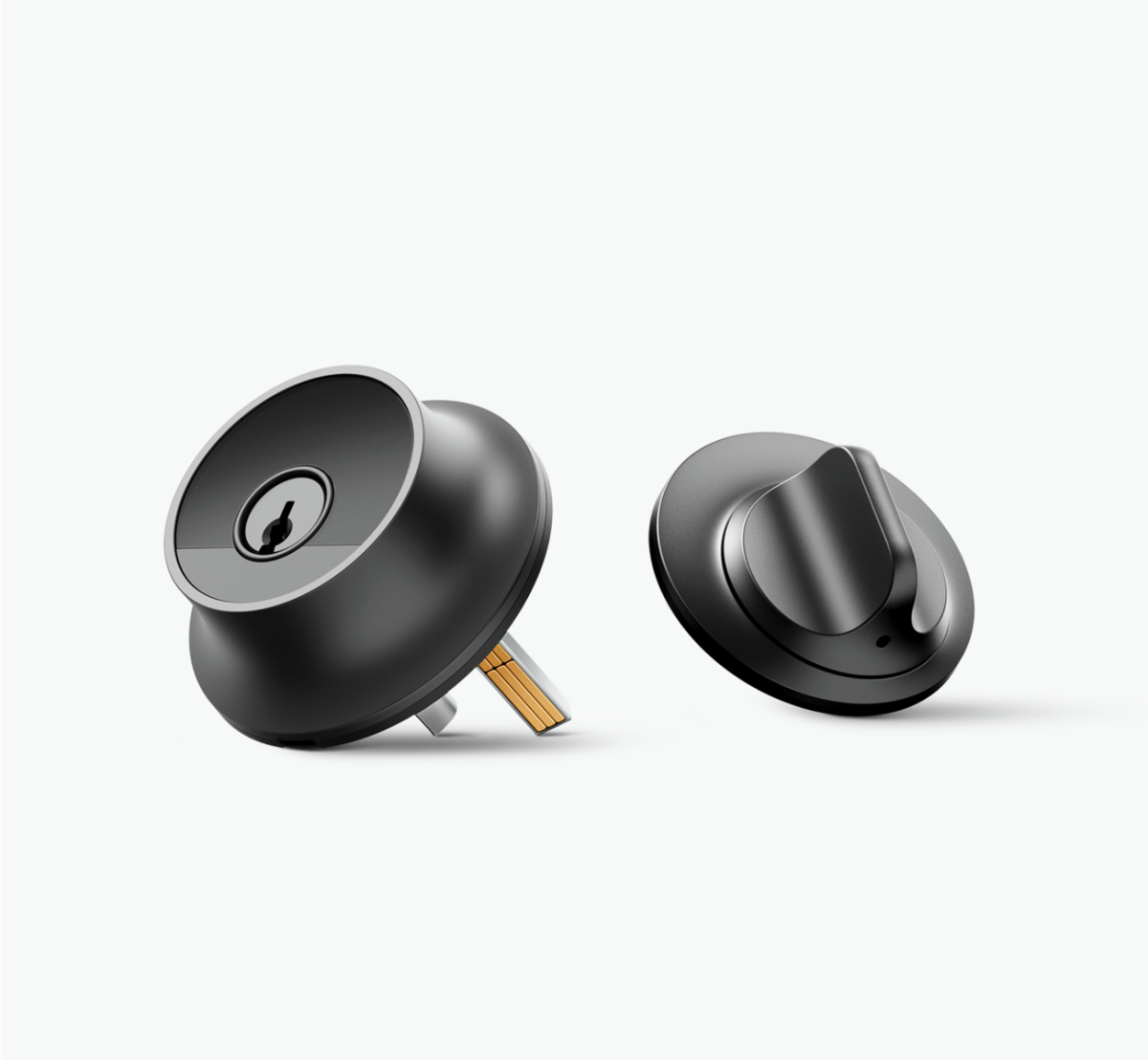
A lock that refuses to look like one.
Walk up to a Level-equipped front door and you'll do what most visitors do, which is nothing. There is no glowing keypad. No fingerprint scanner. No squared-off slab of plastic announcing that the homeowner has Embraced The Internet of Things. There is a keyway. There is a thumbturn. There is, if you look carefully, a lock - the same lock that has been guarding American front doors since roughly the Truman administration.
That is the entire point. Level Home, headquartered in a low building in Redwood City, builds smart locks for people who do not want a smart lock. The company's flagship products - Level Lock, Level Lock+, Level Lock Pro - tuck the motor, the radios, the sensors, and the battery into the same one-inch cylinder as the deadbolt itself. From the outside, nothing has changed. From the inside, you can unlock the door with an iPhone, a Watch, a NFC keycard, Siri, an Airbnb guest pass, or, if you must, an actual metal key.
The smart home got ugly.
By 2016, the smart-lock category had a problem nobody wanted to say out loud, which is that smart locks were ugly. They came in two shapes - blunt black brick or beige medical device - and they came with a contract: surrender a chunk of your front door's appearance in exchange for the convenience of unlocking it with your phone. Most homeowners passed. Realtors complained that buyers ripped them out before move-in. Landlords liked them; designers did not.
This was a category problem dressed up as an aesthetic one. The reason early smart locks were bulky was that all the electronics had to live somewhere, and the path of least engineering resistance was a large black box bolted to the inside of the door. Shrinking the electronics into the deadbolt itself was, by all reasonable accounts, a terrible idea. It meant micro-motors, custom batteries, and a manufacturing tolerance that resembled watchmaking more than home hardware. It also meant convincing component suppliers that a startup nobody had heard of would order at scale.
Two ex-Apple engineers and a four-year silence.
John Martin and Ken Goto met at Apple, where they had spent years on hardware that ships. They had also collaborated, at various times, at Microsoft and Starbucks - which is the polite way of saying they had spent careers learning the difference between making something work in a demo and making something work in a million homes. In 2016 they left, raised a quiet seed round, and proceeded to do almost nothing in public for nearly four years.
Stealth-mode startups are a Silicon Valley cliché, and most deserve the eye-roll. Level's silence was different in degree. Engineers were hired without a stated company name. Investors signed unusually thick NDAs. The product, when it finally appeared in October 2019, arrived alongside a press release announcing $71 million in funding from Walmart, Lennar, and BlackBerry, which is a sentence designed to startle reporters into reading the next paragraph. The next paragraph was Level Lock.
The Level Timeline
- 2016John Martin and Ken Goto leave Apple, found Level Home, enter stealth.
- 2019Emerges from stealth with $71M and the original Level Lock - the world's first invisible smart lock.
- 2020Apple HomeKit integration ships; Level Bolt retrofit version launches.
- 2021Wins Red Dot, iF Design, and IDEA Gold. Raises $100M+ Series C led by Cox; acquires Dwelo.
- 2022Level Lock+ ships with NFC and becomes the first deadbolt to support Apple Home Key.
- 2023Level Lock Pro announced with Matter over Thread and extended Bluetooth range.
- 2024ASSA ABLOY acquires Level Lock hardware business; multifamily arm spun out as Ambient.
What's inside the bolt.
The CR2 battery sits inside the deadbolt. Unscrew the end cap of the bolt, drop in a new battery, screw it back. There is a small motor. There are radios - Bluetooth, and in newer models, Thread. There is a Wi-Fi bridge, sold separately, if you want remote access from beyond Bluetooth range. There is, satisfyingly, no app dependency at all if you're an Apple HomeKit household - the lock pairs with Home like any other accessory.
For non-Apple homes the Level app handles guest passes, NFC keycard programming, activity logs, and time-limited codes. Hosts on Airbnb assign passes per booking. Parents give a kid temporary entry after school. The lock works with Alexa and Google Home. None of this is new. What is new is that it all happens inside what is functionally an upgraded mechanical deadbolt - one that, crucially, your in-laws cannot tell apart from the lock that was there before.
Money, builders, and the Apple stamp.
Walmart led the original 2019 round. Lennar, the country's second-largest homebuilder, joined in - and then started preinstalling Level locks in new construction. Cox Communications led the $100M+ Series C in late 2021, which Level used to acquire Dwelo, a multi-dwelling-unit smart-home platform. By the time ASSA ABLOY came calling in September 2024, total capital raised was $171 million and Level had become the rare smart-home brand that Apple was willing to give a Home Key launch slot to.
Funding by Round
- Red Dot 2021
- iF Design 2021
- IDEA Gold 2021
- IoT Breakthrough 2022
- Good Design
- Apple Home Key launch partner
Technology that doesn't show up to dinner.
The polite description of Level's philosophy is "invisible technology." The honest one is that John Martin and Ken Goto did not want their houses to look like spaceships. The smart home, in their telling, has a body-image problem. It puts screens everywhere, blinking LEDs on every surface, and labels on every device. Level's argument is that the best smart-home product is the one you forget is a smart-home product. The lock is the cleanest test case for the thesis, because a lock is the one piece of hardware everyone in the household uses every day, and the one piece of hardware nobody wants to think about.
This shows up in small choices. The keyway stays. The thumbturn is real metal, not painted plastic. The bolt throws with the satisfying clack of a real deadbolt rather than the whirring whine of a motor doing too much work. Even the company name - Level - is engineered to be forgettable.
What ASSA ABLOY bought.
In September 2024, ASSA ABLOY - the Swedish giant that makes roughly one in every three locks sold globally - acquired Level Lock's hardware business, brand, IP, and team. The multifamily software side, formerly Dwelo, was spun out as Ambient Property Technologies. Terms were not disclosed. ASSA ABLOY described Level as their twelfth acquisition of the year, which is the kind of corporate language designed to make a deal sound routine. The deal was not routine. ASSA ABLOY had spent a decade watching software-first startups - August, Yale's own brand, Nest - chip away at the legacy lock business by adding screens and apps. Level was the first credible argument that you could ship a smart lock without surrendering the design language of a lock at all.
For Level, the acquisition is the rare exit where the acquirer's distribution makes the product's thesis even more powerful. ASSA ABLOY owns the locksmith channel. Level owns the design. Put together, the smart deadbolt with no visible electronics can land in every new build, every contractor's truck, every Lowe's aisle - which is exactly where invisible technology is supposed to live.
Watch & Read
Same scene, different lock.
Return, then, to the front door we started at. The lock looks unchanged - keyway, thumbturn, deadbolt. The visitor still does nothing, because there is still nothing to do. But the homeowner walks up with their phone in a pocket, and the bolt slides back without a touch. The Apple Watch on a runner's wrist taps the door and the lock obliges. A house cleaner arrives at exactly 10 a.m. with a one-day pass that will quietly stop working at 3. The dog walker has a code. The contractor has a key. The mother-in-law has neither and rings the bell, as always.
None of this is visible from the street, which is the entire point of Level Home, and it is also why a 230-year-old Swedish lock company decided that a quiet Redwood City startup with a forgettable name was worth the price of a twelfth acquisition. Sometimes the most ambitious thing technology can do is disappear.