Krishna Kallakuri remembers bringing an automotive marketing executive a boatload of dashboards and reports. The executive had a rather inconvenient response: he wanted a conclusion. Somewhere between assembling the numbers and deciding what to do with them, the machinery of business intelligence had left its customer with another job.
“Data that doesn’t lead me to a conclusion to make a decision is no good to me,” Kallakuri recalls him saying. It is a wonderfully economical review of enterprise software. The charts may have been excellent. The executive still had work to do.
That exchange gives shape to a career spanning DataFactZ, the analytics consultancy Kallakuri helped found, and Diwo, the decision intelligence company he leads. He describes the automotive assignment as an early inspiration for Diwo. Building a software company had been an ambition since university. The dissatisfied user supplied a problem worthy of it.
There is a certain professional awkwardness in making reports for a living and then questioning how much reports accomplish. Kallakuri’s career makes room for both activities. First comes the work of getting information into usable condition. Then comes the harder conversation about what its recipient can actually do with it.
The work behind the warehouse
In August 2012, Kallakuri was describing DataFactZ’s expanding client work as its owner and vice president. The projects were specific enough to strip the abstraction out of “analytics.” For Meijer, there were custom business intelligence web applications, mobile intelligence and Google Maps integration. For Lord & Taylor, a real-time e-commerce data mart was being added to a warehouse.
Other assignments included support for Gap’s data warehousing and business intelligence, and mobile dashboards for a MARS sales-force solution. These were working systems with particular users and particular constraints. A retailer’s information problem could arrive through a website, a store, a map or a salesperson’s screen.
The variety matters. A consultancy meets the details that a product demonstration can politely step around. Existing systems have to be accommodated. Someone has to decide which data belongs together. Someone else will ask why the answer looks different from last week’s report.
Kallakuri’s responsibilities then included strategic planning, operational effectiveness and strategic initiatives. It was a position between the technical project and the business that needed it. The vocabulary would change over the following years. The need to connect those two worlds remained a useful thread.
A useful joke in Northville
By April 2013, a local business interview offered a less ceremonial view of the entrepreneur. Asked about the best experience of being a small business owner, Kallakuri reached for accumulated experience, then mischievously reduced its powers.
It helps us recognize a mistake “When we make it again” - “But we do it again.”Krishna Kallakuri, 2013
The joke is useful company for an analytics executive. A career devoted to better decisions need not come with a claim to personal infallibility. Here was a founder admitting that recognition and prevention do not always arrive together. Experience, apparently, could be relied upon to provide the commentary.
He also spoke warmly about Northville. Michigan had been his home for several years, he said, and he loved the town. He credited friendly, supportive people and an environment that encouraged new businesses. Those details give the enterprise vocabulary an address: a Michigan community, people willing to help, a business taking shape among them.
His account of getting started was practical. Consulting work had shown him demand for business intelligence and data warehousing expertise. He saw an opportunity to build a company around that demand. There was a market to serve before there was a grand theory to explain.
Choosing tools, then building one
DataFactZ’s 2016 description of its work divided the job into data engineering and data science. The first covered foundations such as modeling, transformation and governance. The second helped companies use those foundations through business intelligence, prediction and related analysis. It was an approach with plenty of plumbing beneath the polished output.
One restaurant-business project illustrates the issue. Information existed in separate silos; different parts of the company could not consistently use it together. DataFactZ examined the architecture and designed a route toward an enterprise warehouse while preserving existing investments. Before asking the data to be clever, the company had to make it available.
Kallakuri’s own technical writing carried a similarly practical instinct. In February 2016 he wrote about NoSQL, describing the pressure placed on traditional databases by large volumes of information and many simultaneous users. He argued for matching the data store to the task, while keeping a place for relational systems.
That position is revealing without needing to be turned into a personality slogan. Database choices have consequences for the people operating them. His article discussed categories of NoSQL systems and the kinds of workloads they could serve. The question was what suited the work in front of the team.
That March, DataFactZ’s work with IBM put analytics close to transactions on z Systems. The announced applications included detecting fraudulent activity in real time. Presentations at the Strata conference were assigned to IBM’s Mythili Venkatakrishnan and DataFactZ’s Sreeram Nudurupati. Kallakuri’s role was to articulate the business purpose of the collaboration.
Timing was part of that purpose. Analysis delivered after an event has a different use from analysis that can inform a response while something is happening. Across warehouses, databases and transaction systems, the distance between information and action kept presenting itself in another form.
A patent and a place at the table
The software ambition also left a technical record. A patent application filed on October 19, 2017, names Krishna Prakash Kallakuri alongside Satyendra Pal Rana and Chandra Puttanna Keerthy. Granted on April 14, 2020, US10621169B2 concerns maintaining knowledge within a decision-making framework.
The mechanism includes receiving a knowledge request, forming a structured query and breaking it into subqueries to retrieve relevant knowledge objects. It is a more exacting description than the phrase “better decisions.” Software needs a way to find and assemble the information on which a useful answer depends.
The three names matter, too. This part of the career belongs to a collaboration. A founder’s account can make a company sound like an extended act of individual will; the invention record puts colleagues back into the picture.
In 2019, Kallakuri appeared on the Predictive Analytics World program as president and founder of Loven Systems, the creator of Diwo. A panel on embedding analytics in the front line placed him with James Taylor, Aaron Cheng and Gourab De. The subject was adoption at the point where people actually work.
Diwo’s commercial relationships developed alongside that technical work. Its 2020 partnership with Acxiom combined operational information with customer data and identity management. The initial focus included inventory and incentives for larger retail and automotive businesses. Automotive questions had followed him into another chapter.
By July 2021, Diwo was appointing David Collins as chief revenue officer, reporting to Kallakuri. The company described expanding its sales, marketing and engineering teams. Building the software also meant building the organization that could explain it, deliver it and find the next customer.
The room in Detroit
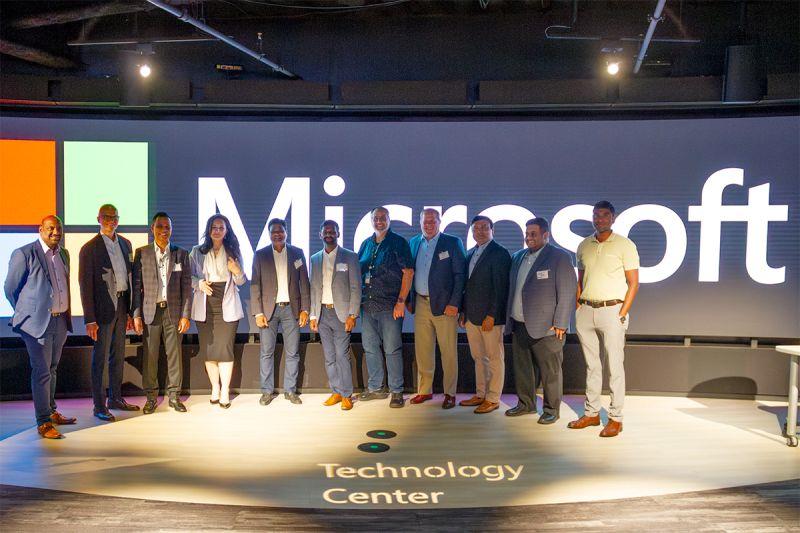
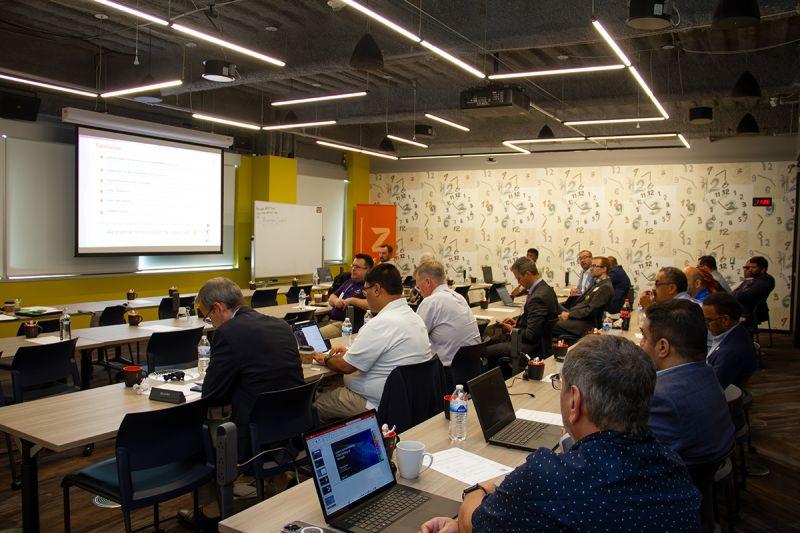
In August 2024, Kallakuri shared photographs from the AI Insider Forum at Microsoft’s Innovation Hub in Detroit. The images give this otherwise diagram-heavy world some ordinary furniture: tables, laptops, a presentation screen, people listening. The group photograph has a Microsoft sign large enough to remove any doubt about the venue.
The discussion covered generating insights with Fabric, building copilots with Azure AI Studio and Copilot Studio, and governance with Microsoft Purview. Kallakuri thanked Microsoft and the attendees. It was a local gathering around tools whose applications reached far beyond the room.
The setting connects with the Northville interview from eleven years earlier. The place he had praised as a home for business remained part of his working geography. Enterprise technology still required a room where someone could bring a question and another person could try to answer it.
The question follows the founder
Diwo’s name compresses the ambition into four words: data in, wisdom out. Its company timeline now lists general availability of Decide v2.0 and the launch of Catalyst in April 2026. Catalyst brings natural-language conversations to data, with customers able to use their chosen language model and database.
The leadership includes familiar connections: Ravi Vallem as co-founder and chief operating officer, and Sridhar Kodati as co-founder and chief financial officer. Kallakuri is founder and CEO. The work has new interfaces, but it continues to involve colleagues turning an idea into something a business can use.
There is an appropriately demanding test at the end of this career story. A system can retrieve knowledge, produce analysis and present a recommendation. The person receiving it must still decide whether it belongs in the circumstances of the day. That is where the promise meets its customer.
Kallakuri’s remembered automotive executive had expressed that requirement with little patience for ornament. Years of consulting, software development and conversations have grown around it. The next useful answer still has to earn its place on somebody’s desk.